
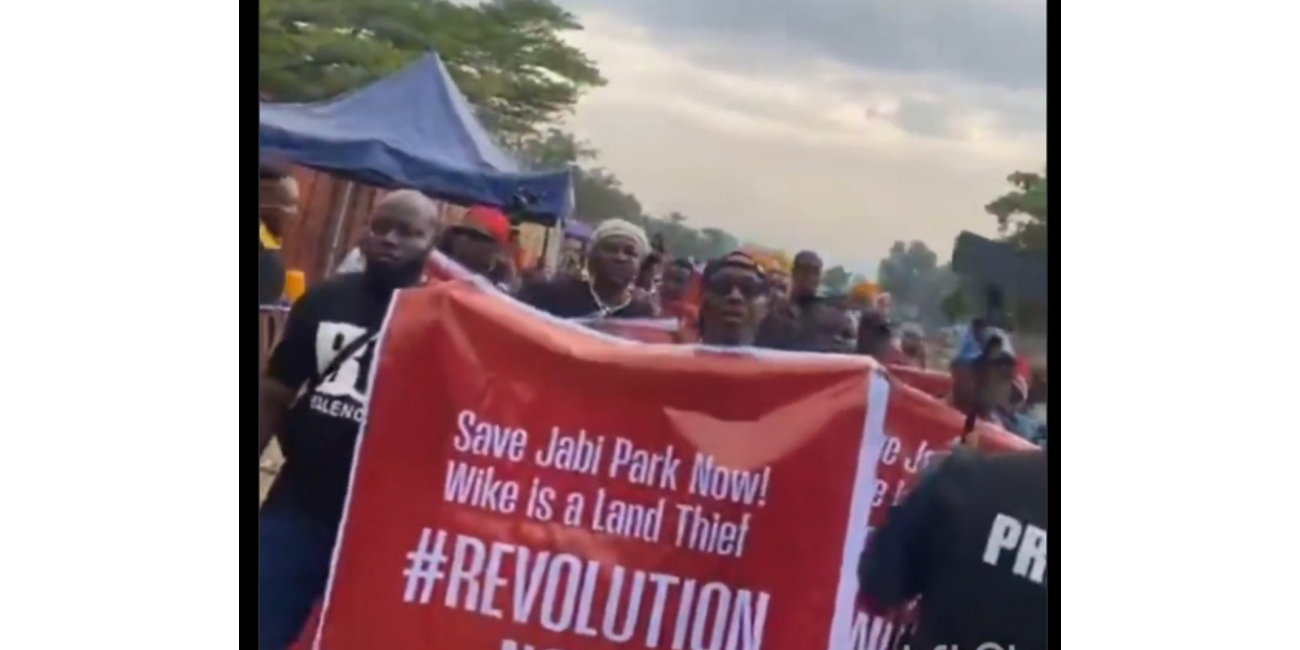
Protesters accuse FCT administration of land grabbing amid rising tensions over Abuja’s urban development and public space preservation
By Angela Udende / May 23, 2026
ABUJA, NIGERIA –Human rights activist and politician Omoyele Sowore on Friday led hundreds of protesters in Abuja under the “Save Jabi Lake” campaign, accusing the Federal Capital Territory (FCT) administration of alleged land encroachment and environmental degradation linked to urban development projects.
The demonstration, which drew civil society groups, environmental advocates, and concerned residents, specifically targeted policies and approvals linked to the administration of FCT Minister Nyesom Wike, whom protesters accused of enabling aggressive land allocation practices that threaten public access to key ecological and recreational spaces.
Protest Erupts Over Jabi Lake Development Concerns
The protest, which began early Friday morning in parts of Abuja, focused on concerns over alleged encroachment on Jabi Lake’s surrounding environment — one of the capital city’s major recreational and ecological assets.
Demonstrators carried placards demanding transparency in land allocation processes, environmental protection, and an immediate halt to what they described as “systematic conversion of public spaces into private estates and commercial developments.”
Organisers argued that unchecked urban expansion around Jabi Lake could lead to long-term environmental degradation, flooding risks, and loss of public access to green spaces.
Sowore’s Position on Urban Governance and Accountability
Sowore, addressing protesters, described the situation as part of a broader governance challenge involving land administration and public resource management in the Federal Capital Territory.
He insisted that public assets such as lakes, parks, and conservation areas must remain protected from private acquisition and politically connected developments.
According to him, the protest was not only about Jabi Lake but also about what he termed “systemic misuse of public land across Abuja.”
Allegations Against FCT Administration
Protesters accused the FCT administration of enabling large-scale land allocation to private developers without adequate environmental impact assessments or public consultation.
They further alleged that such approvals disproportionately affect low-income communities and reduce access to public recreational spaces within the capital city.
While no formal legal findings were presented during the protest, participants called for independent investigations into land-use approvals, environmental compliance, and urban planning procedures within the FCT.
Wike’s Administration Under Public Scrutiny
The administration of FCT Minister Nyesom Wike has faced increasing public attention since his appointment, particularly over urban renewal projects, demolition exercises, and land reallocation policies across Abuja.
Supporters of the administration argue that ongoing developments are part of broader efforts to modernise the capital city, improve infrastructure, and enforce urban planning regulations.
However, critics say the pace and nature of these developments raise concerns over transparency, displacement of informal communities, and the long-term environmental impact of large-scale construction projects.
Environmental and Urban Planning Concerns
Urban development experts warn that Abuja’s rapid expansion requires stricter environmental safeguards, especially around water bodies such as Jabi Lake.
Environmental advocates stress that unchecked construction around wetlands and lakes can increase flood risks, reduce biodiversity, and undermine climate resilience efforts in the Federal Capital Territory.
They are calling for stronger enforcement of environmental impact assessment laws and improved stakeholder engagement in land-use decisions.
Civil Society Demands Transparency
Civil society organisations participating in the protest called for full disclosure of land allocation records in Abuja, particularly around high-value areas.
They also urged the National Assembly and relevant regulatory agencies to conduct oversight investigations into FCT land administration practices.
According to them, transparent governance is essential to balancing urban development with environmental sustainability and public interest.
The Jabi Lake protest underscores growing tensions in Abuja over land use, environmental protection, and urban governance under the Federal Capital Territory administration.
While the FCT government continues to defend its development agenda as part of a modernization drive, activists and civil society groups are demanding greater accountability, environmental safeguards, and public participation in decision-making processes.
As debates intensify, the handling of Jabi Lake and other sensitive public assets is likely to remain a key flashpoint in Nigeria’s broader conversation on urban development and governance.













Leave a Reply