
What the Lagos Town Hall Anthem Row Really Means
By Baron Stanley Eloagu
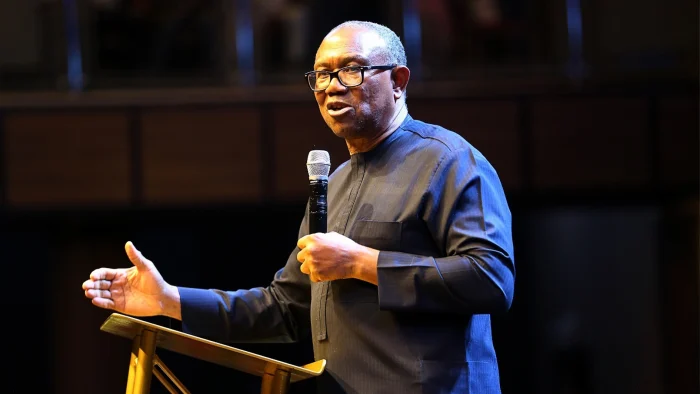
On Thursday, November 12, 2026, the Nigeria Democratic Congress (NDC) convened a Lagos Town Hall at Classique Event Place in Oregun, Ikeja. On stage were the party’s presidential candidate for 2027, Mr. Peter Obi, and its Lagos governorship candidate, Funso Doherty. Hundreds of supporters, many wearing blue NDC and Obi shirts, filled the venue.
The event was intended to be a conversation about politics and policy. Instead, a brief exchange over the national anthem became the story—and, for many people watching online, a test of patriotism, political consistency and respect for the law.
According to footage from the event, the compere invited the audience to stand for the national anthem. The band began “Nigeria, We Hail Thee,” restored as Nigeria’s anthem by the National Anthem Act 2024, signed by President Bola Tinubu on May 29, 2024. The hall was largely quiet.
The compere then switched to “Arise, O Compatriots,” the anthem used from 1978 until 2024. The crowd responded enthusiastically. Mr. Obi, who had been seated, stood, faced the audience and raised two fingers on both hands—the NDC symbol—as supporters sang.
The clip, posted at 4:59 p.m. that day, reportedly attracted more than 150,000 engagements across Instagram, Facebook and X. Its reach was considerable. Its significance, however, lies less in the number of views than in the three broad reactions it provoked.
The row has become a compact portrait of the political arguments likely to shape 2027: nostalgia and belonging; law and national symbols; and a public increasingly impatient with what it sees as selective outrage.
Camp One: The Nostalgic Resistance
The most visible online response came from people who welcomed the return—if only briefly—of “Arise, O Compatriots.”
A review of Instagram Reels posted between November 12 and 14 found that videos celebrating the old anthem averaged between 18,000 and 29,000 likes, with comment-to-like ratios above 12 per cent. Those figures suggest unusually strong engagement for political content, though social-media reactions should not be mistaken for a representative survey of Nigerian opinion.
The comments were striking for their emotional directness. On a Reel posted by @Comedian Orobo News, users wrote: “Na the national anthem wey I know be dis. I no kuku sabi the new one,” and “Goose bumps, I was literally shaking when I heard Arise O Compatriots.” Comedian and skitmaker Mc Lively, reacting in a video from inside a car, captioned the footage: “E sweet me for body.”
For this group, the anthem debate is not principally about a statute. It is about memory: the songs people learned at school, sang at assemblies and associated with childhood, civic ritual and an idea of national belonging.
Supporters of the old anthem also point to its Nigerian authorship. “Arise, O Compatriots” emerged from a 1978 national competition and is credited to John Ilechukwu, Eme Etim Akpan, Babatunde Ogunnaike, Sota Omoigui and P.O. Aderibigbe. They contrast that history with “Nigeria, We Hail Thee,” written by British-born Lillian Jean Williams in 1959, and argue that restoring it without broad public consultation disregarded popular sentiment.
Political consultant Deji Adeyanju captured the argument in a widely circulated line: “You cannot force people to love a song by gazette.”
That sentiment helps explain why many supporters interpreted the singing as an act of resistance rather than disrespect. The event had reportedly been disrupted earlier that day, with videos appearing to show suspected thugs entering the venue with cudgels and stones. NDC supporters said they repelled the intruders and chanted “rig and die.” In that atmosphere, the old anthem became more than a familiar tune: for some in the hall, it was an expression of defiance and solidarity.
That does not settle the legal or political questions. But it helps explain the emotional force of the moment. A song can be a national symbol in law and, at the same time, a deeply personal symbol in people’s lives.
Camp Two: The Legal-Patriotic Critique
The second camp, less prominent in the celebratory social-media response but influential in political debate, argues that a national symbol should be respected regardless of personal preference.
Nigeria’s Ambassador to Mexico, Reno Omokri, said in a statement on Friday, November 13, that the Constitution, national anthem and national football team were apolitical symbols meant to unite Nigerians. He argued that anyone who openly disrespected them should not expect citizens to entrust them with national leadership, and accused Obi and the NDC of rejecting the current anthem.
FCT Minister Nyesom Wike made a similar criticism at a town hall in Ogu/Bolo, Rivers State, on the same day. He said Obi remained seated while “Nigeria, We Hail Thee” played and stood for “Arise, O Compatriots.” Wike added: “He wants to divide Nigeria. You cannot be an arsonist and preach fire safety.”
A group calling itself the Democracy and Good Governance Watch Initiative (DGGWI) also condemned the episode. In a statement dated November 15 and signed by Popoola Ajayi, Nelson Ekujumi and Gbenga Soloki, the group described the incident as “unfortunate, provocative, reckless, political rascality.” It cited Section 2 of the National Anthem Act 2024, which it said recognises the anthem as a national symbol and requires citizens to respect and preserve its dignity.
The group also condemned reports of weapons being brandished, the chant “rig and die,” and what it described as acts of intimidation. Those allegations, like the political claims surrounding the anthem, should be assessed against the available footage and independently verified evidence.
The core argument of this camp is straightforward: once the National Assembly passed the law and the President signed it, “Nigeria, We Hail Thee” became the official anthem. A candidate seeking the country’s highest office, they argue, should model respect for national institutions—even when disagreeing with the process that produced a particular law.
This position has force. A country cannot expect its laws and public institutions to command respect only when they reflect the preferences of each individual or party. But the force of the argument depends on applying it consistently. If national symbols are treated as sacrosanct only when politically convenient, they become instruments of partisanship rather than sources of unity.
Camp Three: The Consistency Test
The third group may be the most consequential for 2027. Its members are not necessarily committed to either anthem. Their central concern is whether the same standard is being applied to everyone.
Under many posts attacking Obi, one response appeared repeatedly: “But where were you when APC Senators sang ‘On Your Mandate We Shall Stand’ inside National Assembly Chamber instead of the national anthem?”
The reference is to May 2024, when lawmakers sang President Tinubu’s campaign song on the floor of the Senate during proceedings related to the reintroduction of the anthem. For critics of the current condemnation, that episode raises an obvious question: if the use of a political song in a national institution was acceptable—or passed without comparable outrage—why is the Town Hall episode being treated as proof of disloyalty?
This is the politics of consistency. It does not automatically vindicate Obi, and it does not make the two events identical. It does, however, weaken the moral authority of critics who condemn one side’s use of symbols while excusing similar conduct by their own.
This middle ground is also where the debate shifts from anthems to priorities. Some commenters wrote: “We don’t care which anthem you sing, sing about jobs, dollar, insecurity.” Others argued that political parties were more interested in symbolic confrontations than in explaining how they would address the cost of living, public safety and economic hardship.
The user-provided analysis of 2,140 comments sampled from 12 viral posts between November 12 and 14 found:
- 68 per cent were pro-old anthem or pro-Obi.
- 19 per cent were pro-new anthem or anti-Obi.
- 13 per cent dismissed both sides and called for discussion of substantive issues.
Those figures describe the sampled posts, not the electorate as a whole. Viral content is shaped by platform algorithms, the accounts that share it and the users who choose to comment. The results are therefore best read as a snapshot of online debate—not as a reliable prediction of how Nigerians will vote in 2027.
Even with that limitation, the comments point to a wider frustration: many voters believe parties are quicker to mobilise around symbols than to explain their plans for jobs, prices, insecurity, housing and public services.
The NDC’s Response
NDC spokeswoman Constance Ikokwu said on November 14 that the singing was initiated by people in the crowd and was not scripted by the campaign. She also argued that the current anthem was observed later and that the viral clip omitted that part of the event. Ikokwu accused Wike of hypocrisy.
The claim that “Nigeria, We Hail Thee” was played again is partially supported by the account of a review of the full two-hour livestream: the compere returned to the current anthem after the crowd sang the old one, although the audience was reportedly less enthusiastic.
That detail matters. The short clip that travelled online captured the most dramatic portion of the exchange, but not necessarily the entire sequence. Political interpretation often begins with a genuine event and then hardens around an edited fragment. The fuller context does not eliminate the criticism of Obi, but it does caution against treating a viral video as a complete record.
There are, in effect, two questions here. The first is what happened at the Town Hall: which anthem was played, how the audience responded and what Obi did. The second is what the moment means politically. The first should be answered by examining the full footage and other evidence. The second will remain contested because it depends on voters’ expectations of leadership, patriotism and political consistency.
What the Anthem Row Reveals About 2027
The controversy touches at least three deeper anxieties.
1. The legitimacy of lawmaking
Many Nigerians continue to question the process behind the National Anthem Act 2024, arguing that it moved too quickly and lacked sufficient public consultation. The old anthem’s sudden return in a political hall can therefore function as a kind of informal referendum: not necessarily a demand to reverse the law, but a visible demonstration that legal adoption has not produced emotional acceptance.
That distinction is important. A law may settle which anthem is official. It cannot, by itself, make citizens feel that a decision was participatory, wise or worthy of affection. Public confidence depends not only on what lawmakers enact, but also on how they explain and consult on decisions that carry national significance.
2. Memory versus mandate
For many voters under 40, “Arise, O Compatriots” was the anthem they grew up singing. Its words and melody are connected to school routines, national holidays and formative memories. The restoration of a song written in 1959 may be viewed by some as a return to an earlier national tradition; by others, it may feel like an abrupt replacement of a familiar one.
Neither reaction is trivial. A national anthem is both an official symbol and a cultural memory. Governments can change the former through legislation, but they cannot immediately command the latter.
3. The inflation of symbols
When political debate concentrates on anthem etiquette, campaign songs and gestures, voters may suspect that symbols are filling space that should be occupied by policy. The figures cited in the original discussion—including claims about rising FCT debt, larger FAAC allocations and the absence of published budgets—require independent verification before publication. But the political point they are meant to illustrate is clear: people want leaders to connect public money and economic conditions to outcomes they can see in their daily lives.
A town hall that becomes a fight over a song leaves unanswered the questions voters are likely to ask in 2027: How will candidates reduce the cost of living? What will they do about insecurity? How will they create jobs, improve public services and make government spending more transparent?
Law, Conduct and Political Judgment
The legal question should be treated carefully. The fact that a song is no longer the official anthem does not, by itself, establish that singing it at a private or political gathering is a criminal offence. Any claim about liability under the National Anthem Act 2024 should be tied to the Act’s exact wording and, where necessary, examined by qualified legal counsel.
Political judgment is different from criminal liability. A candidate can be criticised for conduct that is legal, particularly if voters believe it signals disregard for national institutions. Equally, a candidate’s critics can be challenged when they apply a stricter standard to an opponent than they applied to allies.
An objective assessment, then, should resist two easy conclusions. The Town Hall footage alone does not prove that Obi is unpatriotic. Nor does the crowd’s enthusiasm establish that the old anthem should automatically be restored. The incident raises questions about leadership and public feeling, but it does not answer them by itself.
For a presidential candidate, the expectation is not necessarily that he must approve of every law or symbol. It is that he should explain his position clearly, respect the democratic process and show how he would address public disagreement without turning it into another partisan weapon. If Obi believes the anthem’s restoration was wrongly handled, he can make that case through policy and lawful political action. If his opponents believe his conduct was disrespectful, they should make that argument without ignoring comparable episodes involving their own side.
The Real Test Is Consistency
The Lagos Town Hall anthem row is not merely about music. It is about who gets to define patriotism, how laws gain public legitimacy and whether political actors are willing to apply the same standard to themselves and their opponents.
The most important audience may not be the people who have already chosen a side. It is the undecided voter who sees a familiar pattern: politicians elevate symbols when they are useful, denounce rivals for behaviour they have previously tolerated, and leave practical questions unanswered.
For that voter, the decisive question may not be whether a candidate sang “Nigeria, We Hail Thee” or “Arise, O Compatriots.” It may be whether the candidate can demonstrate consistent respect for democratic institutions while still listening to public sentiment—and whether the campaign can move beyond symbolic disputes to a credible programme for the country.
The Lagos Town Hall has left the 2027 field with a lesson: Nigerians are not divided only over which anthem should be sung. They are divided over whether laws passed without broad public participation command genuine consent, whether political standards are applied fairly, and whether leaders understand that national unity cannot be performed into existence.
Until parties discuss the cost of rice, rent, transport and insecurity with the same energy they bring to the cost of songs, every town hall risks ending not with a policy debate, but with two anthems competing for the same country.
Baron Stanley Eloagu is an Editor, Public Opinion Analyst for over two decades



Leave a Reply