
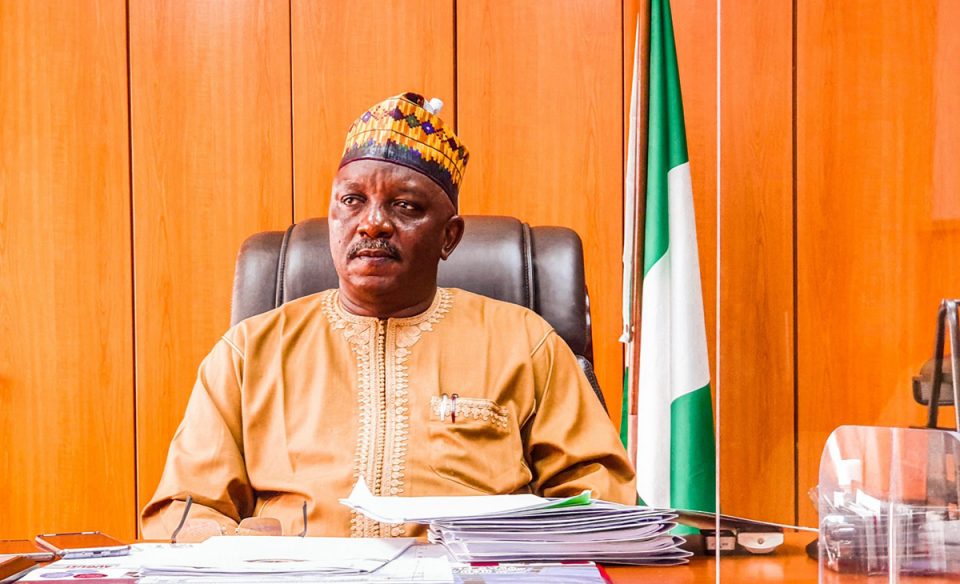
Court orders immediate imprisonment as EFCC intensifies asset recovery drive against former minister convicted in multi-billion naira corruption scandal.
By Anela Udende / May 28, 2026
ABUJA, NIGERIA —Former Minister of Power, Saleh Mamman, has officially commenced serving a 75-year prison sentence at the Kuje Custodial Centre following his transfer by the Economic and Financial Crimes Commission after a Federal High Court ruling in Abuja.
The development marks a dramatic escalation in one of Nigeria’s most high-profile corruption cases involving alleged diversion of approximately N33.8 billion in public funds during Mamman’s tenure as Minister of Power.
Justice James Omotosho of the Federal High Court, Maitama, ordered the immediate commencement of the sentence after the former minister was re-arraigned before the court following his recent arrest in Kaduna State by EFCC operatives.
The anti-graft agency has also intensified moves to seize additional luxury properties allegedly linked to the former minister.
EFCC Transfers Mamman To Kuje Prison
The Economic and Financial Crimes Commission confirmed that Mamman was transferred to the Kuje Correctional Centre in Abuja to begin serving the prison term imposed on him earlier this month.
The former minister had previously been sentenced in absentia after failing to appear in court for the conclusion of his corruption trial.
At Tuesday’s proceedings, Justice Omotosho informed Mamman that the custodial sentence officially commenced immediately.
“The sentence starts to run from today,” the judge declared.
“You were in Abuja when the judgment was passed. You were in Abuja when the sentence was passed. You left alone in a taxi for Kaduna. I have done my work. I just have to inform you because today is the commencement of your sentence.”
The judge’s remarks underscored judicial frustration over Mamman’s disappearance after conviction.
How Former Minister Allegedly Fled Abuja
During the proceedings, a relative identified as Shamsudeen Mohammed testified before the court regarding Mamman’s movement after the judgment.
According to the witness, the former minister travelled from Abuja to Kaduna by taxi shortly after his conviction.
“My name is Shamsudeen Mohammed. He is my relative. He was sick, and I was helping him to take his traditional medicine. He was brought by a taxi from Abuja to Kaduna,” he told the court.
The witness further stated that he did not know the owner of the apartment where Mamman allegedly hid in the Rigasa area of Kaduna.
“I don’t know the owner of the apartment where he was staying. It was a rented one,” he added.
Mamman himself told the court that ill health contributed to his absence during earlier proceedings.
EFCC Moves To Seize More Properties
In a fresh twist to the corruption case, the EFCC filed a consequential application seeking forfeiture of five additional properties allegedly connected to the former minister.
The application, dated May 25, 2026, was presented before the court by the Director of Public Prosecution of the Federation, Rotimi Oyedepo.
Among the properties targeted for forfeiture are:
- Walijam Apartments located at Plot 435 Lobito Crescent, Wuse 2, Abuja
- Bloom Luxury Suites Nigeria Limited in Unguwan Rimi, Kaduna State
- Mansions situated at Nos. 11 and 13 Misratah Street, Wuse 2, Abuja
- A.U.A. Plaza on Plot 734 Kade Street, Wuse 2, Abuja
The anti-corruption agency alleges that the assets were acquired using proceeds linked to fraudulent transactions involving public funds.
Defence Counsel Missing As Proceedings Continue
Proceedings also exposed apparent disarray within Mamman’s legal defence team.
The former minister’s counsel, Femi Atteh, was absent from court despite reportedly receiving notice of the forfeiture application.
According to courtroom accounts, another lawyer believed to be representing Mamman allegedly refused to accept the court documents before quietly leaving the courtroom without notifying either the judge or prosecution team.
When questioned by the court, Mamman disclosed that he had not communicated with his lawyer since his arrest by EFCC operatives on May 19, 2026.
Court Grants Adjournment On Asset Forfeiture
Despite the prosecution’s push for immediate forfeiture of the properties, Justice Omotosho ruled that fairness demanded that Mamman be granted an opportunity to defend himself.
“For the forfeiture of additional properties, the court will give adjournment for hearing on it to enable the convict to defend himself,” the judge ruled.
The court subsequently adjourned the matter until June 8, 2026, and ordered that Mamman be personally served to enable him secure legal representation of his choice.
Conviction Reinforces Nigeria’s Anti-Corruption Push
Mamman’s conviction represents one of the stiffest corruption sentences handed to a former Nigerian cabinet minister in recent years.
The case has drawn national attention amid growing public pressure for accountability over alleged looting of public resources within critical infrastructure sectors, particularly Nigeria’s struggling power industry.
Analysts say the prosecution may strengthen the credibility of anti-corruption efforts if asset recovery processes are transparently pursued to conclusion.
However, some legal observers also warn that lengthy judicial processes, enforcement inconsistencies, and political considerations have historically weakened public confidence in high-profile corruption trials.
Public Questions Over Power Sector Corruption
The conviction has reignited debate about corruption within Nigeria’s electricity sector, where billions of naira have reportedly been spent over the years despite persistent power shortages nationwide.
Citizens and civil society organisations continue demanding broader investigations into contracts, procurement practices, and fund management under previous administrations.
Energy experts argue that systemic corruption has significantly contributed to Nigeria’s chronic electricity crisis, undermining industrial growth, job creation, and economic productivity.
The imprisonment of former Power Minister Saleh Mamman marks a major moment in Nigeria’s anti-corruption campaign as authorities intensify efforts to recover allegedly stolen public funds.
With the EFCC now pursuing additional assets linked to the former minister, the case is expected to remain under close national scrutiny in the coming weeks.
For many Nigerians frustrated by years of failed electricity reforms and corruption allegations, the case represents both a symbol of accountability and a test of whether the country’s justice system can sustain momentum in prosecuting powerful public officials.




Leave a Reply