
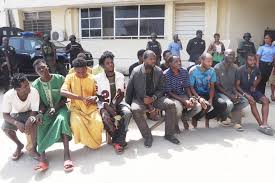
A painstaking 18-month intelligence operation by the Nigeria Police Force has led to the dismantling of a notorious Abuja-based “one-chance” syndicate accused of kidnapping commuters, draining their bank accounts, obtaining fraudulent loans through victims’ phones, and in some cases killing them to erase evidence. Investigators say the gang’s activities left dozens traumatised and allegedly claimed multiple lives.
By John Ishaku / June 7, 2026
ABUJA, NIGERIA —The Nigeria Police Force has announced a major breakthrough in its fight against violent urban crime with the arrest of members of a notorious “one-chance” criminal syndicate that allegedly terrorised residents of the Federal Capital Territory (FCT) for years.
The criminal network, according to police investigators, operated under the guise of commercial transportation services, targeting unsuspecting commuters, particularly women, before subjecting them to robbery, kidnapping, financial extortion and, in some cases, murder.
Authorities disclosed that the arrests followed an extensive 18-month intelligence-driven investigation conducted by operatives of the Force Intelligence Department–Special Tactical Squad (FID-STS), culminating in the arrest of the gang’s alleged kingpin on June 2, 2026.
The operation is being hailed as one of the most significant crackdowns against the notorious “one-chance” menace that has become a recurring security nightmare in Abuja.
THE DARK WORLD OF ABUJA’S ‘ONE-CHANCE’ CRIMINAL NETWORK
In a documentary-style presentation released by the Nigeria Police Force, investigators revealed disturbing details about how the syndicate operated.
Unlike ordinary street robbers, members of the gang allegedly disguised themselves as legitimate taxi operators and strategically positioned their vehicles in busy locations across Abuja.
Unsuspecting passengers would board what appeared to be normal commercial vehicles, only to discover moments later that they had entered a carefully orchestrated trap.
Police officials explained that once victims were isolated inside the vehicle, armed gang members would reveal themselves, lock the doors and assume control of the situation through threats, intimidation and violence.
According to investigators, the operation went beyond robbery.
“It is robbery. It is kidnapping. It is organised violent crime,” police officials stated while describing the syndicate’s activities.
SURVIVORS RECOUNT ORDEALS OF TORTURE AND EXTORTION
One survivor whose testimony was featured in the police documentary recounted the horrifying experience she endured alongside a friend after boarding a black Honda vehicle near Area 8 in Abuja.
What appeared to be a routine trip quickly transformed into a nightmare.
The victim alleged that armed men emerged from concealed positions within the vehicle, brandishing weapons and forcing the passengers into submission.
Their hands were tied and they were blindfolded while valuables including phones, laptops and personal belongings were confiscated.
The ordeal, however, did not end there.
The survivor claimed the suspects compelled victims to reveal passwords, banking details and access credentials to their mobile devices.
Investigators say the criminals then exploited banking applications and digital loan platforms to obtain additional funds.
“They beat us mercilessly. They transferred money from our accounts and even borrowed money through loan applications using our phones,” the victim recounted.
POLICE LINK SYNDICATE TO MULTIPLE DEATHS
Perhaps the most disturbing aspect of the investigation involves allegations that the syndicate may be connected to the deaths of several victims.
Police authorities referenced the cases of two nurses reportedly killed in separate incidents in January and February 2026.
Investigators believe the incidents may be linked to the same criminal network, although further investigations are ongoing.
The allegations have heightened public concern over the increasing sophistication and brutality of criminal groups operating within the Federal Capital Territory.
THE ₦11 MILLION ATTACK THAT TRIGGERED THE INVESTIGATION
According to the Commander of the Force Intelligence Department–Special Tactical Squad, the syndicate first attracted heightened police attention following a major attack on a victim identified as Miss Issa in January 2025.
During that incident, investigators alleged that approximately ₦11 million was stolen from the victim through a combination of direct transfers and digital financial exploitation.
The commander explained that intelligence gathered afterward revealed a highly mobile criminal network that frequently changed operational bases and hotels to avoid detection.
“We have been tracking them for a long time. They constantly changed locations, recruited new members and avoided staying in one place for extended periods,” the commander disclosed.
HOW POLICE FINALLY BROKE THE NETWORK
Security sources revealed that the breakthrough resulted from months of surveillance, intelligence gathering, undercover operations and digital tracking.
Investigators gradually mapped the gang’s movement patterns, financial activities and recruitment structure.
The eventual arrest of the alleged gang leader on June 2, 2026, opened the door for additional arrests and intelligence discoveries.
Police said several members had previously been apprehended, but the group’s leadership structure enabled continuous recruitment and operational resilience.
One suspect identified as David Francis allegedly confessed to joining the syndicate in March 2026.
According to police accounts, Francis admitted participating in robbery operations and assisting in withdrawing funds stolen from victims.
Authorities say his statement has provided valuable insight into the syndicate’s internal operations and recruitment methods.
WHY WOMEN BECAME PRIMARY TARGETS
Investigators revealed that female commuters constituted the majority of the gang’s targets.
The syndicate reportedly focused on busy transportation corridors and operated predominantly between late afternoon and evening hours when many workers were returning home.
Security experts believe criminals targeted women because they often appeared less suspicious of commercial transportation options and were perceived as easier to overpower.
The findings have renewed concerns over commuter safety in Abuja and the vulnerability of women to organised urban crime.
POLICE ISSUE FRESH SECURITY ALERT
Following the arrests, the Nigeria Police Force urged residents to exercise heightened caution when using public transportation.
Authorities advised commuters to avoid vehicles carrying unknown passengers, verify transportation arrangements whenever possible, utilise trusted ride-hailing platforms and share travel information with family members or trusted associates.
Police also encouraged citizens to promptly report suspicious movements and criminal activity, emphasizing that public cooperation remains critical to crime prevention.
A MAJOR WIN, BUT THE FIGHT CONTINUES
While celebrating the dismantling of the syndicate, security experts caution that the battle against “one-chance” operations is far from over.
The phenomenon has evolved into a sophisticated criminal enterprise involving surveillance, financial fraud, digital exploitation and violent crime.
Law enforcement agencies face the ongoing challenge of identifying and dismantling similar networks operating across major Nigerian cities.
The arrest of the Abuja “one-chance” syndicate marks a significant victory for the Nigeria Police Force and offers renewed hope to residents who have long lived under the threat of violent commuter-related crimes.
However, the chilling revelations emerging from the investigation underscore the growing sophistication of criminal networks exploiting technology, mobility and public trust to target innocent Nigerians.
As prosecutions commence and investigations continue, many residents will be watching closely to see whether the breakthrough signals a lasting decline in one of Abuja’s most feared criminal enterprises.











Leave a Reply