
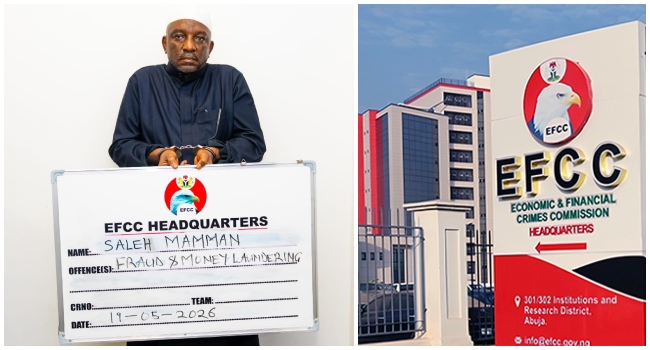
Anti-Graft Agency Arrests Former Minister in Kano Following 75-Year Jail Sentence Over Alleged Mambilla, Zungeru Power Funds Diversion
By A1NEWS International / May,20,2026
ABUJA, NIGERIA — The Economic and Financial Crimes Commission (EFCC) has arrested former Minister of Power, Saleh Mamman, weeks after a Federal High Court in Abuja convicted and sentenced him in absentia to 75 years imprisonment over alleged ₦33.8 billion money laundering linked to the controversial Mambilla and Zungeru hydroelectric power projects.
The dramatic arrest, confirmed by EFCC Chairman Ola Olukoyede, marks one of the most high-profile anti-corruption crackdowns involving a former cabinet member under the current administration’s intensified financial crimes enforcement campaign.
According to the EFCC, Mamman was apprehended around 3:30 a.m. in Kano after weeks of intelligence tracking and surveillance operations allegedly revealed that the former minister had been moving between safe locations to evade arrest.
The anti-graft agency also disclosed that two unnamed individuals were arrested alongside the ex-minister for allegedly shielding and assisting a convicted fugitive.
EFCC Details Midnight Arrest Operation
Speaking during a media briefing in Abuja, Olukoyede said the operation followed months of legal proceedings and intelligence gathering after the former minister allegedly absconded during the concluding phase of his trial.
According to the EFCC chairman, the commission had secured convictions on all 12 criminal counts filed against Mamman, but sentencing was delayed after the former minister repeatedly failed to appear before the court.
“At about 3:30 a.m. this morning, we arrested Mr. Saleh Mamman somewhere in Kano,” Olukoyede stated.
The EFCC boss further revealed that the property where Mamman was arrested is now under investigation to determine whether individuals knowingly harbored a fugitive convicted in a financial crimes case.
Investigators are also reportedly examining possible financial networks and accomplices linked to the movement of allegedly diverted public funds tied to the power projects.
The ₦33.8 Billion Fraud Allegations
At the center of the case are allegations that billions of naira earmarked for the Mambilla and Zungeru hydroelectric power projects were unlawfully diverted during Mamman’s tenure as Minister of Power.
The EFCC accused the former minister of laundering and misappropriating over ₦33 billion through multiple transactions and proxies in violation of Nigeria’s anti-money laundering laws.
The Mambilla Power Project, one of Nigeria’s most ambitious electricity infrastructure plans, has faced years of delays, funding controversies, legal disputes, and allegations of corruption despite repeated promises by successive governments to improve national power supply.
The Zungeru Hydroelectric Power Project has similarly suffered implementation challenges and scrutiny over financing structures and project transparency.
Analysts say the latest conviction further exposes longstanding accountability concerns surrounding Nigeria’s power sector, where billions of dollars have reportedly been spent over decades with limited improvement in electricity generation and distribution.
Court Sentences Mamman To 75 Years In Prison
Justice James Omotosho of the Federal High Court, Abuja, had earlier convicted Mamman on all 12 counts filed by the EFCC.
The court ruled that the former minister deliberately avoided judicial proceedings in an attempt to frustrate justice.
Justice Omotosho imposed separate prison terms across multiple counts, ordering that the sentences run consecutively, resulting in a cumulative 75-year jail term.
Court records showed:
- Seven-year imprisonment terms were imposed on multiple counts without an option of fine.
- Three years imprisonment with a ₦10 million fine option was handed down on one count.
- Another count attracted two years imprisonment without fine option.
The judge further directed all security agencies, including Interpol, to collaborate in ensuring Mamman’s arrest and enforcement of the judgment.
Power Sector Corruption Under Renewed Spotlight
The arrest has reignited public debate over systemic corruption in Nigeria’s electricity sector, particularly concerning mega infrastructure projects that have consumed public funds without corresponding improvements in power supply.
Energy experts note that despite decades of massive allocations and foreign-backed power projects, millions of Nigerians still struggle with unstable electricity, high energy costs, and dependence on generators.
Anti-corruption advocates argue that prosecutions involving politically exposed persons remain critical to restoring public confidence in governance and fiscal accountability.
However, critics also warn that convictions alone may not address deeper structural issues unless stolen public funds are fully recovered and institutional safeguards strengthened.
EFCC Signals Tougher Crackdown On Financial Crimes
Olukoyede described the arrest as evidence that public officials accused of corruption would eventually face justice regardless of status or influence.
He said the commission remains committed to pursuing politically exposed persons accused of diverting public resources.
The EFCC chairman added that the agency would continue collaborating with domestic and international law enforcement institutions to track fugitives and financial crimes suspects.
Political observers believe the case could become a major reference point in Nigeria’s ongoing anti-corruption narrative, particularly as public pressure mounts over economic hardship, debt concerns, and governance accountability.
Questions Surrounding Nigeria’s Power Infrastructure Spending
The Mamman case also raises broader concerns about oversight failures surrounding strategic national infrastructure spending.
The Mambilla and Zungeru projects were originally designed to significantly boost Nigeria’s electricity generation capacity and reduce the country’s chronic power deficit.
Yet repeated allegations of contract irregularities, delayed execution, inflated costs, and political interference have plagued both projects.
Transparency groups are now demanding deeper audits into past energy sector expenditures and procurement processes involving former government officials and contractors.
The arrest of former Power Minister Saleh Mamman represents a dramatic escalation in Nigeria’s anti-corruption enforcement efforts and places renewed scrutiny on the management of billions allocated to critical national infrastructure.
While the EFCC portrays the operation as proof that no politically exposed individual is above the law, the case simultaneously highlights persistent institutional weaknesses that continue to undermine public trust in governance and service delivery.
As legal proceedings continue, Nigerians will be watching closely to see whether the prosecution results in broader reforms within the power sector or becomes another high-profile corruption case absorbed into the country’s long history of unresolved accountability battles.








Leave a Reply