
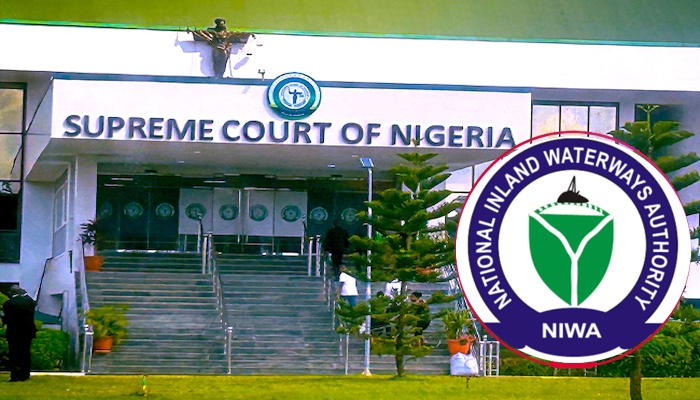
Apex court restricts FG’s authority over adjoining waterfront lands, declaring parts of inland waterways law unconstitutional in landmark constitutional ruling
By Anita Babalola / May 23, 2026
The Supreme Court of Nigeria has struck down key provisions of the National Inland Waterways Authority (NIWA) Act, ruling that the Federal Government lacks constitutional authority to regulate lands adjoining inland waterways for non-navigational purposes within states.
The landmark judgment, delivered in Suit No. SC/CV/541/2025, arose from a constitutional dispute between the Lagos State and the Federal Government over the scope of federal powers under the inland waterways regulatory framework.
The ruling significantly redefines the legal boundaries between federal and state control over waterfront lands, with far-reaching implications for land administration, urban development, and infrastructure planning across Nigeria.
Court Declares Sections of NIWA Act Unconstitutional
A seven-member panel of the Supreme Court, led by Justice Mohammed Lawal Garba, held that Sections 12 and 13 of the NIWA Act were unconstitutional to the extent that they extended federal authority beyond navigation-related activities.
The court ruled that the National Assembly exceeded its constitutional powers by attempting to regulate adjoining waterfront lands for purposes unrelated to:
- Navigation
- Maritime operations
- Fishing activities
The judgment stated that such extensions of authority violated constitutional limits set under the Exclusive Legislative List.
Legal Battle Between Lagos State and Federal Government
The case was instituted by Lagos State under the Supreme Court’s original jurisdiction, challenging Sections 10, 11, 12, and 13 of the NIWA Act.
Lagos State, represented by senior advocates including Babatunde Fashola (SAN), Olasupo Shasore (SAN), and Muiz Banire (SAN), argued that federal control should be limited strictly to inter-state and international waterways.
The Federal Government, represented by Akin Olujimi (SAN), maintained that NIWA’s regulatory powers were constitutionally valid.
The court’s ruling partially upheld Lagos State’s position, while rejecting broader declarations sought against Sections 10 and 11.
Injunction Restrains Federal Government Powers
In a major consequential order, the Supreme Court issued a perpetual injunction restraining the Federal Government from exercising control over lands adjoining inland waterways within Lagos State and other states for non-navigational purposes.
The court emphasized that federal authority must remain confined within constitutionally defined limits.
However, it declined to invalidate Sections 10 and 11 of the NIWA Act, citing consistency with its earlier decision in NIWA v. Lagos State Waterways Authority.
Split Decision Highlights Judicial Division
While the judgment was largely unanimous, the court was divided 5–2 on aspects relating to Sections 10 and 11 of the Act.
Justices Emmanuel Akomaye Agim and Mohammed Baba Idris dissented, arguing that additional reliefs sought by Lagos State should have been granted.
The split underscores the constitutional complexity surrounding federal-state jurisdiction over inland waterways.
Court Dismisses Federal Government Objections
The Supreme Court also dismissed preliminary objections raised by the Federal Government challenging the court’s jurisdiction to hear the matter.
The panel affirmed its authority to adjudicate the dispute under its original jurisdiction provisions, describing the objections as lacking merit.
Constitutional Limits on Federal Authority Reaffirmed
Legal analysts say the ruling reinforces Nigeria’s federal structure by clarifying the limits of national legislative power over land and environmental resources within states.
The court held that the National Assembly acted ultra vires in extending federal control beyond navigation-related functions, thereby violating constitutional boundaries.
Implications for Land Use and Development Policy
The judgment is expected to have significant implications for:
- Coastal and waterfront development
- State-level land administration
- Infrastructure planning near inland waterways
- Federal regulatory agencies operating in riverine areas
Governments at both federal and state levels may now be required to reassess regulatory frameworks governing waterfront development and environmental control.
The Supreme Court’s decision marks a major constitutional shift in Nigeria’s governance of inland waterways, limiting federal authority while reinforcing state control over adjoining lands.
By invalidating key provisions of the NIWA Act, the apex court has redefined the balance of power between federal and state governments in one of the country’s most contested regulatory spaces.
The ruling is expected to trigger policy reviews, legal realignments, and potential administrative restructuring within agencies overseeing inland waterway development.










Leave a Reply