
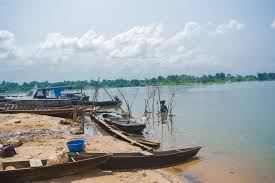
Navy completed the pre-dredging survey in 2023, while Imo’s 2025 budget provided for the project — yet the actual dredging and proposed Atlantic sea access remain unresolved.
By Baron Eloagu
ABUJA, October 1, 2026
Three years after the Federal Government and Imo State Government launched the process for opening a navigable waterway from Oguta Lake through the Orashi River to the Atlantic Ocean, the promised transformation of the South-East’s maritime and commercial landscape remains incomplete.
The project, formally presented as the Oguta Lake–Orashi River–Degema to Atlantic Ocean Sea Access Project, was launched on May 11, 2023, when then Vice President Yemi Osinbajo flagged off the pre-dredging hydrographic survey at Oguta, Imo State.
The proposed corridor was designed to connect Oguta Lake and the Orashi River with Degema in Rivers State and ultimately the Atlantic Ocean, with the stated objectives of improving maritime connectivity, trade, investment, agriculture, industrial development and security.
But more than three years later, the key question remains: what happened after the survey?
Available public records show that the Nigerian Navy completed and submitted the hydrographic and bathymetric survey report in September 2023. Imo State subsequently said the next stages would include an Environmental Impact Assessment and other preparatory arrangements before the actual dredging.
Yet there has been no publicly documented completion of the proposed full dredging and sea-access corridor comparable to what was envisaged at the 2023 launch.
FROM GRAND LAUNCH TO A SURVEY REPORT
At the May 2023 flag-off, Osinbajo described the project as having the potential to promote trade and investment and stimulate sectors including shipping, manufacturing and agriculture.
The official account of the event said the project was a collaboration involving the Imo State Government, the Nigerian Navy and technical partners. The proposed route was to run from Oguta Lake through the Orashi River and Degema to the Atlantic Ocean.
Governor Hope Uzodimma also said the project would be executed through a public-private partnership and would contribute to economic growth and maritime security.
The project was linked to the Federal Government’s approval of an oil and gas free trade zone covering Oguta, Ohaji/Egbema and surrounding areas. Osinbajo said the combination of the proposed sea route and the free trade zone could create significant commercial opportunities.
The initial announcement therefore raised expectations that a new maritime and industrial corridor could emerge in the South-East.
THE NAVY COMPLETED THE FIRST MAJOR STAGE
The first major technical stage did, in fact, take place.
In September 2023, the Nigerian Navy completed the hydrographic and comprehensive bathymetric/investigative survey of the proposed Oguta Lake–Orashi River route.
The report was formally presented to Governor Uzodimma on September 25, 2023.
The Navy’s recommendations included further dredging and canalisation of portions of the proposed route towards Bonny River via Onne to enable navigation by larger vessels, as well as environmental assessment and the installation of navigation aids such as standard buoys.
That distinction is important.
The 2023 flag-off was not the completion of the dredging project. It initiated the survey and development process.
The survey was completed. The much bigger question is what happened to the implementation stages that were supposed to follow.
WHAT HAPPENED AFTER SEPTEMBER 2023?
When the Navy handed over the survey report, the Imo State Government said it was ready to proceed to the next stage.
Uzodimma stated that the state would undertake an Environmental Impact Assessment and other necessary arrangements leading to the actual dredging. He also said discussions were ongoing with a foreign company that could participate in the dredging through a PPP arrangement.
The publicly available record, however, does not show that the full Oguta–Orashi–Atlantic dredging works were subsequently completed.
Indeed, the project’s continued appearance in government plans suggests that it remained an unfinished undertaking.
In December 2024, while presenting the 2025 budget, Uzodimma again reaffirmed his administration’s commitment to dredging Oguta Lake and the Orashi River to connect the waterway to the Atlantic Ocean.
That statement, coming more than a year after the Navy had delivered its survey report, raised another question:
Why was a project launched in 2023 still being presented as a future commitment in late 2024?
₦100 BILLION BUDGET LINE — BUT WHAT HAS BEEN DELIVERED?
There is another important piece of evidence.
The Imo State Government’s approved 2025 budget contained a line item titled:
“Dredging of Orashi River to Atlantic Ocean (PPP)”
with a budget provision of ₦100 billion under the Ministry of Transport.
The first-quarter 2025 budget implementation report showed zero expenditure against that line item at the time covered by the report.
By the third quarter, however, the implementation report showed a substantially different position: the same project line had recorded ₦32.23 billion in expenditure, representing 32.2 per cent, leaving about ₦67.77 billion of the budgeted amount.
That finding materially changes the picture.
It would therefore be inaccurate to simply describe the project as having received no government activity whatsoever.
The available fiscal records indicate that money was recorded as spent against the project in 2025.
But an equally important question remains unanswered:
What physical works did the reported ₦32.23 billion expenditure finance, and how far has the actual navigable route progressed?
The budget documents alone do not answer that question.
A SECOND SURVEY APPEARED IN 2025
There is yet another development that deserves public scrutiny.
In July 2025, the National Inland Waterways Authority advertised an expression of interest for hydrographic survey and side-scanning of a 90-kilometre section of the Orashi River from Oguta in Imo State to Ebocha in Rivers State.
This does not necessarily mean the original project was abandoned.
Rather, it raises a technical and administrative question:
How does the 2025 NIWA survey relate to the comprehensive survey already undertaken by the Nigerian Navy in 2023?
Was it a complementary survey?
Was it required for another section of the waterway?
Was it part of a revised project design?
Or did the project require additional technical work before dredging could begin?
Those questions should be answered publicly by the relevant agencies.
THE HISTORICAL WATERWAY QUESTION
The case for reopening the corridor is not entirely new.
At the 2023 flag-off, Osinbajo referred to the historical use of the route for moving produce from the hinterland towards the coast.
The Navy’s hydrographic team similarly reported that the route had been used during the colonial era, with the survey recommendations pointing to the historical significance of the waterway.
The historical record is therefore part of the argument for investigating the waterway’s modern commercial potential.
But historical navigation should not, by itself, be treated as proof that a modern commercial sea route is currently viable.
Modern shipping requires adequate channel depth, navigational aids, environmental approvals, terminals, security, maintenance and commercially sustainable infrastructure.
That is precisely why the 2023 hydrographic survey and subsequent technical recommendations were significant.
FROM OGUTA TO THE ATLANTIC — WHAT WAS PROMISED?
The proposed project was never merely about dredging a river.
Its promoters presented it as part of a broader economic corridor.
The stated objectives included:
connecting the South-East hinterland to the Atlantic maritime network;
facilitating movement of goods;
supporting industrial and energy development;
strengthening access to the proposed Orashi energy/free-trade zone;
improving maritime security;
reducing the difficulty of transporting products;
supporting investment and employment;
and creating a potential logistics corridor linking the South-East and Niger Delta.
The Imo State Government continues to promote the Orashi Special Energy Free Zone as an industrial and logistics corridor centred around gas, petrochemicals, manufacturing and exports.
That makes the status of the proposed waterway relevant beyond Oguta itself.
THE PROJECT IS NOT NECESSARILY “DEAD” — BUT IT NEEDS ACCOUNTABILITY
Calling the project completely abandoned would go beyond the evidence currently available.
The records show continued government references to the project, a 2025 budget allocation, reported expenditure in the 2025 third-quarter implementation report, and a separate 2025 NIWA procurement process involving the Orashi River.
What the records do establish is that the project has not reached the publicly anticipated end-state of a completed dredged sea-access corridor from Oguta to the Atlantic Ocean.
That gap deserves explanation.
If the reported ₦32.23 billion expenditure was genuinely connected to the project, Nigerians deserve to know:
What was constructed, dredged, surveyed, procured or otherwise delivered with the money?
Where is the Environmental Impact Assessment?
What company or consortium was selected under the proposed PPP?
What is the current project scope?
What is the total revised project cost?
What portion is being financed by the Federal Government, Imo State Government or private investors?
What milestones have been achieved since the Navy’s 2023 survey?
And, most importantly:
When will vessels actually be able to navigate the completed corridor?
A PROJECT WITH REGIONAL IMPLICATIONS
The debate should also move beyond partisan politics.
The proposed Oguta–Orashi corridor concerns infrastructure, logistics, maritime transportation, industrialisation and regional economic integration.
The South-East does not become an Atlantic coastline simply because a waterway is dredged. But a properly engineered and commercially viable inland-waterway connection can potentially provide access to existing coastal maritime infrastructure.
The Navy’s 2023 recommendations themselves envisaged further canalisation towards Bonny River via Onne for larger vessels.
Consequently, the project should be judged not by political speeches or ceremonial flag-offs, but by measurable infrastructure outcomes.
THE QUESTIONS GOVERNMENT MUST ANSWER
Three years after the 2023 launch, the central issue is no longer whether the project was announced.
It was.
It is no longer whether a hydrographic survey was conducted.
It was.
And it is no longer whether government documents contain financial provisions for the project.
They do.
The unresolved issue is implementation.
The Federal Government, Imo State Government, Nigerian Navy and relevant maritime agencies should publish a comprehensive status report showing the project’s technical, financial and contractual position.
Such a report should include the 2023 Navy survey, environmental approvals, PPP arrangements, contracts, expenditure records, physical works completed, current project scope, outstanding works and a realistic completion timeline.
The Oguta/Orashi project was introduced to Nigerians as a potentially transformative maritime corridor capable of connecting the South-East hinterland with the Atlantic and supporting a wider industrial and energy-development strategy.
Three years after the high-profile 2023 launch, the promised transformation remains incomplete.
Available evidence shows that the story is more complicated than simply saying the project was “abandoned”: the government continued to budget for it, official records show expenditure in 2025, and further hydrographic work was advertised along the Orashi corridor.
But the absence of a clearly documented, publicly verifiable account of the project’s physical progress leaves a substantial accountability gap.
The question for the Federal Government, Imo State Government and the relevant maritime authorities is therefore straightforward:
WHERE EXACTLY IS THE OGUTA/ORASHI RIVER DREDGING PROJECT TODAY — AND WHAT HAS BEEN DELIVERED FOR THE MONEY SPENT?
For a project once described as capable of transforming the economic fortunes of the South-East, Nigerians deserve more than another ceremonial announcement.
They deserve the records, the work and the result.
A1NEWS International will continue to follow the money, the contracts and the physical progress of the project.





Leave a Reply