
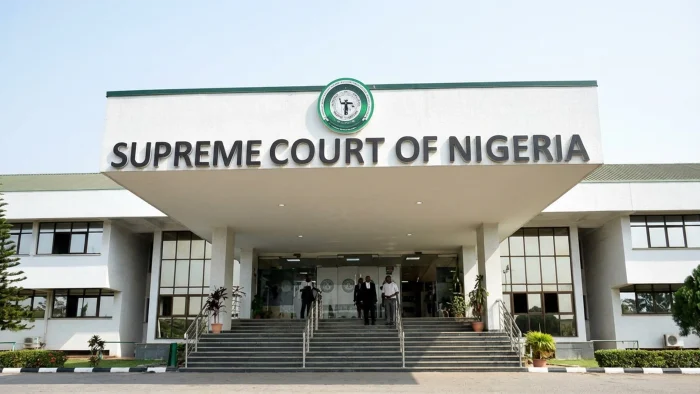
Apex Court Faults Appeal Court’s Ex Parte Orders, Restores Control of Assets to Oil Firms as High-Stakes Financial Battle Returns to Trial Court
By Angela Udende / June 2, 2026
ABUJA, Nigeria — In a landmark ruling with far-reaching implications for Nigeria’s financial, oil and gas, and judicial sectors, the Supreme Court has nullified an order of the Court of Appeal that froze the assets of Neconde Energy Limited, Nestoil Limited, and two other entities over an alleged indebtedness of approximately $1.1 billion to FBNQuest Merchant Bank Limited and First Trustees Limited.
The judgment, delivered on Monday by a five-member panel of the apex court led by Justice Stephen Adah, effectively restores operational control of the affected companies and reopens critical questions regarding the limits of judicial intervention in commercial disputes.
The ruling marks the latest development in a protracted legal battle involving some of Nigeria’s most prominent indigenous oil and gas interests, financial institutions, and competing interpretations of judicial authority.
Supreme Court Faults Appeal Court’s Exercise of Power
In a strongly worded judgment, the Supreme Court held that the Court of Appeal exceeded its constitutional and judicial powers when it granted an ex parte application that effectively restored restrictions on the companies’ assets and operations.
Justice Adah criticized the appellate court for assuming jurisdiction over a matter that, according to the apex court, was not properly before it.
The Supreme Court further held that the Court of Appeal improperly interfered with proceedings already pending before the Federal High Court in Lagos.
Legal observers say the decision reinforces the principle that appellate courts must exercise caution when granting extraordinary interim reliefs capable of substantially affecting the rights of parties before a full hearing.
Origins of the Multi-Billion-Dollar Dispute
The dispute stems from debt recovery proceedings initiated by lenders, including FBNQuest Merchant Bank Limited and First Trustees Limited, against Nestoil Limited and Neconde Energy Limited.
The lenders contend that the companies owe substantial sums arising from financing arrangements linked to oil and gas assets, investments, and operational obligations.
The debt dispute reportedly involves transactions valued at approximately $1.1 billion, making it one of the most significant commercial litigation matters currently before the Nigerian courts.
Industry analysts note that the outcome of the case could influence future lender-borrower relationships within Nigeria’s energy sector, where large-scale financing arrangements often involve complex security structures and asset-backed obligations.
How the Asset Freeze Began
The controversy intensified in October 2025 when the Federal High Court in Lagos granted an ex parte Mareva injunction against the companies.
A Mareva injunction is a court order designed to prevent a defendant from dissipating assets while litigation is pending.
The order froze the companies’ assets, bank accounts, shares, and other financial interests across more than 20 financial institutions.
The lenders argued that the restrictions were necessary to preserve assets pending the determination of the substantive debt recovery suit.
However, the affected companies challenged the order, contending that it could not remain in force indefinitely without compliance with procedural safeguards.
Federal High Court Declared Order Expired
A significant turning point occurred in November 2025 when Justice Daniel Osiagor of the Federal High Court ruled that the ex parte order had lapsed by operation of law.
The companies had argued that once they filed a motion seeking to discharge the injunction, the order became subject to strict timelines under the Federal High Court Civil Procedure Rules.
Justice Osiagor agreed, holding that the interim restrictions were no longer legally valid and had ceased to exist after the prescribed period.
The ruling was viewed as a major victory for Nestoil and Neconde, potentially allowing them to regain unrestricted access to their operations and assets.
Appeal Court Reversed the Situation
The matter took another dramatic turn on November 29, 2025, when Justice Yargata Nimpar of the Court of Appeal granted what became known as an interim restorative injunction.
The appellate court’s decision effectively reversed the practical effect of the Federal High Court’s ruling by restoring control of the companies’ assets and operations to a receiver-manager appointed by the lenders.
The court also nullified actions taken by Nestoil after the Federal High Court judgment and allowed the Mareva injunction to continue operating.
The decision generated significant debate within legal circles, with some practitioners arguing that the appellate court had ventured into territory ordinarily reserved for a substantive determination of rights.
Supreme Court Sets Aside Appeal Court Decision
Monday’s judgment has now overturned the Court of Appeal’s intervention.
The Supreme Court held that the appellate court acted beyond its authority in granting the ex parte orders and staying proceedings before the trial court.
The apex court’s decision effectively restores the legal position established by the Federal High Court and allows Nestoil and Neconde to resume full control of their assets and business operations while the substantive dispute continues.
Legal analysts say the ruling sends a strong message about judicial restraint and respect for procedural rules.
The judgment is also expected to become an important reference point in future disputes involving asset preservation orders, receivership arrangements, and debt recovery proceedings.
Implications for Nigeria’s Banking and Energy Sectors
The dispute extends beyond the immediate parties and could have broader implications for Nigeria’s financial markets and energy industry.
For lenders, the case highlights the challenges associated with enforcing large-scale corporate debt obligations through judicial mechanisms.
For borrowers and corporate entities, the ruling may strengthen confidence in procedural protections against extensive ex parte orders that significantly affect business operations.
Industry experts note that the case underscores the delicate balance courts must maintain between protecting creditors’ interests and safeguarding the rights of businesses to continue lawful operations pending final determination of disputes.
What Happens Next?
Although the Supreme Court has set aside the Court of Appeal’s orders, the substantive debt recovery case remains unresolved.
The matter is expected to continue before the Federal High Court, where issues relating to the alleged indebtedness, contractual obligations, financing arrangements, and enforcement rights will be fully examined.
Both sides are likely to intensify legal arguments as the trial court proceeds with hearing the substantive claims.
The eventual outcome could determine not only liability for the disputed debt but also establish important precedents for commercial litigation involving major corporate entities in Nigeria.
The Supreme Court’s decision to nullify the Court of Appeal’s asset-freezing orders represents a major victory for Nestoil and Neconde Energy and a significant development in one of Nigeria’s most closely watched commercial disputes. By restoring control of the companies’ assets and emphasizing adherence to judicial procedure, the apex court has reinforced important principles governing ex parte reliefs and appellate intervention.
As the underlying $1.1 billion debt dispute returns to the Federal High Court, stakeholders across Nigeria’s banking, energy, and legal sectors will be watching closely. The final resolution of the case could shape future debt recovery strategies, corporate financing arrangements, and judicial approaches to complex commercial litigation.






Leave a Reply