
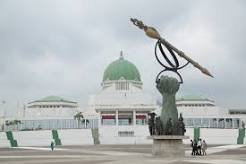
In a landmark judgment with far-reaching implications for public accountability and legislative spending, the Federal High Court in Lagos has declared the National Assembly’s ₦110 billion vehicle procurement and allowance scheme unlawful, ruling that the expenditure violated procurement laws, constitutional provisions, and principles of transparency and value for money.
By Anita Babalola | June 8, 2026
Lagos, Nigeria – In a decision that could reshape public spending oversight in Nigeria, the Federal High Court sitting in Lagos has nullified the National Assembly’s controversial ₦110 billion vehicle procurement and allowance package for lawmakers.
The court held that the expenditure, comprising ₦40 billion for the acquisition of 465 vehicles and ₦70 billion in support allowances for newly elected legislators, failed to comply with statutory procurement requirements and constitutional standards governing the management of public resources.
The ruling, delivered by Justice Yellim Bogoro in Suit No. FHC/L/CS/1606/2023, marks one of the most significant judicial interventions in legislative spending since Nigeria’s return to democratic rule.
The suit was instituted by the Socio-Economic Rights and Accountability Project against Senate President Godswill Akpabio and Speaker of the House of Representatives Tajudeen Abbas.
THE CONTROVERSIAL ₦110 BILLION EXPENDITURE
At the center of the legal dispute was the National Assembly’s decision to allocate:
- ₦40 billion for the purchase of 465 vehicles for lawmakers.
- ₦70 billion as support allowances for newly elected members.
The expenditure attracted widespread criticism when details emerged in 2023, particularly against the backdrop of worsening economic hardship, rising inflation, growing poverty levels and increasing insecurity across the country.
Civil society groups questioned the necessity and timing of the spending, arguing that it reflected misplaced priorities at a time when millions of Nigerians were struggling to meet basic needs.
The National Assembly, however, defended the allocations as legitimate expenditures within its operational framework.
COURT REJECTS CLAIMS OF LEGISLATIVE IMMUNITY
One of the central arguments advanced by the defendants was that the doctrine of separation of powers insulated legislative spending decisions from judicial scrutiny.
Justice Bogoro firmly rejected that position.
The court held that while the legislature enjoys constitutional autonomy, such autonomy does not extend to actions that violate statutory provisions or constitutional obligations.
According to the judgment, the judiciary retains the authority to review legislative actions where questions of legality, constitutionality and compliance with public procurement laws arise.
“The doctrine of separation of powers does not operate as a shield for illegality,” the court ruled.
The judge further emphasized that judicial intervention becomes necessary whenever public institutions exceed legal boundaries.
PROCUREMENT PROCESS FOUND DEFECTIVE
A major component of the judgment focused on the procurement process used for the vehicle acquisition programme.
The court found insufficient evidence that the expenditure complied with the requirements of the Public Procurement Act.
Specifically, the judgment noted the absence of demonstrable evidence relating to:
- Competitive bidding procedures.
- Transparency safeguards.
- Due process requirements.
- Value-for-money assessments.
Justice Bogoro concluded that the defendants failed to provide credible documentation showing compliance with established procurement standards.
The court held that such failures undermined public confidence and violated statutory obligations designed to ensure prudent management of public resources.
SELF-DEALING AND CONFLICT OF INTEREST CONCERNS
In one of the strongest aspects of the judgment, the court described the arrangement as creating a conflict of interest.
According to the ruling, lawmakers approved expenditure packages from which they were direct beneficiaries.
The court observed that public office holders must avoid situations where personal benefit could compromise public interest obligations.
Justice Bogoro stated that the expenditure scheme was inconsistent with constitutional principles governing public service and the Code of Conduct applicable to public officers.
The ruling stressed that public office remains a public trust and must never be used as a vehicle for personal enrichment.
ECONOMIC HARDSHIP AND NATIONAL PRIORITIES
The judgment also reflected on Nigeria’s prevailing economic realities.
Justice Bogoro took judicial notice of the severe hardship facing many citizens and questioned the appropriateness of allocating such significant public funds for legislative benefits under those circumstances.
The court noted that government spending decisions must be guided by national priorities and public interest considerations.
The ruling suggested that expenditures of this magnitude demand heightened scrutiny, particularly when they involve elected officials directly benefiting from the allocations.
Analysts say this aspect of the judgment could influence future legal challenges involving government spending and budgetary allocations.
SERAP HAILS LANDMARK VICTORY
Reacting to the judgment, SERAP described the ruling as a major victory for transparency, accountability and responsible governance.
The organisation’s Deputy Director, Kolawole Oluwadare, said the judgment reaffirmed the principle that public funds must be spent strictly in accordance with constitutional and legal requirements.
According to SERAP, the ruling sends a clear message that no arm of government is above the law and that public institutions must be accountable to citizens.
The organisation has formally urged the National Assembly leadership to immediately comply with the court’s directives.
FALANA CALLS FOR FULL COMPLIANCE
Senior Advocate of Nigeria, Femi Falana, also welcomed the judgment.
Falana described the ruling as a significant affirmation of constitutional accountability and criticized what he termed excessive public spending by political office holders amid widespread poverty.
He called on the National Assembly to obey the judgment and urged the Revenue Mobilisation Allocation and Fiscal Commission to exercise its constitutional authority in regulating salaries and allowances of lawmakers.
According to him, reducing wasteful spending could free substantial resources for critical sectors such as education, healthcare and national security.
IMPLICATIONS FOR FUTURE LEGISLATIVE SPENDING
Legal experts believe the judgment may establish an important precedent for future oversight of legislative expenditures.
The ruling reinforces the principle that all public institutions, including the legislature, remain subject to procurement laws, constitutional safeguards and judicial review.
The court directed Senate President Akpabio, Speaker Abbas and members of the National Assembly to ensure that all future expenditures strictly comply with due process, transparency, accountability and value-for-money requirements.
Observers say the judgment could encourage greater public scrutiny of budgetary allocations and strengthen the role of civil society organizations in promoting accountability.
The Federal High Court’s decision represents a significant milestone in Nigeria’s ongoing struggle for transparency and responsible governance.
By declaring the ₦110 billion vehicle and allowance scheme unlawful, the court has reinforced a fundamental democratic principle: public resources belong to the people and must be managed in accordance with the law.
As economic pressures continue to mount and citizens demand greater accountability from public officials, the ruling serves as a reminder that no institution is exempt from constitutional scrutiny.
Whether the National Assembly fully complies with the judgment may now become a critical test of its commitment to transparency, fiscal responsibility and the rule of law.







Leave a Reply