
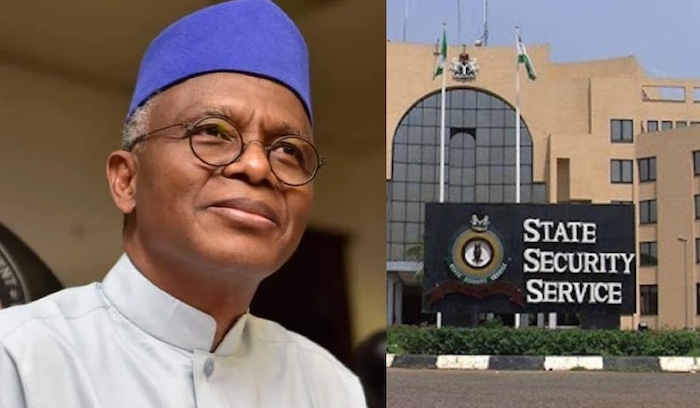
Court hears testimony linking former Kaduna governor’s televised remarks to ongoing cybercrime and unlawful interception charges filed by the DSS.
By Zakari Muhammed – June 23, 2026
ABUJA, NIGERIA – The ongoing trial of former Kaduna State Governor, Nasir El-Rufai, took a dramatic turn at the Federal High Court in Abuja on Monday as a prosecution witness told the court that the former governor publicly admitted listening to conversations involving the National Security Adviser (NSA), Mallam Nuhu Ribadu.
The witness, Mr. Deji Adeyanju, testifying on behalf of the Department of State Services (DSS), stated that El-Rufai made the controversial remarks during a live Arise News television programme, an interview that later became the basis of an investigation and criminal charges against the former governor.
The case has attracted widespread public attention because of its implications for national security, privacy rights, cybercrime enforcement, and political accountability in Nigeria.
Witness Recounts Televised Admission
While being led in evidence by prosecuting counsel, Mr. Oluwole Aladedoye, Adeyanju informed the court that he participated in an Arise News programme on February 16, the same day El-Rufai appeared on the station.
According to the witness, the former governor stated during the broadcast that “we listened to the conversations of the NSA, Mallam Nuhu Ribadu.”
Adeyanju told the court that he personally heard the statement and considered it significant enough to attract public attention.
He further confirmed that he was familiar with El-Rufai’s public profile as a former governor and recalled publicly reacting after reports emerged that security operatives planned to arrest the former governor over the remarks.
DSS Investigation Triggered By Public Statements
The witness revealed that following the television appearance, DSS investigators invited him to provide information concerning what transpired during the programme.
According to Adeyanju, he informed investigators that El-Rufai not only acknowledged that the NSA’s conversations were listened to but also suggested during further questioning that another individual carried out the alleged interception and subsequently supplied him with the information obtained.
The testimony forms a critical component of the prosecution’s effort to establish that statements allegedly made by the former governor amounted to an admission of knowledge regarding unlawful interception of sensitive communications.
Court Admits Documentary And Digital Evidence
During proceedings, prosecutors tendered the subpoena issued to summon Adeyanju as a witness.
Justice Mohammed Umar admitted the document into evidence and marked it as Exhibit G.
The court also viewed the Arise News interview in open court, allowing both parties and the judge to examine the broadcast at the centre of the dispute.
Additionally, a flash drive containing Adeyanju’s own television interview, accompanied by a certificate of compliance, was admitted into evidence.
The admission of both documentary and digital exhibits is expected to play a significant role in the court’s eventual determination of the facts.
Defence Challenges Witness Testimony
Under cross-examination, defence counsel, Chief Paul Erokoro (SAN), sought to clarify the extent of the witness’s knowledge regarding the alleged interception.
Adeyanju conceded that he never heard El-Rufai specifically state that he personally hacked or intercepted the NSA’s telephone lines.
However, he maintained that the former governor expressly stated that “we listened to the conversations of the NSA.”
The defence also questioned the witness on whether he knew the communication devices used by the NSA and whether investigators had verified which specific device was allegedly compromised.
In response, Adeyanju stated that such matters were outside the scope of his involvement and concern.
The Charges Against El-Rufai
The DSS has instituted a three-count criminal charge against El-Rufai, alleging unlawful interception of the communications of the National Security Adviser.
The charge, filed under case number FHC/ABJ/CR/99/2026, accuses the former governor of violating provisions of the Cybercrimes (Prohibition, Prevention, etc.) Amendment Act, 2024, and the Nigerian Communications Act, 2003.
Count One: Alleged Admission Of Illegal Interception
According to prosecutors, El-Rufai allegedly admitted during an Arise TV interview on February 13, 2026, that he and others unlawfully intercepted communications involving the NSA.
The DSS contends that the statement constitutes an offence under Section 12(1) of the Cybercrimes Act.
Count Two: Failure To Report Alleged Offender
The second count alleges that the former governor acknowledged knowledge of a person who unlawfully intercepted the NSA’s communications but failed to report the individual to security authorities as required by law.
Prosecutors argue that this action violates Section 27(b) of the Cybercrimes Act.
Count Three: Threat To National Security
The third charge alleges that El-Rufai and other persons currently at large employed technical equipment or systems to unlawfully intercept the NSA’s communications.
The DSS argues that the alleged conduct compromised public safety and national security, contrary to Section 131(2) of the Nigerian Communications Act.
Broader National Security Implications
Legal and security experts say the outcome of the case could establish important precedents regarding electronic surveillance, unauthorized interception of communications, and accountability for statements made by public officials.
The case also raises broader questions about the protection of sensitive government communications and the legal obligations of individuals who possess knowledge of potential cybercrime activities.
Observers note that the proceedings are likely to be closely monitored because they involve a former state governor and one of Nigeria’s highest-ranking security officials.
Trial Adjourned
After the witness concluded his testimony, Justice Mohammed Umar adjourned further proceedings until June 23, 2026, for continuation of trial.
The court is expected to hear additional witnesses and review further evidence as the prosecution seeks to establish its case against the former Kaduna governor.
As the DSS intensifies its prosecution of Nasir El-Rufai over allegations of unlawful interception of the National Security Adviser’s communications, Monday’s testimony has added a significant layer to the case.
While the defence insists that no direct admission of hacking or interception was made by the former governor, prosecutors maintain that his televised remarks amount to evidence of knowledge and participation in activities that violated Nigeria’s cybercrime and communications laws.
The eventual outcome of the trial could have far-reaching implications for national security jurisprudence, political accountability, and cybercrime enforcement in Nigeria.





Leave a Reply