
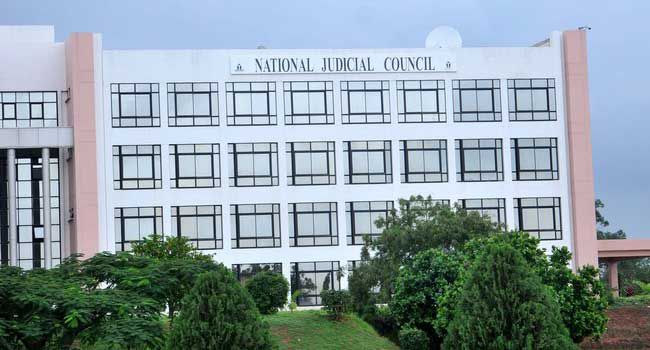
Judicial Council releases certified correspondence on activist’s case, reiterates it lacks constitutional authority to transfer cases as defence presses for reassignment over fair hearing concerns.
By Amarachi Odenigbo
Abuja, Nigeria | June 30, 2026
The National Judicial Council (NJC) has released Certified True Copies (CTCs) of its correspondence relating to the criminal prosecution of child rights activist and Convener of Operation Save Nigerian Children, Comrade Ighorhiohwunu Aghogho, clarifying that it lacks the constitutional and administrative authority to transfer or reassign pending court cases.
Instead, the Council maintained that such powers reside exclusively with the Chief Judge of the Federal High Court, effectively reaffirming the limits of the NJC’s constitutional mandate in matters relating to case assignment.
The clarification comes amid a prolonged legal dispute over Aghogho’s prosecution for alleged cyberstalking before the Federal High Court, Warri Division, and persistent efforts by his legal team to have the matter reassigned to another judge.
NJC Responds to Defence Requests
In a letter dated June 29, 2026, signed by the Secretary of the National Judicial Council, Ahmed Gambo Saleh, on behalf of the Chief Justice of Nigeria (CJN) and Chairman of the Council, Justice Kudirat Motonmori Olatokunbo Kekere-Ekun, the Council responded to fresh correspondence from Aghogho’s counsel, Andrew N. Elekeokwuri.
The requests sought updates on petitions and administrative applications connected to the criminal proceedings in Charge No. FHC/WR/92C/2022: Federal Republic of Nigeria v. Ighorhiohwunu Aghogho.
According to the NJC, it had previously responded to several petitions and requests submitted by the defence.
However, one of its replies, dated March 6, 2026, failed to reach counsel after the courier company reportedly could not locate the address provided for service.
Undelivered Letter Prompted Fresh Request
The Council disclosed that before it could formally notify the defence about the failed delivery, another letter dated June 23, 2026, was received requesting Certified True Copies of every correspondence relating to the petitions.
Consequently, the NJC attached certified copies of all previous communications and forwarded them to counsel.
The Council stated that the certified documents include both its earlier responses and the undelivered correspondence returned by the courier service.
Only Chief Judge Can Transfer Cases, NJC Insists
Perhaps the most significant aspect of the released correspondence is the Council’s repeated clarification that it possesses no authority to transfer or reassign pending court matters.
In one of the certified letters dated March 6, 2026, the NJC acknowledged receiving a request for administrative reassignment of Aghogho’s criminal case but emphasized that only the Chief Judge of the Federal High Court can exercise such powers.
The Council reaffirmed the same position in another communication dated April 8, 2026, reiterating that case assignment and reassignment fall entirely within the administrative jurisdiction of the Chief Judge.
The clarification effectively distinguishes the disciplinary and policy oversight functions of the NJC from the internal administrative powers exercised by heads of courts.
Council Advises Defence to Pursue Appeal
Beyond the issue of case reassignment, the NJC also advised the defence that where parties are dissatisfied with judicial decisions, the appropriate constitutional remedy is to pursue an appeal through the appellate courts.
The Council reminded counsel that the judicial system already provides mechanisms for reviewing decisions of trial courts.
It further urged the defence to pursue all available legal remedies rather than seeking administrative intervention beyond the Council’s constitutional powers.
Background of the Petitions
Among the documents released is an acknowledgement dated July 3, 2025, relating to a petition filed by Aghogho against Justice M. I. Sani, now serving at the Court of Appeal, and Justice H. A. Nganjiwa.
The petition reportedly alleged:
- Judicial misconduct;
- Abuse of court process;
- Corruption;
- Violations of fundamental rights.
In response, the Council advised the petitioner to explore legal remedies provided under Nigerian law where dissatisfied with judicial decisions.
The latest correspondence maintains the same position.
Defence Seeks Transfer of Warri Trial
Despite the NJC’s position, Aghogho’s legal team has continued pressing for administrative reassignment of the criminal proceedings.
In an application dated February 19, 2026, addressed to the Chief Judge of the Federal High Court, Justice John Tsoho, defence counsel requested that the case be transferred from the court of Justice H. A. Nganjiwa to another judge of coordinate jurisdiction.
The defence argues that such reassignment has become necessary to preserve public confidence in the administration of justice.
Jurisdiction Challenge Remains Unresolved
The defence has also mounted a constitutional challenge against the prosecution itself.
A Notice of Preliminary Objection, filed on October 3, 2025, questions both the competence of the criminal charge and the jurisdiction of the court.
According to the defence, Section 174(1) of the 1999 Constitution empowers only the Attorney-General of the Federation (AGF) or officers acting under his authority to institute criminal proceedings on behalf of the Federal Government.
Counsel argues that the prosecution was commenced without the authorization or consent of the Attorney-General, rendering it constitutionally defective.
These arguments remain pending because the preliminary objection has yet to be determined.
ECOWAS Court Proceedings Introduced into Defence Argument
The defence has also relied on proceedings before the ECOWAS Community Court of Justice.
According to court filings, the Attorney-General of the Federation allegedly stated in a Statement of Defence filed before the regional court on July 31, 2025, that his office was unaware of the prosecution pending before the Federal High Court in Warri.
The defence argues that this position raises important constitutional questions regarding the legality of the criminal proceedings.
These assertions remain part of the defence’s arguments and have not yet been determined by the trial court.
Recusal Request and Bail Revocation
Court documents indicate that during proceedings on February 16, 2026, Justice Nganjiwa informed counsel that petitions had been filed against him before both the NJC and the Office of the Chief Judge of the Federal High Court.
The judge also reportedly noted that his name had surfaced in proceedings before the ECOWAS Court and stated that he would await guidance from the appropriate judicial authorities before taking further steps.
Following those remarks, the defence orally requested that the judge recuse himself from the case.
The court reportedly directed counsel to file a formal application.
Meanwhile, Aghogho has remained in custody following the revocation of his bail in June 2025, while his preliminary objection challenging jurisdiction remains unresolved.
Legal Questions Raised
The case has brought several constitutional questions into focus, including:
- The respective constitutional powers of the NJC and heads of courts.
- Administrative reassignment of judges.
- Judicial recusal where allegations of bias are raised.
- The constitutional authority to institute federal criminal prosecutions.
- The right to a fair hearing within a reasonable time under Section 36 of the Constitution.
Legal analysts say the eventual outcome could clarify important issues relating to judicial administration and criminal procedure.
The National Judicial Council’s latest correspondence underscores the constitutional boundaries of its authority, making clear that requests for transferring pending cases must be directed to the Chief Judge of the relevant court rather than the Council itself.
While the defence continues to challenge both the jurisdiction of the court and the propriety of the prosecution, those issues remain for judicial determination. As such, the NJC’s correspondence should not be interpreted as expressing any view on the merits of the criminal charges or the defence’s constitutional objections.
The case remains pending before the Federal High Court, with related administrative and appellate processes continuing alongside the substantive proceedings.










Leave a Reply