
New nationwide poll reveals overwhelming support for decentralized policing, while concerns over brutality, profiling, extortion and accountability continue to shape public perception of law enforcement.
By Baron Eloagu – June 24, 2026
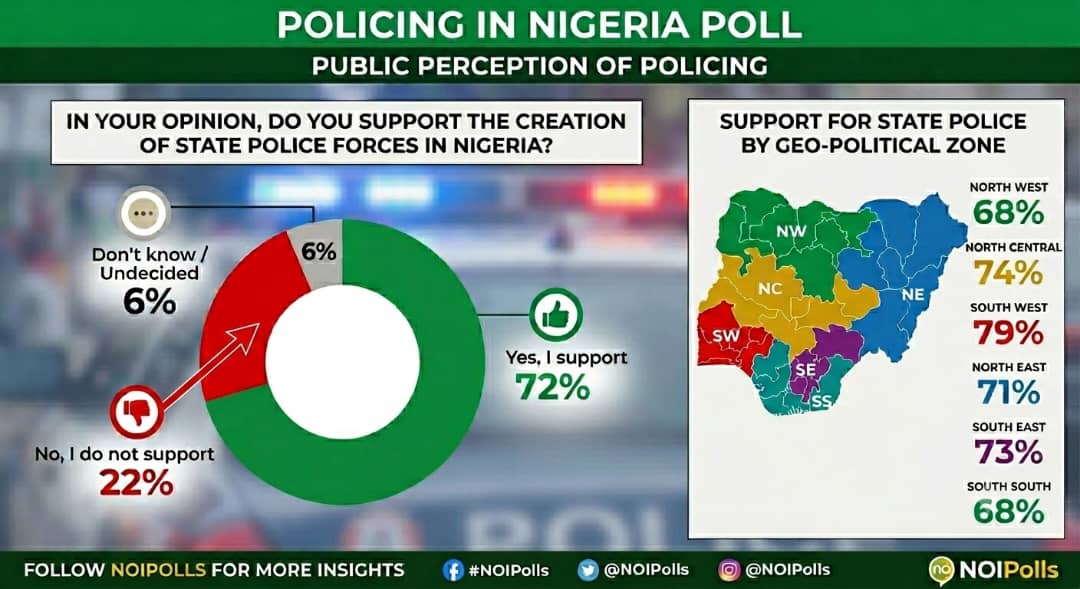
ABUJA, Nigeria – A comprehensive nationwide opinion poll conducted by NOIPolls has revealed that an overwhelming 72 percent of adult Nigerians support the establishment of State Police Services, signaling growing public demand for decentralized security management amid worsening insecurity across the country.
The survey, which examined public perceptions of policing, accountability, profiling, brutality and security reforms, also found that 40 percent of Nigerians believe police reform can only be considered genuine when young people are no longer profiled based on their appearance, vehicles, hairstyles, tattoos, or possession of laptops and other electronic devices.
The findings provide one of the most detailed snapshots of public attitudes toward law enforcement since the October 2020 #EndSARS protests that triggered nationwide demands for police accountability and institutional reforms.
Strong National Support for State Police
The poll found broad support for state policing across all six geopolitical zones.
According to the survey:
- 72% support the creation of State Police
- 22% oppose the proposal
- 79% support recorded in the South-West
- 74% support in the North-Central
- 68% support in both the North-West and South-South
The survey further revealed stronger support among women, with 78 percent backing state police compared to 66 percent among men.
Analysts say the figures reflect increasing frustration with Nigeria’s centralized policing structure and growing belief that locally controlled security institutions may respond more effectively to community-specific threats.
Public Trust in Police Remains Fragile
Despite growing support for structural reforms, the survey shows that confidence in the Nigeria Police Force remains mixed.
While 52 percent of respondents said they feel safe and reassured when they encounter police officers at checkpoints, significant regional disparities were recorded.
Safety perceptions were highest in:
- North-East (66%)
- North-West (65%)
However, trust levels dropped significantly in southern regions:
- South-South (39%)
- South-East (lower confidence levels)
- South-West (higher threat perception)
The South-South recorded the highest level of irritation toward police encounters at 22 percent.
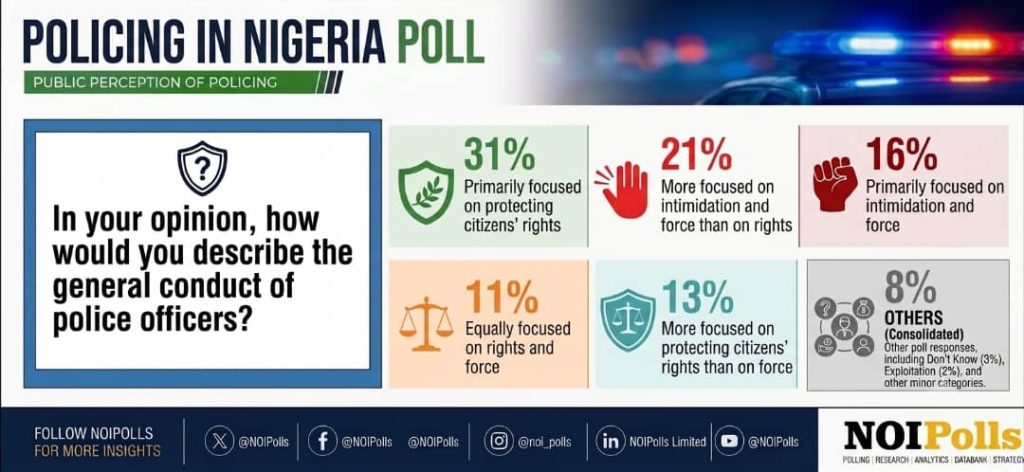
Furthermore, 37 percent of Nigerians described police conduct as being focused more on intimidation and force than on protecting citizens’ rights.
Profiling and Harassment Remain Major Concerns
One of the most troubling findings of the survey relates to appearance-based profiling.
The report revealed that:
- 33% of Nigerians said they or someone close to them had been stopped, searched, or questioned because of their appearance, hairstyle, tattoos, laptop ownership, or vehicle.
- The figure rises to 56% in the South-South.
- 43% in the South-East reported similar experiences.
- 33% in the South-West reported profiling incidents.
The findings suggest that despite reforms introduced following the #EndSARS movement, discriminatory policing practices remain widespread.
According to the report, these experiences continue to shape public attitudes toward law enforcement and police legitimacy.
Youth Believe Reform Means Freedom From Harassment
The survey found a significant generational divide regarding what constitutes genuine police reform.
Overall:
- 40% of Nigerians agreed that police reform will only be meaningful when young people can move freely without fear of profiling.
- Support for this position rises to 46% among Nigerians aged 18 to 35.
For many young Nigerians, the legacy of SARS and allegations of arbitrary arrests remain powerful symbols of police misconduct.
The poll suggests that visible behavioural change on the streets may be more important to many citizens than legislative reforms enacted in government offices.
Cybercrime Operations Viewed With Suspicion
Public opinion on anti-cybercrime policing operations remains deeply divided.
According to the findings:
- 40% of Nigerians believe cybercrime operations are often used as a cover for extortion and harassment.
- Only 26% view such operations primarily as legitimate security measures.
The skepticism is strongest in:
- North-Central
- South-South
Experts say the findings highlight the urgent need for transparency and accountability in cybercrime enforcement activities.
Nigerians Question Police Attitude Toward Youth
The survey paints a troubling picture of police-youth relations.
Key findings include:
- 38% believe police view young people as criminals or fraudsters.
- 15% say officers routinely harass and intimidate youths.
- Only 5% believe police generally view youths positively.
Observers note that rebuilding trust between security agencies and Nigeria’s youthful population remains one of the country’s most significant policing challenges.
Legal Awareness Remains Low
The poll also exposed significant gaps in public awareness regarding citizens’ rights under the Nigeria Police Act 2020.
Findings show:
- 48% are aware of protections against arbitrary arrest and profiling.
- 48% remain unaware of these rights.
Women and residents of the North-East recorded the lowest levels of legal awareness.
Legal experts say ignorance of constitutional protections weakens accountability mechanisms and leaves citizens vulnerable to abuse.
Accountability Still Faces Credibility Challenges
Although official complaint channels have been strengthened since the #EndSARS protests, public confidence remains divided.
The survey found:
- 51% believe reporting police misconduct could lead to action.
- 37% remain skeptical.
The South-South region recorded the highest level of distrust, with half of respondents believing complaints would yield no meaningful consequences.
Nigerians Demand Body Cameras and Independent Oversight
When asked what would convince them that police accountability is genuine, respondents prioritized technological monitoring and external oversight.
Preferred reforms include:
- Mandatory body cameras for tactical units (27%)
- Independent external investigative body (19%)
- Public dismissal of guilty officers (18%)
- Regular detention facility inspections (17%)
- Public complaint tracking systems (11%)
Security governance experts argue that these measures could significantly improve transparency and public confidence.
Mixed Verdict on Post-EndSARS Reforms
The survey acknowledges some progress since the October 2020 protests.
According to the findings:
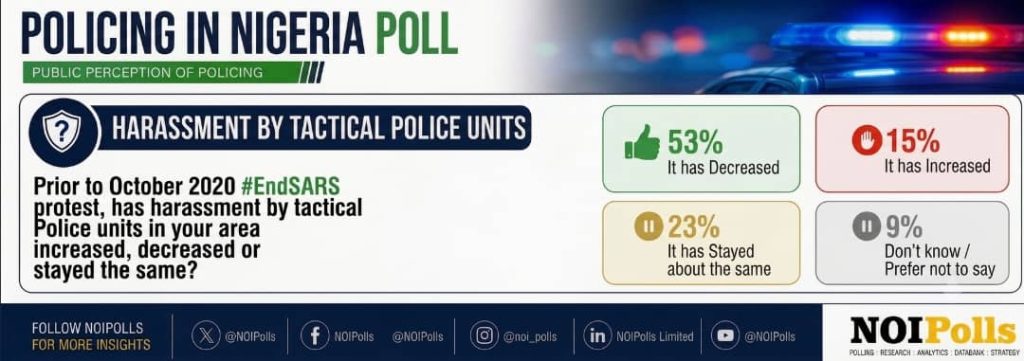
- 53% report reduced harassment by tactical police units.
- 23% believe conditions remain unchanged.
- 15% say harassment has increased.
The South-West and North-East recorded the greatest perceived improvements, while the South-South reported the least progress.
These findings suggest that while reforms have produced measurable gains, implementation remains uneven across the federation.
Experts See Blueprint for Security Reform
Policy analysts believe the poll provides valuable guidance for lawmakers currently considering constitutional amendments to establish state police.
The findings come at a critical moment as the National Assembly debates proposals that could fundamentally alter Nigeria’s security architecture.
Supporters argue that state police could enhance local intelligence gathering, community trust and rapid response capabilities.
However, experts caution that decentralization must be accompanied by strong accountability safeguards to prevent abuse and political interference.
The NOIPolls survey presents a clear message from Nigerians: citizens overwhelmingly support the creation of State Police Services but insist that institutional reforms must be matched by visible improvements in police conduct.
While many acknowledge progress since the #EndSARS movement, concerns over profiling, extortion, brutality and accountability continue to undermine public trust.
For millions of Nigerians, particularly young people, genuine reform will not be measured solely by new laws or new policing structures, but by everyday interactions that respect citizens’ rights, dignity and freedoms.
As policymakers deliberate the future of policing in Nigeria, the poll offers a data-driven roadmap for building a more accountable, community-focused and trusted security system.








Leave a Reply