
Emerging opposition coalition party opens sale of forms as Obi, Kwankwaso alliance reshapes 2027 political calculations
By Baron Eloagu – Abuja, Nigeria — May 13, 2026
The Nigeria Democratic Congress has officially unveiled its timetable and guidelines for the 2027 general elections, fixing the cost of its presidential Expression of Interest and Nomination Forms at ₦60 million.
The development marks a significant step in the consolidation of the emerging political platform, which has recently attracted several high-profile political figures, including former Labour Party presidential candidate Peter Obi and former New Nigeria Peoples Party presidential flagbearer Rabiu Musa Kwankwaso.
The party also reaffirmed its earlier decision to zone its 2027 presidential ticket to Southern Nigeria, a move already generating political debate across the country’s major power blocs.
Presidential Aspirants to Pay ₦60 Million
According to the timetable jointly signed by the party’s National Chairman, Senator Moses Zwughele, and National Secretary, Barrister Ikenna Enenweizu, aspirants seeking the NDC presidential ticket will pay ₦20 million for the Expression of Interest Form and ₦40 million for the Nomination Form.
The party announced that the sale of Expression of Interest Forms would commence on May 13, 2026, and end on May 18, 2026.
Screening and interviews for aspirants are scheduled to hold between May 19 and May 21, after which successful aspirants would proceed to purchase nomination forms.
Completed forms are expected to be submitted on or before May 25, while appeals arising from the screening process will be entertained between May 25 and May 26.
The presidential primary election is scheduled for May 29, 2026, in Abuja.
NDC Releases Comprehensive Timetable for All Elective Offices
Beyond the presidential race, the party also announced fees and timelines for governorship, National Assembly and State Assembly aspirants.
Under the approved fee structure:
- State House of Assembly aspirants will pay ₦2.5 million
- House of Representatives aspirants will pay ₦6 million
- Senate aspirants will pay ₦8 million
- Governorship aspirants will pay ₦30 million
The party stated that governorship aspirants would pay ₦10 million for the Expression of Interest Form and ₦20 million for the Nomination Form.
Primary elections for various elective offices are scheduled to hold between May 27 and May 28, 2026.
According to the party, screening for State House of Assembly aspirants will take place within their respective states, while National Assembly, governorship and presidential aspirants will be screened at the party’s national headquarters in Abuja.
Governorship primaries, the party added, will be conducted at the local government level.
NDC Introduces Concessions for Women, Persons With Disabilities
In what it described as part of efforts to deepen inclusion and internal democracy, the NDC announced discounted nomination fees for female aspirants and persons living with disabilities.
The party disclosed that women contesting elective offices on its platform would pay only 50 percent of the approved fees, while persons with disabilities would pay 25 percent across all categories.
Party officials said the policy was designed to encourage broader participation in the democratic process and reduce barriers to political involvement.
All aspirants, according to the guidelines, would also be required to sign undertakings affirming compliance with the party’s code of conduct and electoral guidelines.
Open Secret Ballot System Adopted for Primaries
The NDC further announced the adoption of an open secret ballot voting system for all primary elections.
Party leaders argued that the method would improve transparency, reduce manipulation and strengthen internal credibility ahead of the 2027 polls.
Political analysts say the decision may be aimed at differentiating the party from established political parties often criticized for opaque delegate systems and disputed primaries.
Obi, Kwankwaso Alliance Strengthens NDC’s National Profile
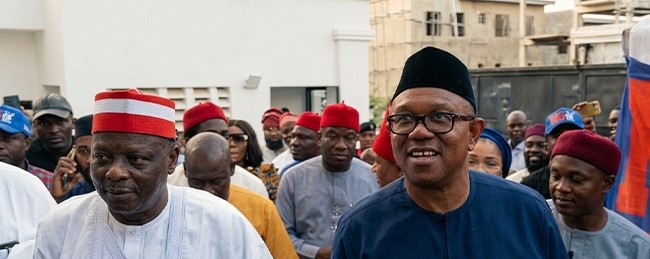
The NDC has rapidly gained national attention following the recent alignment of Obi and Kwankwaso with the platform ahead of the 2027 elections.
The two opposition figures arrived at the party’s secretariat during its inaugural national convention amid enthusiastic support from party loyalists and youth supporters.
Observers believe their involvement could significantly alter Nigeria’s opposition dynamics, particularly if broader coalition talks succeed in uniting anti-establishment political forces.
The party’s growing profile has intensified speculation about possible defections from existing opposition parties and the emergence of a formidable coalition against the ruling All Progressives Congress ahead of the next presidential election.
Dickson’s Influence and Southern Zoning Strategy
The NDC was founded under the political guidance of former Bayelsa State governor Seriake Dickson.
At its inaugural national convention held on May 9, 2026, at the Los Angeles Event Centre in Abuja, the party formally zoned its presidential ticket to Southern Nigeria.
The zoning arrangement is already fueling national political conversations regarding power rotation, regional balance and the future of Nigeria’s unwritten North-South presidential understanding.
Supporters argue that the decision aligns with principles of equity and inclusion, while critics claim it may narrow the field and complicate coalition negotiations.
Analysts Question Rising Cost of Political Participation
Despite the NDC’s claim that its fees remain lower than those charged by major political parties, some political observers argue that the increasing monetization of party nomination processes continues to limit participation by ordinary Nigerians.
Civil society groups have repeatedly criticized the high cost of nomination forms across Nigeria’s political system, warning that it favors wealthy political elites and entrenches money politics.
However, party insiders insist the fees are necessary for administrative logistics and party organization ahead of nationwide primaries.
Opposition Realignments Gather Momentum Ahead of 2027
The NDC’s latest moves come amid growing political realignments ahead of the 2027 general elections.
Multiple opposition actors are reportedly exploring coalition arrangements capable of challenging the dominance of the ruling APC and reshaping Nigeria’s political landscape.
Analysts believe the coming months could witness intense negotiations, strategic defections and alliance-building among opposition parties seeking to consolidate support bases across regions.
With the release of its 2027 election timetable and nomination guidelines, the Nigeria Democratic Congress has formally positioned itself as an emerging force in Nigeria’s evolving political terrain.
The combination of Southern presidential zoning, the entry of influential political figures such as Obi and Kwankwaso, and the party’s promise of transparent primaries signals an ambitious attempt to redefine opposition politics ahead of 2027.
However, questions remain over whether the NDC can transform growing public enthusiasm into a nationwide political structure capable of competing effectively against Nigeria’s entrenched political establishments.
For now, the race toward 2027 has entered a new phase — one defined by coalition building, political recalibration and an increasingly crowded opposition field.




Leave a Reply