
From attacks on political convoys and campaign rallies to killings, intimidation and destruction of campaign properties, escalating political violence raises fresh concerns about electoral security, public confidence and the survival of democratic participation ahead of the 2027 general elections.
By Baron Stanley Eloagu
ABUJA | November 16, 2026
INTRODUCTION
Nigeria’s political environment is witnessing an alarming escalation of violence as political parties intensify preparations for the 2027 general elections, with at least six political parties reportedly affected by attacks, intimidation, destruction of campaign properties and disruptions of political activities across several states.
An examination of incidents documented by election-monitoring organisations, civil society groups, police authorities and political stakeholders indicates that political violence is no longer an isolated feature of Nigeria’s electoral process. Instead, it is increasingly becoming a threat to freedom of political association, peaceful campaigning and citizens’ constitutional right to participate in democratic activities.
Since the Independent National Electoral Commission (INEC) officially lifted the ban on political campaigns on August 19, 2026, incidents involving attacks on political convoys, campaign gatherings, supporters and party structures have continued to generate public concern.
The violence has reportedly affected the Nigeria Democratic Congress (NDC), African Democratic Congress (ADC), All Progressives Congress (APC), Peoples Democratic Party (PDP), Accord Party and African Action Congress (AAC).
Although political parties have accused one another of sponsoring or encouraging some of the attacks, available monitoring reports suggest that no major political platform can confidently claim immunity from the growing security challenge.
More troubling is the emerging public reaction, particularly among young Nigerians, where social media discussions increasingly reflect frustration with the police, distrust of the justice system and calls for retaliatory violence.
ELECTION VIOLENCE: WHAT THE MONITORING DATA REVEALS
Three major monitoring initiatives have provided important insights into the scale of election-related violence and breaches of political peace agreements.
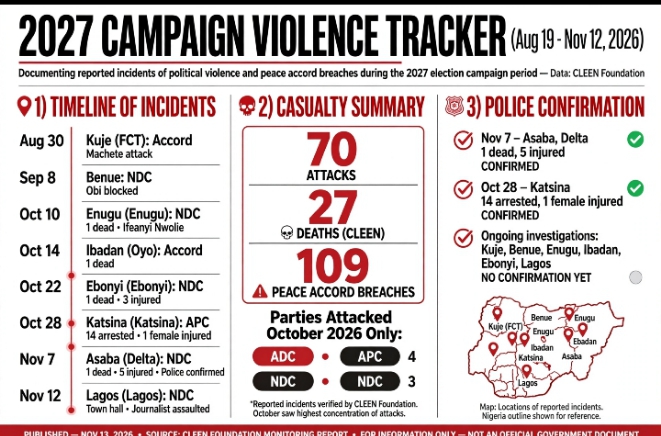
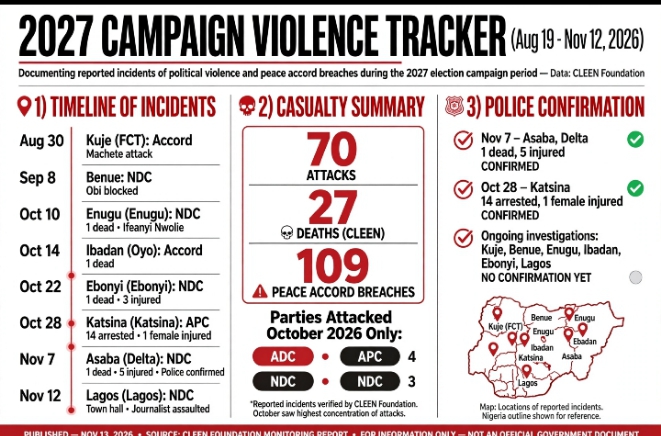
1. CLEEN Foundation and CentreSGD: 70 election-related attacks
According to figures attributed to the CLEEN Foundation and Centre for Social Governance and Development (CentreSGD), Nigeria recorded approximately 70 physical election-related attacks across 19 states and the Federal Capital Territory between January 1 and October 27, 2026.
The monitoring exercise reportedly documented 27 deaths across 20 attacks.
Kaduna, Edo and Enugu were identified as major flashpoints.
The figures are particularly concerning because they cover a period that includes both pre-campaign political activities and the officially recognised campaign season.
2. CDD Election Security Tracker: Political attacks across party lines
The Centre for Democracy and Development (CDD), through its Election Security Tracker, reportedly recorded 16 election-related incidents in October alone, representing a 14.29 per cent increase compared with September.
Eleven of the recorded incidents involved attacks on political gatherings and convoys.
The October breakdown attributed four incidents each to the APC and ADC, while the NDC recorded three.
The tracker also recorded 640 deaths from all categories of incidents during October, although only two were attributed specifically to election-related attacks in Enugu and Ebonyi.
This distinction is important: the 640 deaths should not be interpreted as fatalities from political violence.
3. National Peace Committee: 109 breaches of the Peace Accord
The National Peace Committee reportedly documented 109 breaches of the Peace Accord between August 19 and October 27, 2026.
Of these:
- 33 involved political violence and thuggery.
- 19 involved attacks on campaign assets.
- 15 involved intimidation and threats.
The figures point to a troubling gap between political parties’ public commitments to peaceful elections and the conduct of some supporters and political actors on the ground.
The Peace Accord, signed by representatives of 19 political parties on August 18, was intended to promote peaceful political competition and discourage electoral violence.
However, the subsequent incidents raise questions about the effectiveness of voluntary political commitments without credible enforcement mechanisms.
TIMELINE: MAJOR POLITICAL VIOLENCE INCIDENTS
The following timeline highlights reported incidents before and after the official commencement of the 2027 election campaign season.
PRE-CAMPAIGN INCIDENTS
May 21, 2026 – Kosofe, Lagos State
An APC House of Assembly primary election at Ikosi Senior High School was reportedly disrupted by violence, leaving several people injured.
May 26, 2026 – Bauchi State
A PDP governorship affirmation exercise reportedly witnessed the vandalisation of vehicles, raising concerns about internal party tensions and political intolerance.
June 9, 2026 – Ile-Ife, Osun State
Three people were reportedly injured during an APC political procession involving governorship aspirant Bola Oyebamiji at Sabo.
INCIDENTS SINCE THE OFFICIAL CAMPAIGN COMMENCEMENT
September 8 – Benue State
The presidential campaign convoy of the NDC’s Peter Obi was reportedly obstructed during a political movement in Benue State.
September 12 – Enugu State
Reports emerged of attacks on an NDC ward meeting and a PDP political rally, further highlighting the vulnerability of political gatherings.
October 6 – Igueben and Ikpoba-Okha, Edo State
Political activities involving the ADC and NDC reportedly came under attack.
An ADC convoy associated with party chieftain Kenneth Imansuangbon was attacked in Igueben, with Jerry Oliha reportedly shot and injured.
In a separate incident, the NDC secretariat in Ikpoba-Okha was reportedly vandalised, while party billboards were destroyed.
Another attack was reported against the convoy of ADC senatorial candidate Herberta Okonofua.
October 10 – Enugu State
Violence reportedly disrupted an NDC campaign launch organised under the leadership of governorship candidate Chinyeaka Ohaa.
One supporter, identified as Ifeanyi Nwolie, reportedly died from gunshot injuries sustained during the incident.
The gathering was also reportedly affected by violence during the reception of supporters at Akanu Ibiam International Airport.
October 14 – Mokola, Ibadan, Oyo State
A political procession associated with Accord governorship candidate Oriyomi Hamzat reportedly came under attack.
The incident reportedly resulted in one death, adding to concerns about the safety of political supporters participating in campaign activities.
October 22 – Ebonyi State
Gunmen reportedly attacked the convoy of NDC candidate Rollins Offia-Nwali.
One person was reportedly killed, three others injured, while a vehicle belonging to the candidate was set ablaze.
The candidate reportedly escaped the attack.
October 28 – Malumfashi-Funtua Road, Katsina State
An APC convoy travelling to participate in a political flag-off involving President Bola Tinubu and Governor Dikko Radda was attacked by suspected political thugs.
Katsina State Police Command spokesperson DSP Abubakar Sadiq Aliyu confirmed the incident and disclosed that 14 suspects, aged between 17 and 35, were arrested.
According to the police account, the suspects allegedly used knives and stones to attack the convoy and passing commercial vehicles, smashing windscreens.
A female passenger reportedly sustained injuries.
However, a subsequent investigation published by TheCable on November 4 alleged that the 14 suspects had been released without charge, reportedly following the intervention of a presidential aide.
The allegation raises questions about accountability and the independence of investigations into political violence. The reported intervention has not been independently established.
October 28-30 – Sokoto State
An ADC women’s solidarity march reportedly came under attack.
Separately, the convoy of governorship candidate Manir Muhammad Dan’iya reportedly faced gunfire at Sultan Abubakar III International Airport on October 30.
October 30 – Ado-Ekiti, Ekiti State
The campaign team of African Action Congress presidential candidate Omoyele Sowore reportedly came under attack.
November 4 – Calabar, Cross River State
The NDC convoy associated with Peter Obi was reportedly attacked by individuals armed with machetes and sticks.
Windscreens of vehicles were reportedly smashed during the incident.
November 5 – Kebbi State
The convoy of ADC presidential candidate Atiku Abubakar reportedly came under attack.
The incident attracted condemnation from Amnesty International, which raised concerns about the deteriorating security environment surrounding political participation.
November 7 – Asaba, Delta State
A procession involving NDC supporters, the Obidient Movement and the OK Movement along Nnebisi Road in Asaba reportedly degenerated into violence.
The Delta State Police Command confirmed one death and five injuries, alongside the vandalisation of several vehicles.
The deceased was subsequently identified as Chinaza Sunday, reportedly a member of the COMTOA task force.
Police spokesperson SP Bright Edafe stated that security intelligence had indicated the possibility of violence before the procession.
According to the police, organisers had been invited to a security meeting and advised against proceeding with an open-road procession.
The NDC subsequently claimed that individuals identified as political thugs attacked its supporters and alleged that two attackers died during the confrontation. That additional casualty claim has not been independently verified.
November 12 – Oregun, Ikeja, Lagos State
One of the most disturbing recent incidents occurred during an NDC town hall meeting featuring Peter Obi at Classique Event Centre, Oregun.
Suspected political thugs reportedly invaded the venue armed with cutlasses, cudgels and stones.
Reports indicated that at least five gunshots were heard during the confrontation.
Journalist Samuel Adebanjo was reportedly assaulted, while media equipment was seized and glass installations damaged.
The disturbance reportedly extended beyond the event centre, resulting in a street confrontation that lasted approximately one hour.
One suspected attacker was reportedly beaten by members of the crowd before being handed over to the police.
The incident has generated renewed concerns about the safety of journalists covering political events and the increasing exposure of media professionals to politically motivated attacks.
WHICH POLITICAL PARTIES HAVE BEEN ATTACKED?
Available monitoring reports and documented incidents identify at least six political parties whose activities or supporters have reportedly been affected.
1. Nigeria Democratic Congress (NDC)
The NDC appears prominently in the documented incidents, particularly those involving Peter Obi and other party activities.
Reported incidents include attacks in Benue, Enugu, Ebonyi, Cross River, Delta and Lagos.
The Enugu, Ebonyi and Asaba incidents reportedly resulted in three deaths.
However, the casualty figures should be understood as reported deaths associated with specific incidents, not a comprehensive independently audited total.
2. African Democratic Congress (ADC)
The ADC reportedly recorded four incidents in the October monitoring period.
Reported attacks include incidents involving political convoys in Edo and Kogi, a political meeting in Anambra, and activities in Sokoto.
The reported November attack in Kebbi involving Atiku Abubakar’s convoy has further heightened concerns about the safety of the party’s political activities.
3. All Progressives Congress (APC)
Despite being the ruling party, the APC has also reportedly experienced political violence.
The October tracker attributed four incidents to the party.
The October 28 attack on its convoy in Katsina is among the incidents that attracted police confirmation.
This demonstrates that political violence is not necessarily restricted to opposition parties.
4. Peoples Democratic Party (PDP)
The PDP has reportedly experienced disruptions involving political consultations and gatherings.
Reported incidents include the disruption of its political activities in Bauchi and Enugu, as well as an incident involving political consultations in Calabar.
5. Accord Party
The attack on supporters participating in the October 14 political procession associated with governorship candidate Oriyomi Hamzat in Ibadan reportedly resulted in one death.
6. African Action Congress (AAC)
The campaign team of presidential candidate Omoyele Sowore reportedly experienced an attack in Ado-Ekiti on October 30.
The incident reinforces concerns about the vulnerability of smaller political parties and their candidates.
PUBLIC OPINION: WHEN POLITICAL FRUSTRATION BECOMES A CALL FOR RETALIATION
Beyond the physical attacks, another worrying development is emerging from social media discussions.
An analysis of approximately 50 viral posts and their comment sections between November 4 and November 12 reportedly revealed increasingly hostile reactions to political violence.
Three dominant themes emerged.
1. The emergence of the ‘Aura for Aura’ and ‘Rig and Kpai’ mentality
One of the most disturbing trends is the growing popularity of retaliatory language among sections of politically engaged social media users.
Expressions such as “Rig and die”, “Aura for aura” and “violence for violence” have reportedly appeared repeatedly in discussions surrounding political attacks.
Some commenters have openly suggested that supporters should abandon documentation and legal complaints in favour of physical confrontation.
A frequently circulated expression was:
“If they bring violence, we will deal with them.”
Other comments suggested that political supporters would no longer tolerate attacks without retaliating.
The circulation of videos showing individuals being beaten during political confrontations has also generated celebrations among some social media users.
This development deserves serious attention.
When citizens begin to regard violence as an acceptable means of political self-defence, the distinction between victims and perpetrators becomes increasingly blurred.
More importantly, it creates an environment in which organised political violence can escalate into widespread communal and electoral insecurity.
2. Growing distrust of the police and criminal justice system
Another dominant theme is public scepticism about the ability of security agencies to investigate and prosecute political violence impartially.
Comments such as “Police go still free am” reflect a perception among some Nigerians that individuals arrested for politically motivated violence may eventually escape prosecution.
The controversy surrounding the reported release of the 14 suspects arrested in Katsina has further contributed to these concerns.
The situation is particularly worrying against the backdrop of a reported Yiaga Africa September survey indicating that 61 per cent of respondents feared violence could prevent them from voting.
The reported figure rose to 78 per cent in the North-East.
Although fear does not automatically translate into voter abstention, such findings suggest that insecurity could undermine voter confidence and participation.
3. Political parties trade accusations
The attacks have also intensified accusations among competing political interests.
Some opposition supporters have accused the ruling APC of tolerating or sponsoring political thuggery.
Others have made allegations linking political violence to attempts to intimidate opposition candidates and weaken their electoral support.
On the other hand, some APC supporters have argued that opposition parties are staging or exaggerating attacks to damage the ruling party’s reputation.
There are also suggestions that internal party disagreements may explain some incidents.
However, allegations of sponsorship, orchestration or political responsibility must be established through credible investigations rather than social media speculation.
Civil society organisations, including the Violence Against Individuals Initiative (VAI), SERAP and CentreSGD, have reportedly condemned political violence and called for accountability irrespective of party affiliation.
SERAP DEMANDS ACTION FROM INEC
The Socio-Economic Rights and Accountability Project (SERAP) has reportedly given INEC a seven-day ultimatum, dated November 14, to obtain relevant police investigation files and ensure that individuals suspected of involvement in political violence are prosecuted.
The organisation reportedly invoked provisions of the Electoral Act 2026, including Sections 96, 97 and 120.
The reported provisions prescribe penalties for relevant electoral offences, including fines and imprisonment.
SERAP’s intervention highlights an important institutional question: whether Nigeria’s electoral management and law enforcement institutions are prepared to enforce electoral laws without political interference.
An electoral framework is only as effective as the institutions responsible for implementing it.
If political violence produces no meaningful legal consequences, campaign-season agreements and public condemnations risk becoming ceremonial exercises.
HOUSE OF REPRESENTATIVES OPENS INVESTIGATION
The House of Representatives has reportedly established an ad hoc committee to investigate political violence ahead of the 2027 general elections.
The committee, chaired by Julius Ihonvbere, was reportedly constituted on November 12.
The investigation provides an opportunity for the National Assembly to examine the circumstances surrounding attacks on political gatherings, the conduct of security agencies, the protection of candidates and supporters, and the effectiveness of existing electoral safeguards.
However, Nigerians will expect more than hearings and recommendations.
The ultimate test will be whether the investigation produces actionable recommendations, institutional reforms and accountability for those responsible.
TINUBU CONDEMNS POLITICAL VIOLENCE
President Bola Ahmed Tinubu reportedly issued a statement on November 13 condemning political violence and warning against the use of intimidation during political campaigns.
The President stated:
“Violence should never have a place in our political campaigns.”
He also called on security agencies to confront political thuggery with full force.
The presidential intervention is significant, particularly because the ruling party has a constitutional and political responsibility to ensure that the democratic process remains peaceful and competitive.
However, the public reaction suggests that many Nigerians want concrete action rather than another expression of concern.
For citizens who have witnessed repeated attacks, arrests without prosecution and continuing political intimidation, the credibility of the government’s response will depend on arrests, transparent investigations and successful prosecutions.
THE BIGGER QUESTION: IS NIGERIA PREPARING FOR AN ELECTION OR A POLITICAL CONFRONTATION?
The pattern of reported attacks raises questions that extend beyond the immediate security of political candidates.
Nigeria’s democracy depends on the ability of political parties to organise, campaign, mobilise supporters and compete for public office without fear of violence.
The constitutional right to freedom of association and peaceful assembly cannot be meaningful if political gatherings become potential targets for armed groups.
There is also a significant economic and institutional dimension.
Political violence discourages investment, weakens public confidence in democratic institutions, increases the cost of election security and potentially creates conditions for post-election instability.
More importantly, normalising political intimidation could gradually transform elections from a contest of ideas and public policy into a struggle for physical dominance.
The danger is particularly pronounced when political supporters begin to believe that violence is the only effective response to violence.
Such a development could produce a cycle of retaliation that becomes increasingly difficult for security agencies to contain.
WHAT MUST BE DONE?
The following measures deserve urgent consideration:
1. Independent investigations: Police authorities should investigate every reported attack, identify sponsors and perpetrators, and publish credible updates on the progress of investigations.
2. Equal protection for political parties: Security agencies must protect candidates and supporters irrespective of political affiliation.
3. Prosecution without political interference: Individuals arrested for electoral violence should face due process, and politically influential individuals must not be shielded from accountability.
4. Protection of journalists: Media professionals covering political activities must receive adequate protection against assault, intimidation and destruction of equipment.
5. Enforcement of the Peace Accord: INEC and the National Peace Committee should establish stronger monitoring and accountability mechanisms for political parties and their supporters.
6. Responsible political communication: Political leaders must discourage inflammatory rhetoric, hate speech and the mobilisation of supporters for confrontation.
7. Protection of voters: Security planning must prioritise the safety of voters, especially in areas identified as electoral violence flashpoints.
CONCLUSION: DEMOCRACY CANNOT SURVIVE ON THE POLITICS OF INTIMIDATION
The reported attacks involving at least six political parties reveal a troubling dimension of Nigeria’s preparations for the 2027 general elections.
From Katsina to Enugu, Ebonyi, Delta, Lagos, Edo and other affected states, the incidents demonstrate that political violence remains a serious threat to electoral credibility and democratic participation.
The available figures are not a single consolidated casualty register, and the incidents require further independent verification. Nevertheless, the convergence of election-monitoring reports, police confirmations and civil society interventions provides sufficient grounds for urgent concern.
The most disturbing development may not be the number of political gatherings attacked or campaign vehicles destroyed. It is the growing public acceptance of retaliatory violence as an alternative to legal accountability.
A democracy in which citizens are afraid to attend political meetings, journalists cannot safely cover campaigns and supporters consider physical confrontation a legitimate political response is a democracy under considerable strain.
The 2027 general elections should be decided by votes, public arguments, political programmes and the free choice of citizens — not by intimidation, weapons or the strength of organised political gangs.
President Tinubu, INEC, the police, political parties, the National Assembly and civil society organisations must recognise that the credibility of the 2027 elections is already being tested.
Nigeria cannot afford an election in which political victory is determined by who can mobilise the most intimidating crowd. The ballot must remain stronger than the bullet.
KEY FINDINGS
| Indicator | Reported findings |
|---|---|
| Official campaign commencement | August 19, 2026 |
| Peace Accord signing | August 18, 2026 |
| Political parties signing the Accord | 19 |
| Physical election-related attacks | 70 |
| States and FCT covered | 19 states + FCT |
| Deaths attributed to 20 attacks | 27 |
| Peace Accord breaches | 109 |
| Political violence/thuggery breaches | 33 |
| October incidents recorded by CDD | 16 |
| Parties prominently identified as victims | At least 6 |
| Major monitoring flashpoints | Kaduna, Edo and Enugu |
Casualty clarification: The reported 27 deaths cover the January 1–October 27 monitoring period and must not be confused with deaths occurring exclusively after the official campaign commencement. The October tracker separately attributed two deaths to election-related attacks. The incident-specific casualty figures cited in this report also require reconciliation to avoid double-counting.
SOURCES AND ATTRIBUTION
The report draws on information attributed to:
- Independent election-related violence monitoring by CLEEN Foundation and CentreSGD.
- Centre for Democracy and Development (CDD) Election Security Tracker.
- National Peace Committee monitoring of Peace Accord breaches.
- Nigeria Police Force and relevant state police commands.
- SERAP’s November 14, 2026, intervention concerning electoral violence.
- Yiaga Africa’s September 2026 voter security survey.
- Amnesty International’s condemnation of reported attacks.
- House of Representatives’ reported establishment of an ad hoc investigative committee.
- Media reports, including TheCable and News Central.
- Publicly available political statements and social media reactions.
Editorial note: Social media comments are illustrative of online reactions, not representative scientific polling of Nigerian public opinion. Allegations of political sponsorship and unverified casualty claims should not be treated as established facts.
Baron Stanley Eloagu is an editor, Public Opinion Analyst for over two decades now





Leave a Reply