
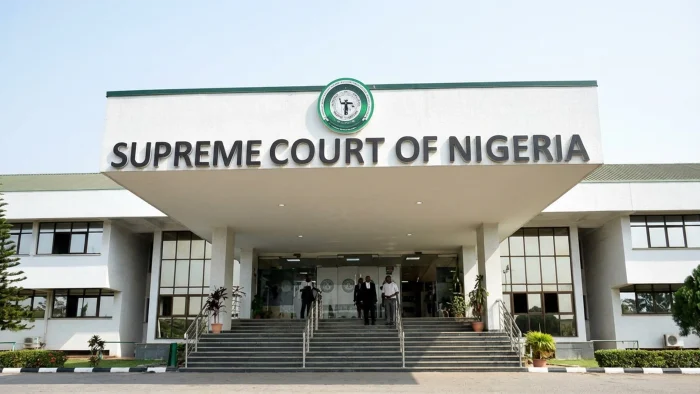
Apex Court Dismisses Police Appeal, Affirms Compensation for Victims of Controversial Kwale Raid and Prolonged Detention
By Obehi Ojo – June 20, 2026
ABUJA, NIGERIA – The Supreme Court of Nigeria has affirmed a ₦10.5 million damages award against the Nigeria Police Force (NPF) for violating the fundamental rights of residents of Delta State, dismissing appeals filed by senior police authorities challenging earlier judgments against them.
In a landmark ruling that reinforces constitutional protections against unlawful arrest and detention, the apex court upheld decisions of both the Federal High Court and the Court of Appeal, Asaba Division, which found the police liable for violating the right to personal liberty of several residents allegedly affected by a controversial security operation in Delta State’s Kwale axis.
The judgment represents a significant victory for human rights advocates and affected families who have long sought justice over allegations of unlawful arrests, prolonged detention, and abuses linked to the operation.
Police Lose Final Bid to Overturn Judgment
The appeals, marked SC/CV/833/2024 and SC/CV/834/2024, were filed by the Commissioner of Police, Delta State Command; the Assistant Inspector-General of Police, Zone 5; and the Inspector-General of Police.
Among the respondents were Sunday Mbam, Jennifer Ogborgu, Ernest Ezenem, and other residents whose cases stemmed from an alleged police raid conducted in communities around the Kwale area of Delta State.
The respondents reportedly represented families and individuals affected by the operation, with allegations that some residents were unlawfully arrested, detained, and in certain cases killed following the raid.
In a majority decision delivered on Friday, Justice Abubakar Sadiq, who read the lead judgment, resolved all issues raised by the police authorities against them and affirmed the lower courts’ findings.
The Supreme Court consequently upheld the award of ₦10 million in aggravated and exemplary damages as well as ₦500,000 in litigation costs against the police.
Personal Liberty Remains a Sacred Constitutional Right
In a strongly worded judgment, Justice Sadiq emphasized that the right to personal liberty remains one of the most fundamental guarantees enshrined in Nigeria’s Constitution.
According to him, courts have an obligation to protect citizens from arbitrary exercises of state power.
The fundamental right to personal liberty is one of the cornerstones of human rights and a bedrock principle in any society governed by the rule of law.
The court cited Section 35 of the 1999 Constitution (as amended), which guarantees every Nigerian protection from unlawful arrest and detention.
Justice Sadiq stressed that security agencies, regardless of their mandate, must operate within constitutional boundaries and remain accountable when those rights are breached.
Evidence Linked Police to Kwale Operation
A major issue before the court was whether the respondents successfully established that police officers were responsible for the arrests and detentions complained of.
The Supreme Court found that available evidence—including a public interview granted by a police spokesperson and subsequently published in The Pointer newspaper—confirmed that armed police officers conducted operations within the Kwale axis during the relevant period.
The police had attempted to argue that the affected communities, particularly Etua-Oliogo and Etua-Etiti, were not directly connected to the operation referenced in the publication.
However, the court rejected that argument.
Justice Sadiq held that the communities where the respondents were arrested fell within the geographical scope of the police operation.
It is safe to conclude that since the appellant admitted that Kwale communities in Ndokwa West Local Government Area of Delta State were part of the area raided, the affected communities were among those where the operation was carried out.
The court further held that the police failed to provide sufficient evidence to disprove allegations that the respondents were arrested and detained during the operation.
Court Defends Award of Damages
Another key issue in the appeal was whether the Court of Appeal acted properly in awarding damages despite the respondents not filing a cross-appeal challenging the trial court’s refusal to grant monetary compensation.
The police argued that the appellate court exceeded its authority by awarding damages in the absence of such a cross-appeal.
The Supreme Court disagreed.
Justice Sadiq ruled that the Court of Appeal validly exercised its powers under Section 15 of the Court of Appeal Act, which empowers appellate courts to make decisions necessary to achieve substantial justice.
The apex court relied on the legal doctrine of “ubi jus ibi remedium”—meaning “where there is a right, there is a remedy.”
According to the court, once a violation of a constitutional right is established, compensation may be awarded as an appropriate remedy.
Where a legal right is violated, the law provides remedy either in damages or other appropriate relief.
The court concluded that the Court of Appeal exercised its discretion properly and reasonably when it awarded damages to the victims.
Police Criticized Reliance on Newspaper Evidence
Representing the police authorities, Dr. Richard Ishiguzo of the Directorate of Legal Services, Delta State Police Command, had urged the Supreme Court to overturn the lower courts’ decisions.
He argued that there was no direct evidence linking police officers to the alleged violations and contended that the courts relied heavily on assumptions and media reports rather than credible proof.
According to him, the newspaper interview relied upon by the respondents did not specifically mention the affected communities and therefore could not establish police culpability.
The police also maintained that the damages award lacked legal foundation.
However, the apex court found otherwise, holding that the totality of the evidence before the courts sufficiently connected the police operation to the violations complained of.
Dissenting Justice Sides With Police
Despite the majority ruling, the judgment was not unanimous.
In a dissenting opinion, Justice Adhumien disagreed with the conclusions reached by the majority panel and resolved the issues in favour of the police authorities.
The details of the dissent highlighted differing judicial interpretations regarding the evidential burden required to establish liability in fundamental rights enforcement proceedings.
Nonetheless, the majority judgment remains the binding decision of the Supreme Court.
Implications for Human Rights Enforcement
Legal analysts say the judgment is likely to strengthen accountability standards for law enforcement agencies and reinforce judicial protection of constitutional rights.
The ruling also underscores the judiciary’s willingness to award monetary compensation where violations of fundamental rights are established, even in circumstances where procedural technicalities are raised to challenge such reliefs.
For victims of alleged abuses by security agencies, the decision signals that constitutional remedies remain available through the courts and that state institutions can be held accountable for unlawful conduct.
With the dismissal of the police appeals, the Supreme Court has brought to a close a prolonged legal battle over alleged rights violations arising from a controversial police operation in Delta State. The judgment not only secures compensation for the affected residents but also reinforces a key constitutional principle: that personal liberty remains inviolable and that violations by state authorities must attract effective legal remedies.









Leave a Reply