

Incumbent Governor Defeats PDP, ADC Rivals by Wide Margin Amid High Voter Turnout and Extensive Result Transmission
By Aderonke Unigbe – June 21, 2026
ADO-EKITI, NIGERIA — Governor Biodun Oyebanji of the All Progressives Congress (APC) has been declared the winner of the 2026 Ekiti State governorship election, securing a second term in office after a commanding victory across the state’s 16 local government areas.
The Independent National Electoral Commission (INEC) announced the result in the early hours of Sunday following the completion of collation at the state collation centre in Ado-Ekiti.
Declaring the result at approximately 3:13 a.m., the Returning Officer for the election, Professor Adenike Oladiji, Vice-Chancellor of the Federal University of Technology, Akure, said Oyebanji polled 319,224 votes to overwhelmingly defeat his closest challengers.
According to the official results, the Peoples Democratic Party (PDP) candidate, Oluwole Oluyede, garnered 40,543 votes, while Dare Bejide of the African Democratic Congress (ADC) secured 12,872 votes.
The outcome represents one of the widest governorship victory margins recorded in Ekiti State’s recent electoral history.

APC Dominates Across Local Government Areas
Results announced by INEC showed that Governor Oyebanji established an early lead and maintained dominance across virtually all local government areas of the state.
The APC candidate recorded significant victories in key voting centres, including:
- Ado-Ekiti LGA – 38,026 votes
- Irepodun/Ifelodun LGA – 29,278 votes
- Ekiti West LGA – 28,258 votes
- Ikole LGA – 26,508 votes
- Ekiti East LGA – 26,359 votes
- Ijero LGA – 25,506 votes
- Moba LGA – 20,500 votes
The PDP’s strongest performance came in Ikere Local Government Area, where Oluwole Oluyede polled 9,892 votes against Oyebanji’s 11,116 votes, making it one of the closest contests in the election.
Political analysts say the results indicate broad voter endorsement of the incumbent governor’s administration across both urban and rural communities.
Voter Participation and Election Statistics
INEC disclosed that a total of 384,940 voters were accredited during the election.
Of this figure:
- Valid votes: 375,777
- Rejected votes: 6,332
- Total votes cast: 382,109
Voting commenced officially at about 8:31 a.m. across the state and concluded at approximately 2:30 p.m., although some polling units extended voting to accommodate voters affected by accreditation delays.
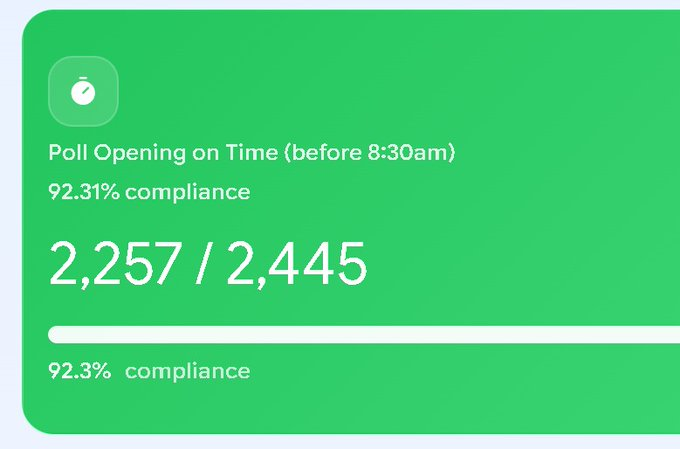
The commission reported that all 2,445 polling units opened successfully, with over 92 percent commencing operations on schedule.
Technology Enhances Transparency
One of the defining features of the election was the extensive use of the Bimodal Voter Accreditation System (BVAS) and the INEC Result Viewing Portal (IReV).
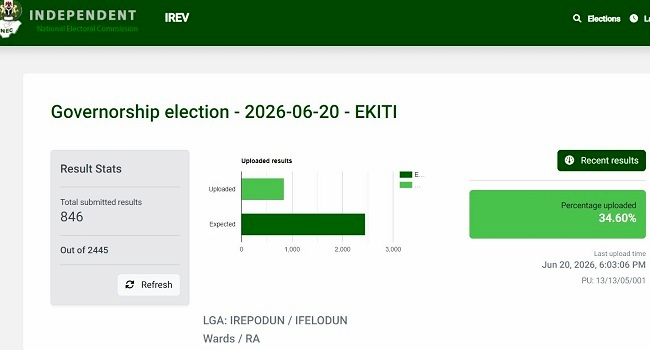
Throughout the day, INEC uploaded polling unit results to the portal, enabling voters, political parties, and election observers to monitor the process in real time.
By late Saturday night, more than 97 percent of polling unit results had been uploaded to the portal, significantly boosting public confidence in the transparency of the process.
Election observers described the transmission rate as one of the highest recorded in recent off-cycle elections.
Mixed Reactions Trail Election Conduct
While many stakeholders commended the peaceful conduct of the poll, some concerns emerged during the exercise.
The PDP candidate, Oluwole Oluyede, raised concerns over BVAS accreditation challenges at his polling unit and alleged irregularities in certain locations.
Similarly, ADC candidate Dare Bejide expressed concerns regarding reports of vote buying.
However, the Commissioner of Police overseeing election security, CP Abayomi Shogunle, stated that security agencies received no official reports of vote buying throughout the exercise.
Election observer groups also acknowledged isolated incidents but generally described the election as orderly and largely peaceful.
Security Agencies Maintain Tight Control
Security personnel from the Nigeria Police Force, Nigerian Army, Nigeria Security and Civil Defence Corps (NSCDC), and other agencies maintained a strong presence throughout the election.
Authorities confirmed the arrest of one suspect linked to an attempted ballot box snatching.
Yiaga Africa reported 24 incidents of election-related disturbances across 10 local government areas, though none significantly disrupted the overall conduct of the election.
Observers noted that the coordinated security deployment contributed to maintaining stability during the poll.
What Oyebanji’s Victory Means
Governor Oyebanji’s re-election is widely viewed as a major political victory for both the APC and President Bola Tinubu’s administration.
Earlier in the day, Kaduna State Governor Uba Sani described the election as a referendum on the APC’s governance record and acceptance among voters in Ekiti State.
The overwhelming margin of victory is expected to strengthen the APC’s political influence in the South-West and provide momentum for future electoral contests.
For the opposition, the outcome may trigger internal reviews as parties assess their performance and strategies ahead of upcoming elections.

With the declaration of Biodun Oyebanji as winner of the 2026 Ekiti governorship election, attention now shifts from campaigns and voting to governance and policy implementation.
The election showcased the growing role of technology in electoral transparency while highlighting ongoing concerns over voter inducement and isolated operational challenges.
As Ekiti residents await the commencement of Oyebanji’s second term, the results have reaffirmed the APC’s dominance in the state and underscored the importance of credible electoral processes in strengthening Nigeria’s democracy.











Leave a Reply