
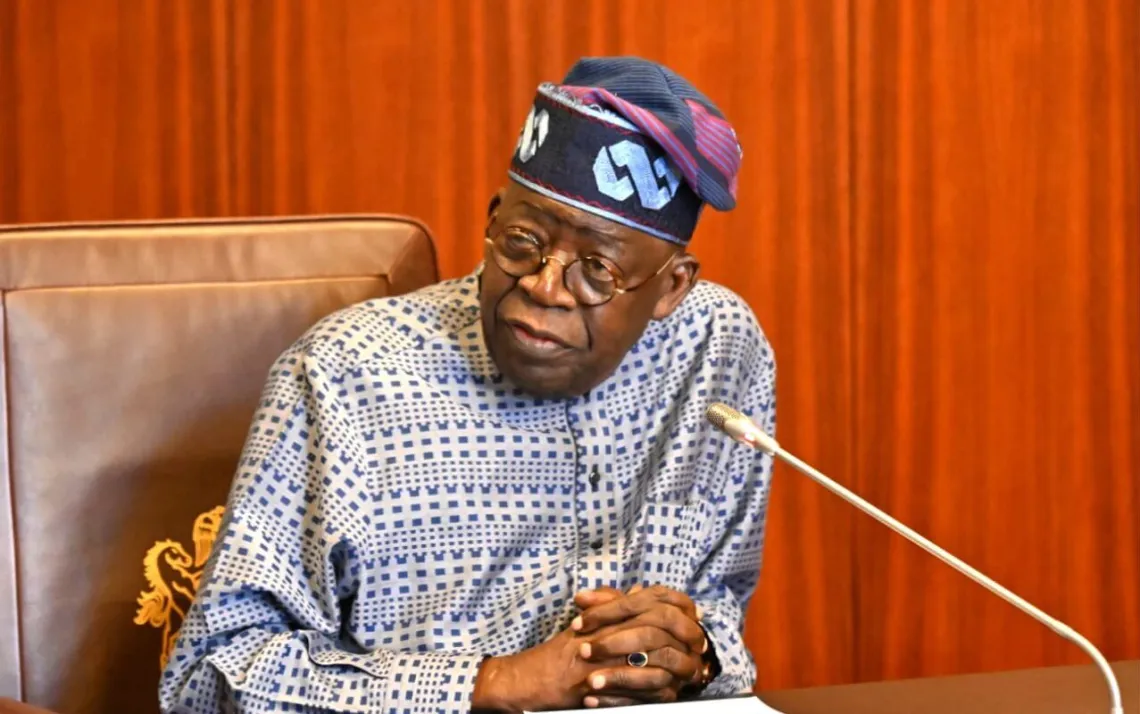
President directs anti-corruption commission to unravel forged appointments, fake government documents, bank accounts and alleged institutional failures behind the controversial Presidential Foreign Intervention Promotion Council.
By Baron Eloagu
ABUJA, Nigeria — July 8, 2026
President Bola Ahmed Tinubu has ordered the Independent Corrupt Practices and Other Related Offences Commission (ICPC) to conclude a comprehensive investigation within 30 days into the activities of the controversial Presidential Foreign Intervention Promotion Council (PFIPC)—an organisation the Presidency insists never existed under Nigerian law.
The directive comes amid mounting public outrage over revelations that the purported government agency allegedly operated from official premises, maintained government-related bank accounts, engaged diplomatic missions and even secured a N1.3 billion allocation in the 2026 Appropriation Act, despite lacking any legal or executive foundation.
As the Presidency moves to contain the fallout, the Senate has rejected suggestions that it bears responsibility for the scandal, insisting the matter remains before the courts and originated within the Executive.
Presidency Declares Council Illegal
The directive was announced on Tuesday in a statement issued by the President’s Special Adviser on Information and Strategy, Bayo Onanuga.
According to the Presidency, the so-called Presidential Foreign Intervention Promotion Council was never created by the Federal Government and has no legal basis under any:
- Act of the National Assembly;
- Presidential Instrument;
- Executive approval; or
- Other lawful government authority.
The Presidency described the organisation as entirely fictitious.
Tinubu Orders Wide-Ranging Investigation
President Tinubu instructed the ICPC to conduct a full-scale investigation into every aspect of the alleged scheme and submit its findings within 30 days.
The investigation will cover:
- The alleged forgery of presidential appointment letters.
- Fake government documents purportedly issued in the name of the Presidency.
- Claims by Adeniyi Adeyemi Mathew, who allegedly presented himself as Director-General of the council.
- Alleged attempts to obtain official recognition and diplomatic privileges.
- The opening and operation of bank accounts in the names of non-existent government agencies.
- The movement and source of funds linked to the operation.
- The possible involvement of public officials, financial institutions, intermediaries or private individuals.
According to the Presidency, investigators are also expected to identify institutional weaknesses that allowed the alleged fraud to acquire an appearance of legitimacy.
Government Agencies Ordered to Cooperate
President Tinubu directed all Ministries, Departments and Agencies (MDAs) to provide the ICPC with unrestricted access to records and information relevant to the investigation.
The President stressed that protecting the credibility of government institutions remains paramount.
“The integrity of the Presidency and the institutions of the Federal Government must be protected against impersonation, forgery, abuse of official identity and the exploitation of weaknesses in the public service.”
He further directed that anyone found culpable should face prosecution in accordance with Nigerian law.

How Did a Non-Existent Agency Receive N1.3 Billion?
One of the central questions surrounding the scandal remains how an agency the Presidency insists never existed appeared in the 2026 Federal Budget with an allocation of approximately N1.3 billion.
The revelation has generated widespread concern among governance experts, anti-corruption advocates and legal practitioners.
Beyond the budgetary allocation, reports indicate that the alleged council also:
- Operated from offices within the Federal Secretariat.
- Opened accounts reportedly linked to government institutions, including the Central Bank of Nigeria.
- Communicated officially with government agencies.
- Interacted with foreign diplomatic missions.
- Allegedly received invitations connected with legislative activities.
The breadth of these activities has raised questions about possible institutional failures across multiple government agencies.
Forgery Allegations Against Suspect
At the centre of the controversy is Adeniyi Adeyemi Mathew, who allegedly claimed to have been appointed Director-General of the council.
According to the Presidency, forensic analysis conducted by the Nigeria Police concluded that the signature of the President’s Chief of Staff, Femi Gbajabiamila, appearing on the disputed appointment documents, was forged.
Speaking on the development, Presidential spokesman Bayo Onanuga said investigators found that the appointment letters and supporting documents were fake.
Police have already filed criminal charges against Adeyemi before the Federal High Court in Abuja on allegations bordering on conspiracy, forgery and impersonation.
The accused has denied wrongdoing.
Falana Questions Broader Institutional Failures
Human rights lawyer Femi Falana (SAN), who represents Adeyemi, has argued that the investigation should extend beyond his client.
Falana questioned how a supposedly fictitious agency managed to secure budgetary allocation and official recognition if the appointment documents were indeed forged.
He has urged investigators to examine all officials who may have processed or approved documents relating to the council.
The Presidency, however, maintains there is no evidence linking Chief of Staff Femi Gbajabiamila to the alleged scheme.
Police Release Suspect’s Father
Meanwhile, the Nigeria Police Force has released Adeyemi’s father after questioning him over the whereabouts of his son.
The elderly man was reportedly detained after officers failed to locate the suspect during a visit to the family residence.
The action attracted criticism from Falana, who described the arrest as unlawful and argued that family members should not be subjected to intimidation.
According to the senior advocate, Adeyemi has appeared before the court on previous occasions and remains willing to continue defending himself through the judicial process.
The next hearing in the criminal case has been scheduled for July 27, 2026.
Senate Rejects Responsibility
As pressure mounted over the controversial budget allocation, the Senate firmly distanced itself from the scandal.
Speaking after plenary, Chairman of the Senate Committee on Media and Publicity, Senator Yemi Adaramodu, acknowledged that the disputed budget line exists in the 2026 Appropriation Act.
However, he rejected claims that lawmakers created the agency or inserted the allocation.
According to him, the matter is now sub judice, making legislative intervention inappropriate at this stage.
He argued that the controversy remains fundamentally an Executive matter.
The senator further stated that the National Assembly would only investigate the issue if a formal petition is submitted by any concerned individual or organisation.
Institutional Accountability Under Scrutiny
The scandal has exposed potential weaknesses across several public institutions.
Reports suggest that official correspondence from the alleged council was processed by government offices months before the Presidency publicly denied its existence.
Questions have also emerged regarding:
- Budget screening procedures.
- Verification of presidential appointments.
- Internal controls within the Office of the Head of the Civil Service.
- Oversight by the Budget Office.
- Administrative checks across relevant MDAs.
Governance experts argue that the investigation may ultimately reveal systemic failures extending beyond the actions of any single individual.
Thirty-Day Deadline Raises Expectations
By imposing a strict 30-day timeline, President Tinubu has signalled the administration’s intention to swiftly address one of the most embarrassing cases of alleged government impersonation in recent years.
Analysts say the outcome of the ICPC investigation could shape future reforms aimed at strengthening document verification, appointment authentication and inter-agency coordination within the Federal Government.

The unfolding PFIPC scandal has evolved from allegations of forgery into a broader examination of Nigeria’s administrative safeguards and public accountability systems.
While the Presidency insists the council never legally existed, unanswered questions remain over how it allegedly secured official recognition, operated within government circles and appeared in the national budget.
With the ICPC now under presidential directive to complete its investigation within 30 days, attention will focus on whether the probe uncovers isolated acts of fraud or deeper institutional failures that enabled the alleged scheme to flourish.
A1NEWS International will continue to follow developments and provide balanced, factual reporting as the investigation progresses.






Leave a Reply