
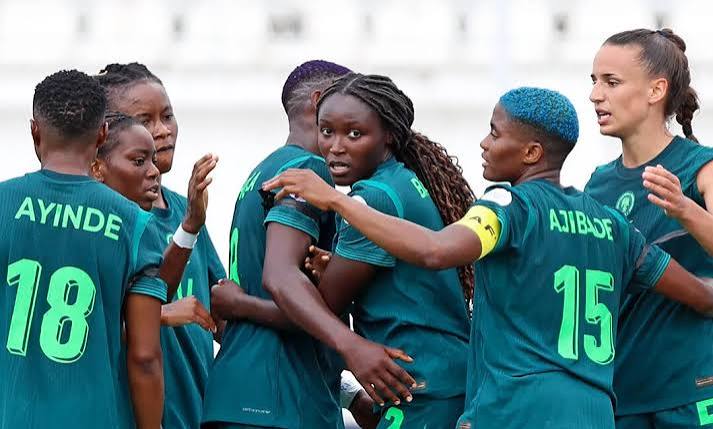
Nyadjou’s 19th-minute free-kick ends Nigeria’s title defence as Cameroon reach the semi-finals and secure a direct place at the 2027 FIFA Women’s World Cup
By A1NEWS International
CASABLANCA, Morocco — August 10, 2026
Nigeria’s Super Falcons have suffered a major setback in their bid to retain the Women’s Africa Cup of Nations (WAFCON) title, losing 1-0 to Cameroon in a tense quarter-final encounter in Casablanca.
The defeat ended Nigeria’s campaign and denied the defending champions an automatic qualification place for the 2027 FIFA Women’s World Cup in Brazil. Under the tournament’s qualification format, the quarter-final winners secure direct World Cup qualification, while the defeated teams enter a play-in route for a possible place in the inter-confederation play-offs.
For Cameroon, the victory represented one of the tournament’s biggest upsets and sent the Indomitable Lionesses into the semi-finals, where they will face hosts Morocco.
Nyadjou Delivers Decisive Blow
The match was settled in the 19th minute when 19-year-old Myriam Nyadjou produced a decisive free-kick.
Nyadjou’s rising effort beat Nigeria goalkeeper Chiamaka Nnadozie, finding the corner of the net and giving Cameroon a lead that Nigeria ultimately failed to overturn.
It was Nyadjou’s first goal of the tournament and proved sufficient to eliminate the defending champions. Contemporary reports confirm the 1-0 scoreline and Nyadjou’s decisive 19th-minute strike.
Super Falcons Search for Equaliser
Nigeria responded by increasing the pressure, particularly as the match progressed.
The Super Falcons created opportunities but struggled to find the decisive final touch against a Cameroon defence that held firm.
Cameroon goalkeeper Michaely Bihina played a central role in protecting the lead, making important interventions as Nigeria pushed forward.
The defining opportunity came deep into stoppage time.
Esther Okoronkwo won possession from Bihina and attempted to guide the ball into the far corner, but her effort drifted wide.
It proved to be Nigeria’s final realistic opportunity to force the match towards an equaliser.
Oshoala Introduction Fails to Change Outcome
Nigeria also turned to veteran attacking firepower in the closing stages.
Six-time African Women’s Footballer of the Year Asisat Oshoala was introduced after reportedly not being sufficiently fit to start.
The decision reflected the urgency facing the Super Falcons as they searched for a way back into the contest.
However, Oshoala could not produce the intervention Nigeria needed before the final whistle.
Cameroon held on to complete a famous victory.
Cameroon Breaks Nigeria’s WAFCON Dominance
The result carries particular significance given the history between the two teams.
Nigeria entered the tournament as defending champions and as the most successful nation in WAFCON history.
Cameroon, meanwhile, had won only one of their previous 13 meetings with Nigeria at the competition before Sunday’s quarter-final, according to the supplied match report.
The victory therefore represents a significant shift in the rivalry and one of the most consequential results of Cameroon’s campaign.
Nigeria’s World Cup Route Becomes More Complicated
The immediate consequence is the loss of Nigeria’s opportunity to qualify automatically for the 2027 Women’s World Cup through a WAFCON semi-final place.
However, the defeat does not necessarily end Nigeria’s World Cup qualification hopes.
The tournament’s qualification structure provides a secondary route for quarter-final losers through play-in matches, with successful teams advancing to the inter-confederation play-offs.
That means Nigeria’s campaign has changed from a direct qualification race into a more difficult qualification pathway.
The Super Falcons must now recover quickly if they are to maintain their record of appearing at every Women’s World Cup since the tournament’s inception.
A Rare Early Exit for the Super Falcons
Nigeria’s elimination is particularly significant because of the team’s extraordinary record in African women’s football.
The Super Falcons are the continent’s most successful WAFCON side and have traditionally been a dominant force in the competition.
Their early elimination therefore represents more than the loss of a single quarter-final.
It raises questions about Nigeria’s attacking efficiency, squad preparation, tactical execution and ability to respond when opponents adopt a compact defensive approach.
The defeat also demonstrates how dramatically the competitive landscape of African women’s football has changed.
Nigeria can no longer rely solely on historical dominance to overcome increasingly organised opponents.
Cameroon Marches Into Semi-Finals
Cameroon’s reward for eliminating Nigeria is a semi-final meeting with Morocco.
The hosts will enter the encounter with the advantage of home support and the momentum of their own campaign, while Cameroon will carry the confidence generated by eliminating the defending champions.
The other side of the semi-final bracket features Malawi against Ghana, with the winner scheduled to face Algeria in the other semi-final according to the supplied tournament information.
What Went Wrong for Nigeria?
The result demands a closer examination of Nigeria’s performance.
1. Early defensive lapse
Nigeria conceded in the opening 20 minutes, forcing the team to chase the game for the majority of the contest.
2. Ineffective finishing
The Super Falcons created pressure but failed to convert their opportunities into an equaliser.
3. Cameroon goalkeeper’s performance
Bihina’s saves became increasingly important as Nigeria intensified its attack.
4. Late introduction of Oshoala
Nigeria’s decision to introduce Oshoala late reflected the attacking problems confronting the team, but there was insufficient time for the experienced forward to alter the outcome.
5. Increased African competition
Cameroon’s victory is another indication that Nigeria’s traditional dominance is being challenged by increasingly competitive African women’s teams.
The Bigger Question for Nigerian Football
The defeat should not be assessed solely as a single-match failure.
Nigeria’s elimination raises broader questions about the country’s preparation for major women’s competitions.
The Super Falcons remain one of Africa’s strongest women’s teams, but sustained continental dominance requires continuous investment in player development, tactical preparation, sports science, coaching structures and domestic women’s football.
The loss also demonstrates the consequences of entering knockout football without sufficient margin for error.
One goal was enough to end Nigeria’s title defence.
World Cup Qualification Now Becomes the Priority
The WAFCON title is gone, but Nigeria’s broader objective is not necessarily over.
The immediate priority for the Super Falcons is now to navigate the World Cup qualification play-in route and preserve their historic participation record.
Nigeria’s previous World Cup campaign ended at the Round of 16 at the 2023 tournament in Australia and New Zealand, where the Falcons were eliminated by England on penalties.
The team’s next challenge is therefore not simply rebuilding confidence after the Cameroon defeat.
It is ensuring that Sunday’s result does not develop into a much bigger failure by costing Nigeria a place at the 2027 World Cup.
Cameroon’s 1-0 victory over Nigeria has brought an abrupt end to the Super Falcons’ WAFCON title defence and deprived them of the opportunity to secure direct qualification for the 2027 Women’s World Cup through the tournament’s semi-finals.
Nyadjou’s early free-kick proved decisive, while Cameroon’s defensive resilience and Bihina’s goalkeeping denied Nigeria the equaliser it desperately needed.
For Cameroon, the result is a landmark achievement.
For Nigeria, it is a warning.
The Super Falcons remain one of Africa’s most decorated women’s football teams, but their elimination shows that historical dominance offers no protection in a tournament where the competitive gap is narrowing.
The immediate task is now clear: recover, secure the alternative World Cup qualification route and ensure that one disappointing night in Casablanca does not end Nigeria’s long-standing presence on the global women’s football stage.








Leave a Reply