
By A1NEWS International
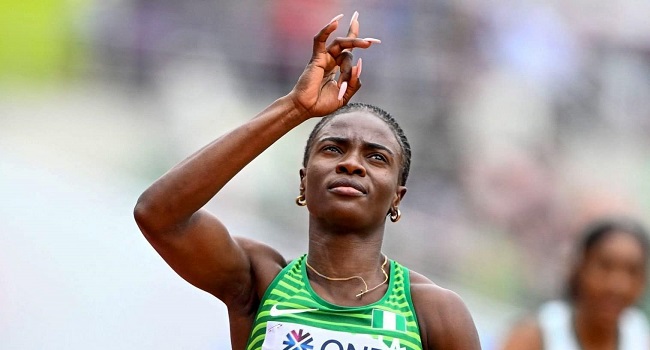
BUDAPEST, Hungary — Nigeria’s Tobi Amusan has secured a silver medal in the women’s 100m hurdles at the inaugural World Athletics Ultimate Championship, finishing behind American Olympic champion Masai Russell in a race that underscored both the Nigerian star’s resilience and the rapidly intensifying competition at the top of the event.
Amusan clocked 12.34 seconds to finish second, while Russell claimed the inaugural title in 12.22 seconds. The Netherlands’ Nadine Visser completed the podium in 12.39 seconds.
The Budapest final marked another significant chapter in Amusan’s career, but it also highlighted a changing balance of power in women’s sprint hurdling.
Russell arrived in Hungary as the clear favourite after taking down Amusan’s long-standing world record with a 12.09-second performance at the Zurich Diamond League in August. She then carried that momentum into Budapest, extending an unbeaten 2026 campaign that has already produced major victories.
Her latest triumph came shortly after her Diamond League Final victory in Brussels, reinforcing her emergence as one of the dominant forces in the event.
Amusan Responds After Difficult Season
For Amusan, however, the silver medal represented more than a place on the podium.
The former world record holder entered the championship following a turbulent stretch in which she had struggled to reproduce the consistency that previously established her among the world’s leading hurdlers.
She finished third at the Commonwealth Games before Russell broke her world record in Zurich. Amusan subsequently placed fourth at the Diamond League Final.
Against that backdrop, she approached the Budapest final with a determination to leave everything on the track.
“First, God is good,” Amusan said after the race.
She acknowledged that her season had taken a physical and emotional toll.
“What started off as an amazing season, you know, in between I had some nipping here and there. You know, I’m not a robot. You know, the body did shut down at a point.”
Rather than allowing those setbacks to derail her campaign, Amusan said she focused on rebuilding her momentum race by race.
‘We Die Here’: Amusan’s Mindset in Budapest
The Nigerian revealed that her approach to the final was deliberately uncompromising.
“Coming into this championship, my mindset going to the line was, ‘We die here.’ I just kept telling myself I have to give it my all,” she said.
Amusan said she had resolved to accept whatever result followed, provided she gave maximum effort.
“All I knew was, look, I did it. That’s all I knew. And the second I saw the second-place finish, I was like, look, I can’t complain. God is good,” she said.
The response reflects the psychological battle surrounding elite sport, particularly for an athlete who has spent years competing under the expectation of winning.
Support Network Helped Amusan Rebuild Confidence
Amusan also pointed to the role of her support network in helping her recover from a difficult period.
She credited her family, mentor, coach and boyfriend with helping restore her confidence after the setbacks.
“I’m not going to lie. It was very rough,” Amusan said.
“I mean, to my family, to my mentor, to my coach, to my boyfriend. That’s brought life back into me.”
According to the Nigerian star, encouragement from those closest to her helped her shift attention away from previous disappointments and concentrate on the Budapest final.
“This morning it was all about put the past behind you and just go for it. And those few sentences that I got here and there got me to this finish line today,” she said.
Silver Medal Sends Warning to Rivals
While Amusan fell short of the title, she regarded the result as evidence that she remains a major contender.
She described the silver medal, alongside her Commonwealth Games medal, as a statement following a difficult period.
“With the Commonwealth medal, it is a statement,” she said.
Her comments point to a wider story emerging in the women’s 100m hurdles: the gap between the leading competitors is narrowing, while the standard required to win major championships continues to rise.
Russell’s world-record performance in Zurich has changed the competitive landscape, but Amusan’s 12.34-second performance in Budapest demonstrates that the Nigerian remains capable of challenging the new benchmark.
‘The Women’s Hurdles Is Just Getting Scarier’
Amusan offered perhaps her strongest warning when discussing the future of the event.
“Honestly, in that event, I think I would be the sleeping lion,” she said.
“I think the women’s hurdles is just getting scarier every damn year. Next year, I do not know what’s going to happen. But it’s going to be bloody.”
The remark captures the increasingly unpredictable nature of women’s sprint hurdling.
With Russell now holding the world record and Amusan determined to reclaim the summit, the next phase of the rivalry could become one of the defining storylines in the event.
For Amusan, the Budapest silver medal may therefore prove less a symbol of defeat than a marker of resurgence.
She did not leave Hungary with the inaugural Ultimate Championship title. But after a season of setbacks, she left with renewed confidence, a major medal and a warning to the rest of the field: the former world record holder is not finished.
Tobi Amusan’s silver medal in Budapest represents a significant recovery in a season marked by physical struggles, a lost world record and disappointing finishes. Masai Russell’s victory confirms the American’s extraordinary 2026 form, but Amusan’s 12.34 seconds shows that the Nigerian remains firmly among the elite.
The rivalry has changed. Russell currently owns the world record and the latest major victories, but Amusan has signalled that the fight for supremacy is far from over.
The next chapter of women’s 100m hurdles could be even faster, more competitive — and considerably more difficult to predict.










Leave a Reply