
As Nigeria prepares for 2027, INEC warns of systemic constraints, pledges improvements while managing expectations over technology, logistics, and political pressure
By Baron Stanley Eloagu | Abuja, Nigeria
With Nigeria’s 2027 general elections officially scheduled, the Chairman of the Independent National Electoral Commission (INEC), Prof. Joash Amupitan, has cautioned Nigerians against expecting a flawless electoral process.
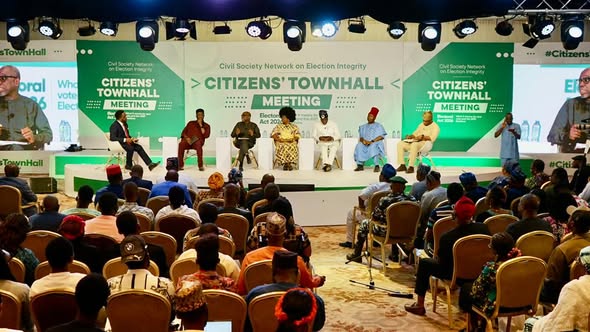
Speaking during a nationally televised Citizens’ Town Hall on the Electoral Act 2026, the INEC boss acknowledged persistent systemic challenges, even as he assured that the commission remains committed to delivering its most credible election yet.
Electronic Transmission: Assurance With Conditions
At the centre of the credibility debate is the electronic transmission of results—a contentious issue since the 2023 elections.
Amupitan affirmed that INEC possesses the capacity for electronic transmission and intends to deploy it. However, he introduced a significant caveat: real-time transmission cannot be guaranteed in all locations.
He cited the recent Federal Capital Territory Area Council election, where results from Kabi Ward in Kuje were delayed by 24 hours due to poor terrain and communication network failure. According to him, polling officials became unreachable, forcing the commission to send verification teams before collation could proceed.
The development highlights a critical vulnerability—if connectivity challenges can disrupt processes within Abuja, concerns deepen over rural, riverine, and security-compromised regions nationwide.
Logistics: INEC’s Persistent Weak Link
The INEC chairman was unequivocal about the centrality of logistics to electoral integrity.
“An election is only as good as its logistics,” he stated, admitting to operational lapses and human errors in past exercises.
Historically, Nigeria’s elections have been undermined less by voting procedures and more by logistical inefficiencies, including:
- Delayed arrival of sensitive materials
- Incomplete or inconsistent result uploads
- Collation bottlenecks
- Legal disputes arising from flawed party primaries
While INEC’s acknowledgement signals institutional awareness, it also underscores a long-standing challenge that reforms alone have yet to resolve.
Electoral Act 2026: Reform Under Scrutiny
INEC is currently reviewing its regulatory framework to align with the Electoral Act 2026, which introduces sweeping changes to political party operations, candidate nomination processes, and digital compliance requirements.
The reform initiative, supported by the Westminster Foundation for Democracy, aims to strengthen internal party democracy, improve financial transparency, and reduce pre-election disputes.
Under the revised electoral timetable:
- Presidential and National Assembly elections are slated for January 16, 2027
- Governorship and State Assembly elections will follow on February 6, 2027
- Political parties must submit verified digital membership registers by April 2, 2026
However, the reduction of the notice period from 360 to 300 days—following a Senate amendment—has drawn criticism from stakeholders who argue that it compresses preparation timelines, particularly for opposition parties.
Digital Membership Drive: Reform or Restriction?
Major political parties are already moving to comply with INEC’s digital membership requirements.
The Peoples Democratic Party (PDP) has launched a nationwide electronic registration exercise, while the African Democratic Congress (ADC) has introduced an online revalidation platform for members. The ruling All Progressives Congress (APC) is also reportedly reactivating its e-registration portal.
Although digital registers are designed to eliminate “ghost” memberships and reduce disputes arising from party primaries, critics warn that compliance deadlines could evolve into regulatory bottlenecks capable of excluding weaker political actors.
INEC, however, insists the reforms are preventive—aimed at shifting electoral management from reactive enforcement to proactive oversight.
Litigation Risks and Trust Deficit
Pre-election litigation remains a major threat to electoral stability in Nigeria. Disputes over opaque primaries, financial irregularities, and exclusionary practices have historically altered candidate lists weeks before elections.
INEC maintains that its revised guidelines will reduce avoidable court cases. However, analysts argue that the effectiveness of these reforms will depend largely on consistent and impartial enforcement across both ruling and opposition parties.
Expectation Versus Reality
Amupitan linked voter education to democratic consolidation, echoing the principle that ballots must prevail over violence. Yet public confidence in Nigeria’s electoral process remains fragile, particularly after controversies surrounding the 2023 elections.
His dual message—that 2027 will be Nigeria’s “best election” while also conceding that perfection is unattainable—captures the tension between ambition and structural limitation.
Key Unanswered Questions
As preparations intensify, several critical issues remain unresolved:
- Will electronic transmission be enforced uniformly across all polling units?
- What contingency plans exist for network failures in remote or conflict-prone areas?
- Can digital party registers genuinely reduce litigation, or merely shift disputes to data integrity concerns?
- Will regulatory enforcement be applied equitably across political parties?
Conclusion
With less than a year to critical pre-election deadlines, Nigeria’s electoral credibility battle is already underway. While INEC signals reform and political parties claim compliance, voter skepticism continues to grow.
In a high-stakes democratic environment, the margin for error is narrowing—and as experience suggests, when logistics fail, public trust often follows.











Leave a Reply