
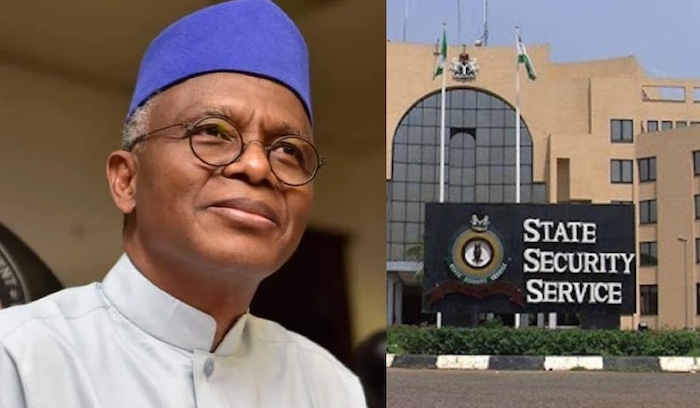
Former Kaduna governor remains in custody over alleged wiretapping, money laundering and abuse-of-office charges as family raises health concerns and lawyers challenge stringent bail conditions.
By Zakari Mohammed / June 24, 2026
ABUJA, Nigeria — Former Kaduna State Governor, Mallam Nasir El-Rufai, has now spent 126 days in detention following his arrest and prosecution on multiple charges, including alleged unlawful interception of communications involving the National Security Adviser (NSA), Mallam Nuhu Ribadu.
The prolonged detention has reignited national debate over bail administration, judicial discretion, due process, and the rights of accused persons awaiting trial, especially as the former governor’s legal team continues to battle what it describes as unusually stringent bail conditions.
On Tuesday, a Federal High Court sitting in Abuja adjourned proceedings in El-Rufai’s wiretapping case until September 22, 2026, after the prosecution formally closed its case.
If he remains in custody until the next hearing date, El-Rufai will have spent approximately 217 days behind bars since his detention began on February 16, 2026.
Court Adjourns Trial After DSS Closes Case
Proceedings before Justice Joyce Abdulmalik took a significant turn when counsel to the Department of State Services (DSS), Mr. Oluwole Aladedoye (SAN), informed the court that the prosecution had concluded its evidence after presenting two witnesses.
The witnesses included a DSS operative and Abuja-based lawyer and activist, Deji Adeyanju, who testified concerning statements allegedly made by El-Rufai during a televised interview.
Following the closure of the prosecution’s case, lead defence counsel, Chief Paul Erokoro (SAN), indicated that the defence intends to file a no-case submission, arguing that the prosecution failed to establish a prima facie case requiring El-Rufai to enter a defence.
The court granted both parties time to file their respective processes and adjourned proceedings until September 22.
The Charges Against El-Rufai
The DSS is prosecuting the former governor under Charge No. FHC/ABJ/99/2026, accusing him of unlawfully intercepting communications linked to the National Security Adviser.
Prosecutors allege that El-Rufai admitted during a television interview that he and others listened to conversations involving Ribadu.
The charges are based on provisions of the Cybercrimes (Prohibition, Prevention, Etc.) Amendment Act and relevant sections of the Nigerian Communications Act.
El-Rufai has consistently denied all allegations and pleaded not guilty.
Apart from the Abuja proceedings, the former governor is reportedly facing other legal challenges in Kaduna State relating to allegations of financial misconduct and abuse of office.
How El-Rufai Ended Up in Custody
The former governor’s legal troubles escalated dramatically in February when he honoured an invitation from the Economic and Financial Crimes Commission (EFCC).
Sources familiar with the matter disclosed that after extensive questioning by anti-corruption investigators, he was transferred to the Independent Corrupt Practices and Other Related Offences Commission (ICPC).
Shortly thereafter, reports emerged that operatives of the DSS also became involved in the investigation.
The ICPC later confirmed that El-Rufai was in its custody.
Since then, his efforts to secure release through court-approved bail have remained unsuccessful.
Court Refuses To Relax Bail Conditions
A major development during Tuesday’s proceedings was the court’s refusal to vary existing bail conditions.
El-Rufai’s legal team argued that the conditions imposed by the court are nearly impossible to satisfy.
The requirements include:
- A federal civil servant not below Grade Level 17;
- A surety residing in either Maitama or Asokoro districts of Abuja;
- Ownership of landed property in those locations;
- Submission of the original Certificate of Occupancy;
- Verification and attestation documents;
- Bank confirmation and salary records;
- Affidavit of means and bail bond documentation.
According to the defence, despite extensive efforts, no suitable surety meeting all requirements has been found.
However, the prosecution opposed the application, insisting that qualified individuals who satisfy the conditions exist.
Justice Abdulmalik agreed with the prosecution and held that the defence failed to provide sufficient legal grounds to justify altering the bail terms.
Family Raises Alarm Over Health Concerns
As the legal battle drags on, members of El-Rufai’s family have expressed growing concerns about his health.
A family source disclosed that medical specialists at the National Hospital, Abuja, have reportedly raised concerns about symptoms related to prostate complications.
According to the source, doctors are monitoring his condition closely amid fears that prolonged health challenges could worsen if not adequately managed.
The family acknowledged that authorities have permitted medical consultations and access to food from relatives but insist that his overall condition has deteriorated significantly during detention.
No official medical report has yet been released publicly regarding the claims.
Allegations of Politically Motivated Bail Conditions
Family members and supporters have also questioned the similarity of bail conditions imposed in multiple courts handling separate cases involving the former governor.
According to them, several courts in Abuja and Kaduna have imposed conditions requiring highly placed public servants and owners of expensive properties in elite neighbourhoods.
They argue that the cumulative effect of these requirements amounts to a denial of bail by administrative means.
The prosecution and government authorities have repeatedly rejected allegations of political persecution, maintaining that all proceedings are being conducted strictly within the law.
NBA Raises Concern Over Stringent Bail Conditions
The controversy surrounding El-Rufai’s detention gained additional attention on Tuesday when Nigerian Bar Association (NBA) President, Afam Osigwe (SAN), criticised what he described as increasingly punitive bail practices across the criminal justice system.
Speaking at a meeting with the Inspector-General of Police in Abuja, Osigwe warned that many bail conditions imposed by courts and law enforcement agencies appear designed to prevent suspects from obtaining release.
He argued that the growing insistence on directors, senior civil servants and wealthy property owners as sureties has created a “black market” for bail arrangements.
The NBA President urged judicial authorities and law enforcement agencies to return to the constitutional principle that bail conditions should be reasonable and intended solely to guarantee appearance in court.
Broader Questions About Justice and Due Process
Legal analysts say the El-Rufai case has evolved beyond the allegations against the former governor and now raises broader questions about the administration of criminal justice in Nigeria.
Among the issues attracting public attention are:
- The balance between national security and civil liberties;
- The constitutional right to bail;
- Judicial discretion in setting bail conditions;
- The speed of criminal trials involving high-profile defendants;
- Oversight of detention facilities and treatment of detainees.
Observers note that the outcome of the case could establish important precedents for future prosecutions involving public office holders and politically exposed persons.
With the prosecution having formally closed its case and the defence preparing a no-case submission, the next phase of the trial may prove decisive for Nasir El-Rufai.
For now, the former governor remains in detention after more than four months in custody, while legal battles over bail conditions, health concerns, and allegations of political targeting continue to dominate public discourse.
As Nigeria awaits the court’s next sitting on September 22, the case remains one of the country’s most closely watched political and judicial developments.


Leave a Reply