
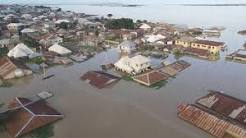
Thousands forced into overcrowded shelters as homes, roads, and farmlands are destroyed across 10 local government areas amid growing fears of humanitarian and food security crisis
By Hassan Jinjiri / DUTSE, Jigawa State / August 28, 2024
A devastating flood disaster has swept across several communities in Jigawa State, killing at least 16 people, displacing thousands of residents, and destroying homes, roads, and agricultural lands in what authorities describe as one of the worst flooding incidents in recent years.
The catastrophic flooding, triggered by days of intense rainfall, affected at least 10 local government areas, leaving widespread destruction and forcing displaced families into overcrowded temporary shelters.
Officials of the Jigawa State Emergency Management Agency warned that the scale of the humanitarian crisis could worsen without urgent intervention, especially as critical infrastructure and food-producing farmlands remain severely impacted.
Thousands Displaced, Homes Destroyed
Speaking during a press briefing in Dutse, Executive Secretary of the State Emergency Management Agency, Haruna Mairiga, disclosed that at least 3,834 residents had been displaced by the disaster.
According to the agency, approximately 3,936 homes were destroyed while 2,744 hectares of farmland were submerged and washed away by floodwaters.
“This is one of the most severe floods we have experienced in recent years,” Mairiga stated.
“The damage is extensive, and our hearts go out to families who have lost loved ones and those displaced from their homes.”
Emergency officials said entire communities were overwhelmed as floodwaters rapidly spread across residential and farming areas.
Victims Recount Terrifying Escape
Survivors described scenes of panic and desperation as floodwaters engulfed homes with little warning.
Displaced residents are currently sheltering in public school buildings and emergency locations, many under difficult sanitary and living conditions.
A resident of Gwaram Local Government Area, Hajara Musa, recounted how her family narrowly escaped the disaster.
“We had no warning. Suddenly, the water was everywhere,” she said emotionally.
“It rose so fast that we barely had time to grab our children and run. Everything we had is gone.”
In Kafin Hausa Local Government Area, farmer Adamu Garba described losing his entire rice plantation to the floods.
“I have lost my entire rice farm. This is our source of income, and now we have nothing left,” he lamented.
Agricultural experts warn that the destruction of thousands of hectares of farmland could deepen food shortages and worsen inflationary pressures in affected communities.
Key Transport Routes Severely Disrupted
Beyond residential destruction, the floods also caused major disruption to transportation and commercial activities.
Authorities confirmed that a major road linking parts of northwestern Nigeria to northeastern states was cut off by floodwaters, leaving motorists stranded and disrupting the movement of goods and services.
Officials of the Federal Roads Maintenance Agency acknowledged the severity of the infrastructure damage.
Assistant Zonal Coordinator Abba Baba said emergency repair efforts were underway to restore access.
“We are working around the clock to restore access and provide relief to affected communities,” Baba said.
Transport analysts note that prolonged road disruption could significantly affect trade, supply chains, and emergency response operations across northern Nigeria.
Humanitarian Concerns Growing
Relief agencies and humanitarian observers have expressed concern over overcrowding in temporary shelters and the risk of disease outbreaks among displaced populations.
Health experts warn that flooding disasters often increase exposure to waterborne diseases, malnutrition, and poor sanitation, especially among children and vulnerable populations.
The destruction of homes and livelihoods has also heightened fears of prolonged economic hardship for thousands of affected families.
Questions Over Flood Preparedness
The scale of destruction has reignited public debate about flood preparedness, drainage infrastructure, and disaster management systems in Nigeria.
Residents in some affected communities claimed they received little or no early warning before floodwaters submerged their homes.
Environmental experts have repeatedly warned about the increasing impact of climate-related flooding, poor urban planning, blocked waterways, and inadequate drainage systems across many Nigerian states.
Analysts say recurring flood disasters continue to expose weaknesses in preventive infrastructure and emergency response coordination.
Government Promises Relief Efforts
In response to the disaster, Jigawa State authorities said they were coordinating with federal agencies and humanitarian partners to distribute relief materials to affected residents.
Officials promised food supplies, temporary shelter assistance, and medical support for displaced communities.
Mairiga urged residents living in flood-prone areas to remain vigilant and comply with safety advisories aimed at preventing further casualties.
“The government is fully committed to helping our people through this difficult time,” he assured.
Long-Term Economic Impact Feared
Experts warn that beyond immediate humanitarian losses, the flooding could have long-term economic consequences for farming communities heavily dependent on agriculture.
The destruction of rice farms and other agricultural investments threatens household incomes and regional food production.
Economists note that climate disasters are increasingly becoming major contributors to rural poverty and food insecurity across northern Nigeria.
The deadly floods in Jigawa State have once again highlighted the devastating human and economic toll of recurring environmental disasters across Nigeria.
As emergency responders battle to provide immediate relief, affected communities now face the difficult task of rebuilding homes, restoring livelihoods, and recovering from traumatic losses.
For many residents, the disaster is not only a natural tragedy but also a painful reminder of the urgent need for stronger flood control systems, early warning mechanisms, and long-term climate resilience strategies.










Leave a Reply