
Publication of controversial infographic intensifies global security concerns as Iran’s new Supreme Leader vows retaliation following the death of Ayatollah Ali Khamenei during the Middle East conflict.
By A1NEWS International
TEHRAN, Iran — July 12, 2026
Tensions surrounding the ongoing Middle East conflict escalated on Sunday after an Iranian newspaper published an infographic naming several prominent Western and Israeli leaders as alleged targets for retaliation following the death of Iran’s former Supreme Leader, Ayatollah Ali Khamenei.
The publication, which appeared on the digital platforms of Hamshahri, a newspaper affiliated with the Tehran municipal authorities and known for its hard-line editorial positions, featured photographs of 13 foreign political leaders accompanied by a statement attributed to Iran’s new Supreme Leader, Mojtaba Khamenei, pledging that those responsible for his father’s death would face retribution.
Although the infographic has attracted widespread international attention, there has been no official confirmation from the Iranian government that the published list represents an authorised state policy or an officially endorsed list of targets.
The development comes amid heightened regional instability following the outbreak of war earlier this year and the death of Ayatollah Ali Khamenei during military strikes that dramatically altered Iran’s political landscape.
Mojtaba Khamenei Vows Revenge
In his first public message since the funeral of his father, Mojtaba Khamenei declared that Iran remained committed to pursuing what he described as justice against those responsible for the attack.
According to the statement circulated by Iranian media, the country’s leadership maintains that retaliation is inevitable.
“Vengeance is the will of our nation and must inevitably be carried out,” Mojtaba Khamenei declared.
He further warned that those deemed responsible would not escape accountability.
However, while the Iranian leader stated that a list of individuals had been compiled, he did not publicly identify any names, leaving uncertainty over whether the newspaper’s publication reflected official government decisions or editorial interpretation.
Who Appears on the Published List?
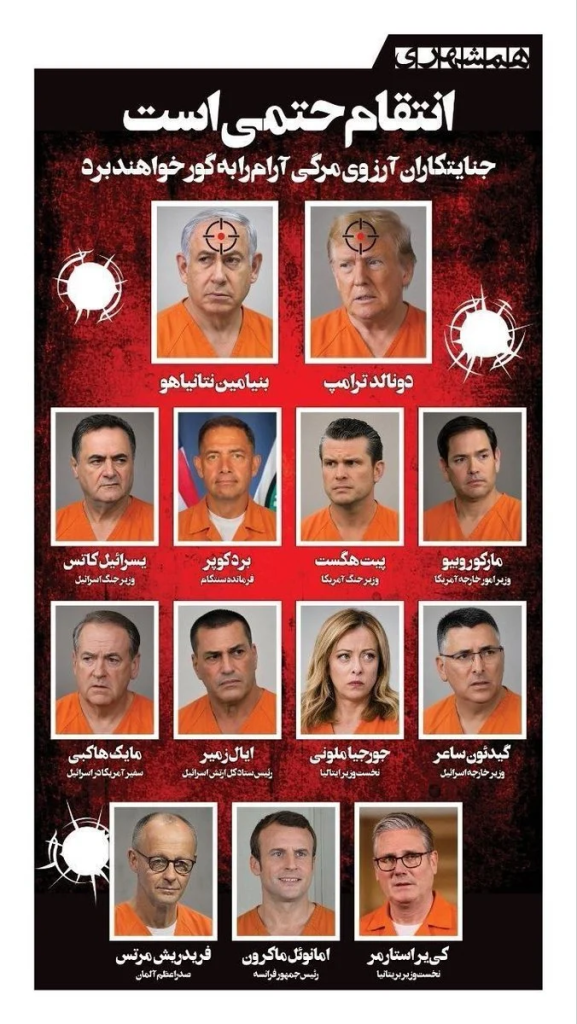
The infographic released by Hamshahri displayed photographs of several high-profile international figures, including:
- United States President Donald Trump
- Israeli Prime Minister Benjamin Netanyahu
- United Kingdom Prime Minister Keir Starmer
- United States Secretary of State Marco Rubio
- United States Secretary of Defense Pete Hegseth
- French President Emmanuel Macron
- Italian Prime Minister Giorgia Meloni
- German Chancellor Friedrich Merz
Other individuals also reportedly appeared in the graphic.
The publication was circulated online late Saturday but was not included in the newspaper’s Sunday print edition, raising further questions regarding its editorial status and intended audience.
No Official Endorsement Confirmed
Despite the widespread circulation of the infographic across international media and social media platforms, Iranian authorities have not officially endorsed the published list.
Government officials have yet to issue any formal statement confirming that the named individuals constitute an authorised list of retaliation targets.
Security analysts caution that publications by media organisations closely aligned with political factions do not necessarily represent official government policy.
Nevertheless, such publications can influence public discourse, shape political messaging and contribute to heightened diplomatic tensions during periods of international conflict.
Background to the Escalating Crisis
The controversy follows one of the most consequential developments in recent Middle East history.
Ayatollah Ali Khamenei was reportedly killed during United States and Israeli military strikes launched on February 28, marking the opening day of the current regional conflict.
His death ended decades of leadership and ushered in a new phase of uncertainty within Iran’s political and military establishment.
Iranian officials have consistently blamed both Washington and Tel Aviv for the attack and have repeatedly pledged that those responsible would face consequences.
The succession of Mojtaba Khamenei has further reinforced expectations that Tehran will maintain a firm response to what it describes as external aggression.
Europe Drawn Further into the Diplomatic Dispute
The inclusion of several European leaders in the published infographic reflects Tehran’s growing criticism of Western governments during the conflict.
Iran has accused a number of European countries of failing to condemn military strikes on Iranian territory.
Officials have also alleged that some European governments facilitated American military operations by permitting U.S. military aircraft to transit through their airspace.
Those allegations have been rejected or not formally acknowledged by the governments concerned.
Diplomatic observers say the accusations have further strained already fragile relations between Iran and several European capitals.
Regional and Global Security Implications
The publication has generated renewed concern among international security analysts, who warn that inflammatory rhetoric from any side of the conflict has the potential to deepen geopolitical instability.
Experts note that while political messaging and symbolic declarations are common during periods of war, governments typically distinguish between public rhetoric and formal state policy.
The emergence of alleged revenge narratives may prompt heightened security measures for public officials and increase diplomatic engagement aimed at preventing further escalation.
International observers continue to monitor developments closely amid fears that additional retaliatory actions could widen the conflict beyond the Middle East.
Questions Surround Mojtaba Khamenei’s Health
Reports also suggest that Mojtaba Khamenei himself sustained injuries during the strikes that killed his father.
Although those reports have circulated in regional media, Iranian authorities have provided limited public information regarding his medical condition.
His recent statement marked his first public communication since the funeral ceremonies held earlier this week.
International Community Watches Closely
Governments across Europe, North America and the Middle East are expected to continue assessing both the political significance of the published infographic and any official policy statements emerging from Tehran.
Diplomatic analysts argue that preventing further escalation will require sustained engagement through international channels while avoiding actions that could intensify already volatile regional tensions.
Whether the publication reflects official government thinking or merely the editorial position of a hard-line newspaper remains one of the central questions confronting international observers.
The publication of an alleged “revenge list” by an Iranian newspaper has added another layer of uncertainty to an already volatile geopolitical crisis following the death of former Supreme Leader Ayatollah Ali Khamenei.
While the infographic names several Western and Israeli leaders, Iranian authorities have not formally confirmed it as an official government document.
As rhetoric continues to intensify, the international community is closely monitoring Tehran’s next moves amid growing concerns over regional stability, diplomatic relations and the potential for further escalation in the Middle East.



Leave a Reply