
Fresh crisis rocks Labour Party as rival factions battle for legitimacy, accuse each other of political fraud, contempt of court, and illegal control of the party’s 2027 electoral machinery.
By Basil Ekeoma | May 18, 2026
The internal crisis tearing through the Labour Party has entered a dangerous new phase following a fierce confrontation between Abia State Governor Alex Otti and embattled former National Chairman Julius Abure over the alleged sale of nomination forms ahead of the 2027 general elections.
What initially appeared to be another episode in the party’s prolonged leadership dispute has now evolved into a full-scale institutional battle involving questions of judicial authority, legitimacy, electoral recognition, and control of the Labour Party’s political future.
At the center of the controversy are viral photographs showing Abure presenting what he described as Labour Party nomination forms to party stakeholders in Abia State, including former National Vice Chairman Ceekay Igara.
The move immediately triggered outrage from the Nenadi Usman-led faction of the party, which accused Abure of acting in defiance of court rulings and operating outside the recognition of the Independent National Electoral Commission (INEC).
Political observers now warn that the escalating feud could severely weaken Labour Party’s already fragile structure ahead of the 2027 elections.
“Worthless Papers” — Labour Party Rejects Abure’s Forms
In a strongly worded statement issued Sunday, the party’s National Publicity Secretary, Ken Asogwa, dismissed the nomination forms allegedly distributed by Abure as invalid and fraudulent.
According to Asogwa, Senator Nenadi Usman remains the recognised national leader of the party, and only the official national secretariat in Utako, Abuja possesses the authority to issue legitimate nomination documents.
“Any so-called Labour Party nomination form obtained from Julius Abure or any unauthorized source is nothing but worthless paper being peddled by political fraudsters seeking to deceive unsuspecting persons,” Asogwa declared.
The statement represented one of the strongest public attacks yet against Abure’s continued political activities within the party.
Otti Camp Accuses Abure of Contempt of Court
The administration of Governor Alex Otti intensified the confrontation by openly questioning Abure’s legal standing to continue functioning as national chairman.
Speaking through his Chief Press Secretary, Ukoha Ukoha, the governor’s camp argued that both the Federal High Court and the Court of Appeal had already recognised the Nenadi Usman-led interim structure.
According to Otti’s camp, INEC had also complied with those judicial directives, effectively stripping Abure of institutional legitimacy.
“I think Abure is in a better position to explain the grounds on which he is still parading himself after competent courts ruled that Senator Nenadi Usman was the interim leader of the Labour Party,” Ukoha stated.
He further described Abure’s continued issuance of nomination forms as a potential act of contempt against judicial authority.
The remarks signaled growing frustration within Otti’s political camp over what they perceive as attempts to destabilize the party’s emerging leadership structure from outside official channels.
Why Abia State Has Become Ground Zero
Political analysts say the concentration of the controversy in Abia State is not accidental.
Governor Otti remains one of Labour Party’s most prominent elected officials and arguably the party’s strongest surviving institutional symbol after the 2023 general elections.
As a result, control of the party structure in Abia carries enormous strategic significance for both factions.
Observers believe Abure’s activities in the state may represent an attempt to challenge Otti’s growing influence within the party while simultaneously demonstrating that his faction still retains grassroots operational networks.
However, the Otti camp insists the state will not succumb to what it described as “street-corner political theatrics, intimidation, or blackmail.”
Abure Camp Fights Back
Despite mounting criticism, Abure’s loyalists insist they remain the authentic leadership of the party pending final judicial determination at the Supreme Court.
Speaking on behalf of the faction, spokesman Obiora Ifoh argued that the leadership elected during the Nnewi convention remains constitutionally valid and operational.
“Our matter is still before the Supreme Court,” Ifoh said. “Until the apex court decides otherwise, we believe the Abure-led National Working Committee remains legitimate.”
The faction rejected allegations of contempt of court and compared the situation to leadership disputes currently affecting other major political parties.
According to the Abure group, suspending political activities while awaiting judicial resolution could create dangerous organisational vacuums capable of weakening party structures nationwide.
The “Preventive Strategy” Argument
Defending the distribution of nomination forms, Ceekay Igara argued that the exercise was merely precautionary.
He claimed the faction was acting to prevent institutional paralysis should the Supreme Court eventually rule in favour of Abure after official party primaries might have already closed.
“If the Supreme Court later restores the structure after primaries have ended, what happens to aspirants?” Igara asked.
The argument highlights a growing concern among some stakeholders that the prolonged legal uncertainty surrounding Labour Party leadership could produce parallel congresses, rival candidates, and conflicting electoral claims ahead of 2027.
A Party Still Haunted by 2023
The latest conflict further exposes Labour Party’s inability to fully consolidate after its dramatic rise during the 2023 elections.
The party’s presidential campaign under Peter Obi transformed Labour Party from a fringe political platform into a national political movement energized by youths, urban voters, and reform-minded Nigerians.
However, political analysts say the post-election period exposed deep structural weaknesses within the party, including weak institutional cohesion, leadership rivalry, and the absence of a unified long-term power-sharing framework.
The current battle between the Usman and Abure factions now threatens to deepen those fractures.
Observers warn that prolonged internal warfare could erode public confidence in the party’s ability to function as a credible opposition force ahead of 2027.
INEC and the Legal Battlefield
The role of Independent National Electoral Commission has also emerged as a critical factor in the dispute.
Both factions are now effectively battling for institutional recognition, knowing that INEC’s acceptance of leadership structures could ultimately determine the legitimacy of future primaries and candidate submissions.
Legal experts say the Supreme Court’s eventual ruling may become decisive not only for the party’s leadership but also for the survival of Labour Party as a coherent political platform.
If unresolved before the electoral calendar intensifies, the dispute could trigger parallel primaries, candidate disqualifications, or prolonged post-election litigations.
The Real Battle: Control of 2027
Behind the public statements and legal arguments lies a more strategic struggle — control of Labour Party’s political machinery ahead of the next general elections.
The authority to issue nomination forms represents more than administrative routine; it symbolizes control over candidate selection, party structures, financial inflows, and future political negotiations.
Political observers argue that whoever controls the nomination process effectively controls the soul of the party.
This reality explains why both factions appear unwilling to retreat despite growing reputational damage to the party.
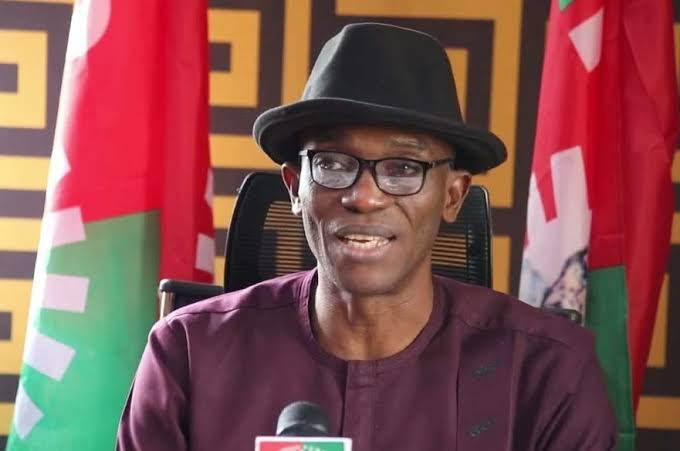
The latest confrontation between Alex Otti’s camp and Julius Abure’s faction reveals a Labour Party increasingly trapped in a battle for institutional survival.
What began as a leadership disagreement has now escalated into a dangerous contest involving court authority, party legitimacy, grassroots control, and the future direction of one of Nigeria’s most influential opposition movements.
As 2027 approaches, Labour Party faces a critical choice: resolve its internal contradictions and rebuild institutional cohesion, or risk collapsing under the weight of prolonged factional warfare.
For now, the nomination forms controversy is no longer just about paperwork.
It is about who truly owns the Labour Party — and who will control its political destiny in the next electoral cycle.



Leave a Reply