
Staple food prices and rising energy costs drive renewed inflationary pressure.
By Baron Eloagu | Abuja, Nigeria
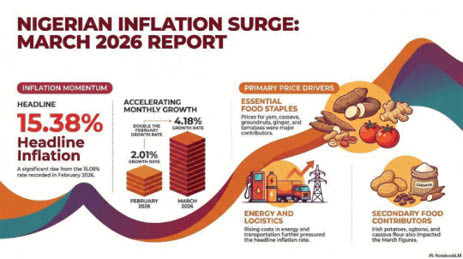
Nigeria’s headline inflation climbed to 15.38 percent in March 2026, according to the National Bureau of Statistics (NBS), reversing earlier moderation trends.
The increase was largely driven by rising prices of staple foods, energy, and transportation.
The NBS, in its latest Consumer Price Index (CPI) report, said inflation rose from 15.06 percent recorded in February, reflecting renewed cost pressures across key sectors of the economy.
The bureau identified sharp increases in the prices of yam, cassava, groundnuts, ginger, tomatoes, Irish potatoes, and cassava flour as major drivers of the spike.
On a month-on-month basis, inflation rose significantly by 4.18 percent in March, compared to 2.01 percent in February, indicating a faster rate of price increases within a short period.
Food and non-alcoholic beverages remained the largest contributors to inflation at 5.55 percent, followed by restaurants and accommodation services at 3.26 percent, and transport at 1.80 percent.
The report also linked rising inflationary pressure to global energy shocks, noting that crude oil prices surged above $100 per barrel following geopolitical tensions earlier in the year. This led to higher fuel prices, which in turn increased transportation and production costs nationwide.
Despite the monthly spike, food inflation declined year-on-year to 14.31 percent in March 2026, compared to 25.22 percent recorded in March 2025. However, month-on-month food inflation remained elevated at 4.17 percent.
Core inflation, which excludes farm produce and energy, stood at 16.21 percent year-on-year, showing a decline from 27.12 percent in the previous year. On a monthly basis, however, it rose sharply to 4.03 percent.
Across states, Bayelsa, Sokoto, and Bauchi recorded the highest year-on-year inflation rates, while Osun, Kano, and Kaduna recorded the lowest. On a month-on-month basis, Zamfara, Bauchi, and Sokoto saw the fastest increases, while Lagos, Akwa Ibom, and Rivers recorded the slowest.
Energy, Transport Costs Drive Inflation Spike
Economic experts say the resurgence in inflation reflects persistent structural challenges, particularly in energy and logistics.
Chief Executive Officer of the Centre for the Promotion of Private Enterprise (CPPE), Dr. Muda Yusuf, said energy costs remain a dominant driver of inflation due to Nigeria’s dependence on diesel, petrol, and gas for power and transportation.
He noted that rising transport costs continue to amplify price increases across sectors, as higher logistics expenses are passed on to consumers.
Households Face Rising Cost-of-Living Pressure
Yusuf warned that the dominance of food and transportation in the inflation basket poses serious welfare risks.
He said these are essential expenses that households cannot easily cut, leading to reduced purchasing power, increased poverty, and widening inequality.
He also highlighted structural weaknesses in Nigeria’s transport system, noting that the heavy reliance on privately operated road transport allows operators to rapidly adjust fares in response to fuel price hikes.
The latest data signals a fragile economic recovery, with inflationary pressures shifting from annual moderation to short-term spikes. If energy and logistics costs remain unchecked, the cost-of-living crisis could deepen, eroding household incomes and slowing economic stability.












Leave a Reply