
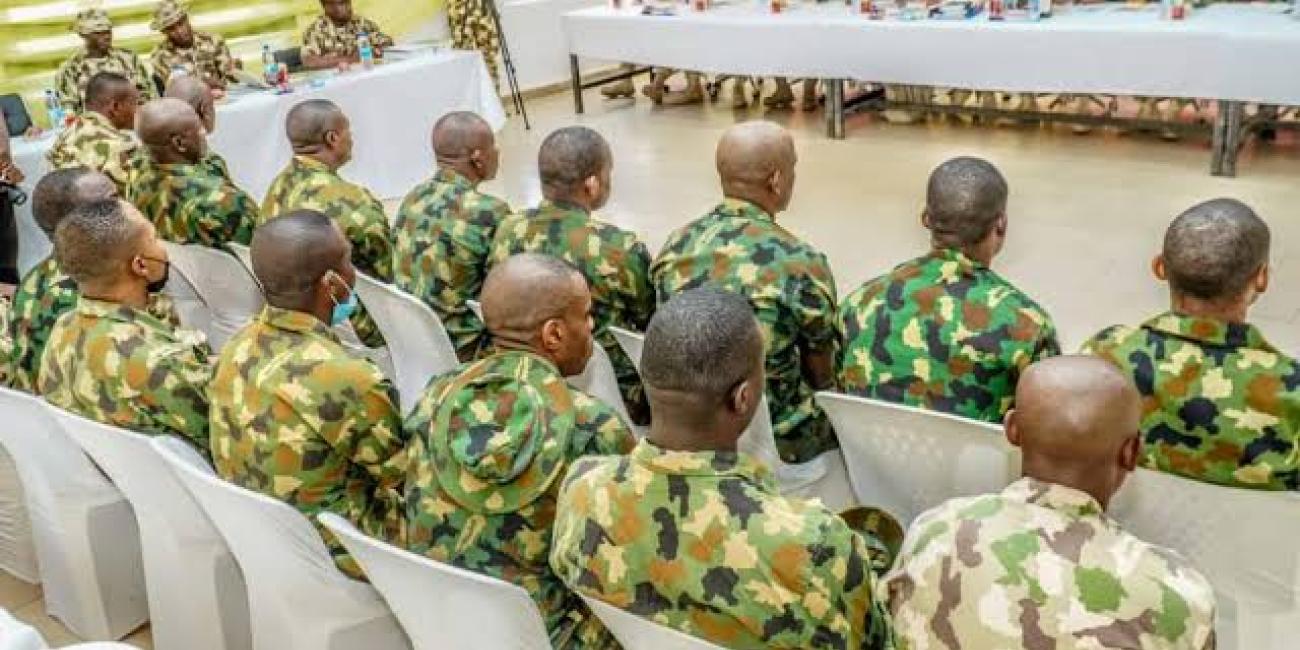
Court-Martial President Air Vice Marshal H.I. Alhaji says detention conditions are “not ideal” and warns restrictions on lawyers’ access to 36 accused military personnel cannot continue indefinitely.
By A1NEWS International
ABUJA, NIGERIA — August 12, 2026
The President of the General Court-Martial sitting in Abuja, Air Vice Marshal H.I. Alhaji, has acknowledged that the detention facility holding 36 Nigerian military personnel accused of involvement in an alleged plot to overthrow President Bola Ahmed Tinubu’s government is “not ideal”, while directing that lawyers be granted greater access to their clients.
The court-martial leadership’s admission places the conditions under which the accused personnel are being detained at the centre of a growing fair-hearing controversy surrounding one of Nigeria’s most politically sensitive military trials.
AVM Alhaji also acknowledged concerns over restrictions affecting lawyers and family members seeking access to the detainees, saying such restrictions could not become permanent because they could undermine the accused persons’ right to fair hearing and access to justice.
The proceedings have therefore raised a fundamental question: Can a military trial over an alleged coup plot meet the demands of justice if the accused cannot have adequate and confidential access to their lawyers and families while in detention?
COURT-MARTIAL ADMITS DETENTION CONDITIONS ARE ‘NOT IDEAL’
The most significant revelation came when the court-martial president addressed concerns over the facility where the accused military personnel are being detained.
AVM Alhaji said the court had examined detention facilities operated by the Department of State Services (DSS) and the police and found them to be considerably better than the facility currently being used.
“Yeah, so this is the issue of detention facilities. Gentlemen, I will tell you that. We have looked at detention facilities of the DSS and the police. They are way, way better,” he said during proceedings.
He went further in describing the conditions, saying:
“If I am part of the DSS, I will not carry my boots. I will not. I will not talk of humanity. I very much understand that the current detention facility is not ideal.”
The remarks are significant because they came from the head of the tribunal responsible for determining the fate of the accused personnel.
Rather than dismissing the concerns raised by the defence, the court-martial president appeared to acknowledge that the conditions warranted attention, while urging the parties to remain patient as efforts were made to address the situation.
ACCESS TO LAWYERS EMERGES AS A FAIR-HEARING ISSUE
The detention conditions are not the only concern confronting the court.
Access to legal counsel has emerged as a central procedural issue, with defence lawyers reportedly raising concerns about the amount of time they are permitted to spend with their clients.
AVM Alhaji said the detaining authority had presented concerns relating to access, but stressed that the restrictions could not continue indefinitely.
He said the court had already made its position known to the authorities responsible for detention.
“Nonetheless, we have directed that their position cannot be a permanent position.”
According to him, maintaining restrictions that interfere with legal consultation could affect the constitutional and procedural rights of the accused.
“Because it will not impede on the right to fair hearing, to justice. We have made it very clear to them. And I am sure we are going to have additional discussions to make sure that that position is rescinded.”
The court-martial president later gave a more direct assurance that the restrictions would eventually have to change.
“But I assure you, this restriction on access will not go on indefinitely.”
COURT ORDERS EARLIER ARRIVAL TO ALLOW LAWYER-CLIENT CONSULTATIONS
While the broader access dispute remains unresolved, the court has introduced an interim arrangement.
Defence lawyers were encouraged to arrive earlier than previously required so that they could spend additional time with their clients before proceedings begin.
AVM Alhaji said:
“We are going to bring them in earlier than we used to. So that you guys can have some time with them, while we work on this matter of access.”
He urged lawyers to take advantage of the arrangement while negotiations continue over wider access.
“I would encourage you to take advantage of the access to your clients. We need them early. Please try and come early so that you can have time with them. Until this matter is resolved.”
The arrangement, however, appears to be temporary rather than a permanent resolution of the access dispute.
‘LAWYERS AND COUNSEL MUST HAVE ACCESS’
The court-martial president made clear that adequate access between accused personnel and their lawyers would be indispensable once the proceedings move into the substantive trial.
“If this falls upon us to do its job, lawyers and counsel must have access to their clients. Without doubt.”
He also expressed dissatisfaction with the current level of access.
“We are not happy with the current arrangement of having limited access… There has to be much more than that.”
His comments indicate that the court itself recognises that restrictions that might be tolerated during preliminary procedural stages could become untenable once substantive evidence and witness testimony begin.
“That is only at this stage. When we get to the proper trial, things will have to change,” he said.
PROSECUTION ACCUSES COURT OF GIVING DEFENCE TOO MUCH ROOM
The court-martial proceedings have also produced an unusual tension between the tribunal and the two sides of the case.
Responding to complaints about alleged unequal treatment, AVM Alhaji disclosed that the prosecution had accused him of giving the defence too much latitude.
“The prosecution has complained that I have been giving too much room to the defence,” he said.
The court president nevertheless insisted that criticism from either side would not prevent the tribunal from performing its judicial responsibilities.
“No good thing goes unpunished. There is nothing I can do about this. It is a timeless job. We are going to get bashings from both sides.”
The statement underscores the delicate position of the court-martial as it attempts to balance national-security considerations with the procedural rights of 36 accused military personnel.
THE 36 ACCUSED PERSONNEL AND THE COUP ALLEGATION
The military personnel are being tried in connection with allegations surrounding an alleged plot to overthrow the democratically elected government of President Bola Tinubu.
The charges are politically and institutionally sensitive because they involve members of the nation’s armed forces and allegations that, if established, could constitute a direct threat to constitutional government.
However, the existence of serious allegations does not eliminate the accused persons’ right to a fair and impartial trial.
The court’s own comments about access and detention conditions therefore introduce an important dimension into the proceedings: national security cannot automatically become a justification for procedures that undermine due process.
WHY THE DETENTION ISSUE MATTERS
The controversy goes beyond the comfort of detainees.
Access to counsel is a fundamental component of an effective defence. Lawyers must be able to communicate adequately with accused persons, review their instructions, prepare responses to allegations and challenge evidence.
Where access is severely restricted, the defence may argue that its ability to prepare the case has been compromised.
Similarly, detention conditions can become a legal issue where they affect the physical or psychological wellbeing of accused persons or interfere with their ability to participate meaningfully in proceedings.
The court-martial president’s own acknowledgement that the facility is “not ideal” therefore gives the issue additional significance.
A DELICATE BALANCE BETWEEN NATIONAL SECURITY AND DUE PROCESS
The allegations before the court involve one of the most serious threats a constitutional government can face: an alleged attempt to seize political power outside the electoral process.
But the gravity of an allegation cannot determine the outcome of a trial.
The central responsibility of the court is to determine the evidence and apply the law impartially.
That requires the prosecution to establish its case while the defence is given a meaningful opportunity to challenge it.
The court-martial’s comments suggest an awareness of this balance.
On one side is the military’s responsibility to protect constitutional order and national security. On the other is the obligation to ensure that individuals accused of wrongdoing are not deprived of fundamental procedural safeguards.
INVESTIGATIVE QUESTIONS THE PROCEEDINGS RAISE
The latest proceedings raise several questions that authorities will eventually have to answer:
- Why are the accused personnel being held in a facility that the court itself considers inadequate?
- Who is responsible for determining the conditions under which the detainees are held?
- Why has access to lawyers and families been restricted?
- What specific security concerns are being used to justify the restrictions?
- Can the restrictions be reconciled with the accused persons’ right to prepare an effective defence?
- Will detention conditions change before the substantive trial begins?
- What independent mechanism exists to monitor the welfare and treatment of the detainees?
- Will the court’s concerns result in concrete changes by the detention authorities?
These questions are particularly important because the proceedings concern allegations against military personnel, where institutional discipline and national security considerations can sometimes collide with individual rights.
COURT’S ASSURANCE: RESTRICTIONS WILL NOT BE PERMANENT
For now, the court-martial has stopped short of ordering an immediate wholesale change in the detention arrangement.
Instead, the tribunal has indicated that discussions with the relevant authorities will continue.
The interim solution is to bring the accused personnel to court earlier so their lawyers can consult with them before proceedings.
But the court president’s repeated assurances indicate that this arrangement is not expected to become the permanent standard.
The substantive trial could therefore become the real test of whether the military detention system can provide adequate access to counsel while maintaining whatever security measures authorities consider necessary.
A TEST OF MILITARY JUSTICE AND RULE OF LAW
The court-martial proceedings over the alleged coup plot have moved beyond the question of whether the accused personnel committed the offences with which they are charged.
They are increasingly becoming a test of how Nigeria’s military justice system balances national security, military discipline, fair hearing and human dignity.
The court-martial president’s admission that the current detention facility is “not ideal” and his insistence that lawyers must have greater access to their clients deserve close scrutiny.
The accused personnel remain presumed innocent until proven guilty in accordance with law. At the same time, the state has a legitimate interest in investigating and prosecuting any genuine attempt to overthrow constitutional government.
The credibility of the proceedings will ultimately depend not simply on the verdict, but on whether the process itself is demonstrably fair.
For the court, the challenge is now clear: protect the integrity of the trial without compromising the rights of those standing trial.
A1NEWS International will continue to monitor the court-martial proceedings, the treatment of the accused personnel and any developments concerning access to lawyers and families.





Leave a Reply