

ADC primary fallout deepens opposition cracks as APC mocks coalition, Labour Party attacks Atiku’s ambition, and Peter Obi edges closer to NDC presidential ticket
By Baron Eloagu / May 29, 2026
ABUJA, Nigeria —A major political confrontation ahead of the 2027 general election erupted on Thursday after the Presidency and the ruling All Progressives Congress dismissed the emergence of former Vice President Atiku Abubakar as the presidential candidate of the African Democratic Congress, insisting he poses no serious threat to President Bola Tinubu’s re-election ambitions.
The political tension intensified as Atiku began reconciliation moves with former Minister of Transportation, Rotimi Amaechi, following a controversial ADC presidential primary that exposed deep cracks within the opposition coalition.
Simultaneously, the Nigeria Democratic Congress prepared to ratify former Anambra State governor, Peter Obi, as its presidential candidate during nationwide primaries scheduled for Friday, setting the stage for a potentially fragmented opposition battle ahead of 2027.
The unfolding developments have reignited fierce debates over zoning, power rotation, coalition politics, and the future of opposition unity in Nigeria.
Atiku Wins ADC Ticket Amid Controversy
Atiku secured a landslide victory in the ADC presidential primary after polling 1,846,370 votes to defeat Amaechi and economist Mohammed Hayatu-Deen, who scored 504,117 and 177,120 votes respectively.
However, the victory was immediately overshadowed by allegations of widespread irregularities.
Both Amaechi and Hayatu-Deen rejected the conduct of the exercise across the 36 states and the Federal Capital Territory, accusing party officials of manipulating the process.
The two aspirants boycotted the collation and declaration of results, deepening concerns over internal cohesion within the ADC coalition.
Political observers noted that the controversy threatens to weaken the opposition alliance barely months after its formation.
Presidency Dismisses Atiku’s Chances
Reacting to Atiku’s emergence, the Presidency dismissed suggestions that the former Vice President could pose a significant challenge to President Tinubu in 2027.
Senior Special Assistant to the President on Media and Publicity, Temitope Ajayi, described Atiku as a “perennial contestant” whose repeated presidential ambitions no longer inspire political momentum.
According to Ajayi, the opposition coalition lacks ideological direction and is merely a gathering of politicians frustrated by exclusion from power.
“Their coalition was not built around any higher purpose or developmental vision. It is simply a coalition of aggrieved individuals,” Ajayi said.
The presidential aide argued that unlike the 2015 opposition merger that produced Muhammadu Buhari’s victory, the current opposition bloc lacks unity and a coherent political structure.
He also pointed to the withdrawal of key figures such as Peter Obi and Rabiu Kwankwaso from the coalition as evidence that the alliance was already collapsing.
“With Obi and Kwankwaso gone, and Amaechi rejecting the process, who is remaining there?” he queried.
Ajayi insisted Nigerians would ultimately vote based on the performance of the Tinubu administration rather than opposition realignments.
Power Rotation Debate Returns
Atiku’s emergence has reopened long-standing debates over Nigeria’s unwritten North-South power rotation arrangement.
Although not constitutionally binding, zoning has remained a major stabilising principle in Nigerian politics since 1999, with major parties informally alternating presidential tickets between the North and South.
Critics argue that Atiku’s renewed presidential ambition risks undermining that delicate balance, particularly after the South only recently regained power through President Tinubu’s victory in 2023.
The Social Democratic Party strongly defended the principle of rotational presidency.
SDP National Publicity Secretary, Rufus Aiyenigba, said the party deliberately reserved its presidential ticket for the South to preserve equity and national cohesion.
“The SDP believes in balancing power and creating a sense of belonging among all sections of the country,” he stated.
The Labour Party also criticised Atiku’s decision to contest again, describing it as politically insensitive.
LP spokesman, Ken Asogwa, warned that ignoring zoning sentiments could further destabilise Nigeria’s fragile political structure.
“Morality and political sensitivity ought to guide such ambitions in a fragile federation like ours,” he said.
APC Attacks Opposition Coalition
The ruling APC joined the growing criticism against Atiku and the opposition coalition.
APC Director of Publicity, Bala Ibrahim, described Atiku’s emergence as evidence of inconsistency and political desperation.
He insisted Nigerians would prioritise Tinubu’s Renewed Hope Agenda over what he termed “emotional opposition politics.”
“Nigerians will evaluate performance and continuity, not sentiment,” Ibrahim stated.
The APC also argued that the political conditions that produced Buhari’s 2015 victory no longer exist, insisting the opposition lacks the unity and grassroots structure required to challenge the ruling party.
Atiku Camp Fires Back
In a swift counterattack, Atiku’s camp accused the Presidency of displaying signs of nervousness.
His Senior Special Assistant on Public Communication, Phrank Shaibu, argued that a government genuinely confident in its performance would not react aggressively to opposition developments.
“Millions of Nigerians battling hunger, insecurity, unemployment, and economic despair already know the country cannot continue on this disastrous path,” Shaibu said.
He dismissed claims that the coalition was driven by grievances, insisting it reflected the frustrations of ordinary Nigerians suffering under worsening economic conditions.
According to him, Nigerians were angry because businesses were collapsing, insecurity was spreading, and food prices had become unbearable.
Atiku Moves To Woo Amaechi
Barely 24 hours after securing the ADC ticket, Atiku visited Amaechi at his Abuja residence in what political observers described as an early reconciliation effort.
The meeting was disclosed by media personality and political ally, Dele Momodu, who described it as part of efforts to unify the party after the contentious primary.
Shaibu later confirmed the visit, insisting it was a brotherly engagement focused on national issues and party unity.
According to him, Atiku used the opportunity to celebrate Amaechi’s birthday while discussing insecurity, economic hardship, and the broader future of Nigeria.
Political analysts believe Atiku’s outreach reflects growing concerns within the ADC over internal fractures that could weaken the opposition before the 2027 elections.
NDC Set To Ratify Peter Obi
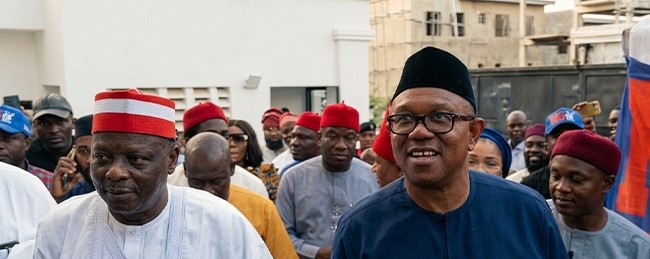
Meanwhile, the Nigeria Democratic Congress is expected to ratify former Anambra State governor, Peter Obi, as its presidential candidate during nationwide primaries scheduled for Friday.
The party confirmed that Obi emerged as the sole aspirant for the ticket.
NDC National Chairman, Moses Cleopas, disclosed that governorship, National Assembly, and state assembly primaries would also hold nationwide despite logistical challenges caused by the Eid-el-Kabir holidays.
The party warned security agencies and state institutions against interfering in the process.
Cleopas also stressed that only the National Working Committee has the authority to announce results from the primaries.
Political observers say Obi’s emergence under the NDC could further complicate opposition coalition talks and deepen fragmentation among anti-APC forces.
Opposition Faces Growing Fragmentation
With Atiku leading the ADC, Obi positioned in the NDC, and other opposition parties pursuing separate strategies, concerns are mounting over whether the opposition can build a unified front ahead of 2027.
Analysts warn that internal rivalries, zoning disputes, and competing ambitions may ultimately strengthen the ruling APC’s chances of retaining power.
While opposition leaders insist Nigerians are desperate for change, the inability to forge a common political direction continues to raise doubts about the viability of any anti-Tinubu coalition.
The emerging 2027 political landscape is already exposing deep divisions within Nigeria’s opposition movement.
As the Presidency dismisses Atiku’s candidacy, opposition parties battle over zoning and legitimacy, while Peter Obi moves closer to securing the NDC ticket, the race for 2027 is rapidly evolving into a high-stakes contest shaped by coalition struggles, regional calculations, and growing public frustration over governance.
Whether the opposition can overcome internal fragmentation and present a united challenge to President Tinubu remains one of the biggest political questions ahead of the next general election.





Leave a Reply