
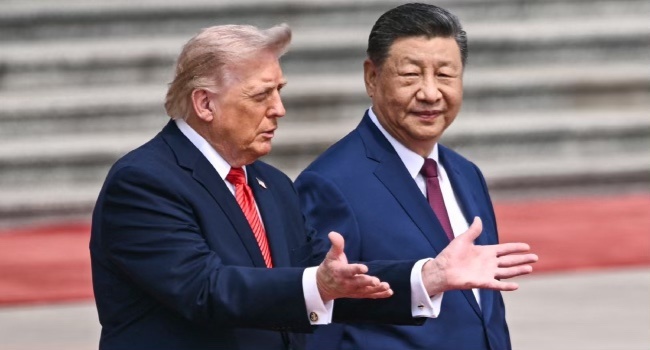
White House says US and Chinese leaders agreed vital shipping route “must remain open” amid escalating Middle East conflict and fears of global economic disruption
By A1NEWS International Foreign Affairs Desk
United States President Donald Trump and Chinese President Xi Jinping have reportedly agreed that the Strait of Hormuz must remain open to global energy supplies as escalating conflict involving Iran, Israel, and the United States threatens one of the world’s most critical oil transit corridors.
The White House disclosed details of the high-level conversation on Thursday, describing the meeting between the two global powers as “good” and strategically important amid growing fears that disruption in the Persian Gulf could trigger severe global economic and energy consequences.
The development comes as Iran allegedly intensifies restrictions around the Strait of Hormuz following the outbreak of war involving the United States and Israel on February 28.
Why The Strait Of Hormuz Matters
The Strait of Hormuz remains one of the world’s most strategically sensitive maritime chokepoints.
Roughly one-fifth of global oil and natural gas supplies normally pass through the narrow waterway linking the Persian Gulf to international markets.
Any prolonged disruption threatens not only Middle Eastern oil exports but also global inflation, fuel prices, shipping costs, and economic stability.
According to maritime analytics firm Kpler, more than half of China’s seaborne crude oil imports originate from the Middle East and largely transit through the Strait of Hormuz.
This heavy dependence explains Beijing’s growing concern over instability in the region.
White House Reveals Strategic Energy Discussions
In its official readout, the White House stated that both leaders agreed on the necessity of maintaining open maritime access through the strait.
“The two sides agreed that the Strait of Hormuz must remain open to support the free flow of energy,” the statement said.
The White House further disclosed that Xi expressed interest in increasing Chinese purchases of American crude oil as part of broader efforts to reduce China’s long-term vulnerability to disruptions in Middle Eastern energy routes.
However, Beijing’s official summary of the meeting reportedly omitted any direct reference to plans for increased US oil imports.
Analysts say the discrepancy reflects the delicate balancing act China faces between securing energy supplies, maintaining strategic ties with Middle Eastern partners, and avoiding perceptions of overdependence on Washington.
Rising Middle East Tensions Drive Global Anxiety
The latest diplomatic engagement between Washington and Beijing comes against the backdrop of rapidly escalating Middle East tensions.
Iran’s actions around the Strait of Hormuz are widely viewed as a pressure tactic aimed at responding to military confrontations involving the United States and Israel.
Energy markets have remained volatile amid fears that further escalation could trigger shipping disruptions, supply shortages, and another global inflation surge.
International observers note that despite ongoing geopolitical rivalry between the US and China, both countries share strong economic incentives to avoid a full-scale energy crisis.
Taiwan Issue Remains Sensitive Flashpoint
While the White House focused largely on energy security and economic stability, the conversation also reportedly touched indirectly on broader geopolitical tensions.
Notably, the White House statement made no reference to Taiwan — the self-governing island claimed by China and one of the most contentious issues in US-China relations.
However, Chinese state media quoted Xi as warning that mishandling the Taiwan issue could potentially lead to “conflict” between both nations.
Diplomatic analysts say the omission of Taiwan from the White House readout may have been deliberate in order to avoid overshadowing urgent discussions on energy security and Middle East instability.
China’s Energy Vulnerability Under Scrutiny
The Strait of Hormuz crisis has once again exposed China’s strategic energy vulnerability.
Unlike the United States, which has expanded domestic energy production in recent years, China remains heavily dependent on imported crude oil, particularly from Gulf states.
Experts say the situation could accelerate Beijing’s long-term efforts to diversify energy sources, expand strategic petroleum reserves, strengthen renewable energy investments, and deepen alternative supply partnerships.
The possibility of increased Chinese purchases of American crude oil could also signal a temporary easing of trade tensions between the world’s two largest economies.
Global Markets Watching Closely
Global energy traders and financial markets are closely monitoring developments around the Strait of Hormuz.
Any sustained disruption could sharply impact global oil prices, weaken supply chains, increase shipping insurance costs, and trigger inflationary pressure across both developed and emerging economies.
Several international shipping firms are reportedly reassessing risk exposure in the Gulf region amid fears of further military escalation.
The rare convergence of interests between the United States and China over the Strait of Hormuz highlights the enormous geopolitical and economic stakes tied to the Middle East crisis.
As tensions continue to escalate involving Iran, Israel, and the United States, global attention is increasingly shifting toward whether diplomacy can prevent a prolonged disruption of one of the world’s most critical energy arteries.
For now, both Washington and Beijing appear united on at least one strategic priority — keeping global energy flowing and avoiding a wider economic shock that could destabilise international markets.









Leave a Reply