
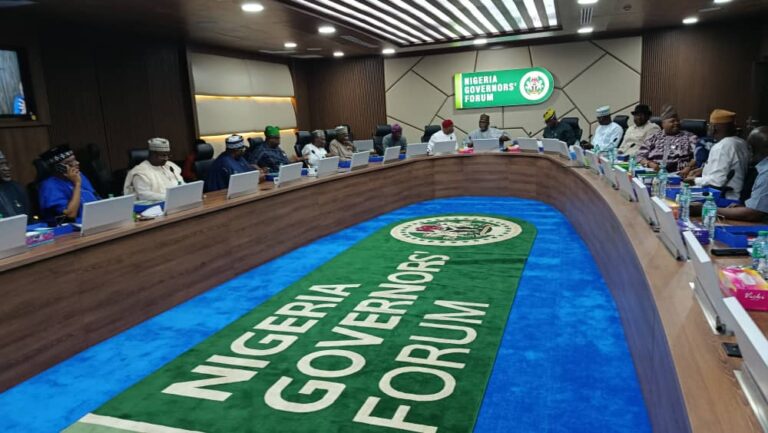
States spent more than N512 billion on Government Houses, Governors’ Offices, executive administration, travel and transport in the first half of 2026 — nearly 4,713 times the combined basic salaries of Nigeria’s 36 governors — raising fresh questions about the real cost of political office amid economic hardship.
By Amarachi Odenigbo
ABUJA, Nigeria — August 26, 2026
As millions of Nigerians continue to grapple with rising living costs, declining purchasing power and pressure on household incomes, state governments spent at least N512.10 billion on Government Houses, Governors’ Offices, executive administration and travel-related expenditure during the first six months of 2026, an analysis of available state budget implementation reports has shown.
The expenditure is striking when compared with the official basic salaries of state governors.
At the reported monthly salary of N503,000 per governor, the combined basic salary of Nigeria’s 36 governors for six months would amount to approximately N108.65 million.
Against that figure, the N512.10 billion identified for executive offices and travel represents roughly 4,713 times the combined six-month basic salaries of all 36 governors.
The comparison does not mean governors personally received the N512.10 billion.
Rather, it exposes a much broader fiscal issue: the enormous public expenditure required to maintain the institutions, administrative structures, official residences, personnel, protocol, logistics and travel associated with state executive offices.
For taxpayers confronting economic hardship, the figures raise a fundamental question:
How much does it actually cost to maintain political power in Nigeria beyond the salaries officially attached to political office?
N420bn Spent on Government Houses and Executive Offices
The analysis identified approximately N420.01 billion under Government House, Governor’s Office and related executive administration expenditure in the first half of 2026.
A further N92.09 billion was identified under travel and transport expenditure heads.
Together, the two categories amounted to N512.10 billion.
The Government House and Governor’s Office component accounted for about 82 per cent of the combined expenditure, making it by far the larger spending category.
Travel and transport accounted for the remaining approximately 18 per cent.
The figures illustrate that the financial burden associated with state executive offices extends far beyond the statutory remuneration of governors.
Government House expenditure can cover a wide range of official activities, including administrative operations, staffing, utilities, maintenance, protocol, official functions, residences and other executive responsibilities.
Travel and transport expenditure similarly covers more than governors’ personal journeys. It may include official travel and transportation costs involving wider state government operations and personnel.
Consequently, the N512.10 billion should not be interpreted as money personally spent by governors.
It represents expenditure recorded under broad government budget heads associated with executive administration and official travel.
The Salary Versus the System
The contrast between the governors’ salaries and the cost of maintaining their offices exposes an important weakness in public discussions about political remuneration.
Governor Sheriff Oborevwori of Delta State recently said he earns a monthly salary of N503,000, noting that some senior civil servants, including permanent secretaries, earn more.
Taken in isolation, the figure appears relatively modest compared with the salaries of some senior public officials and executives in the private sector.
But salary is only one component of the economics of political office.
The broader public expenditure associated with a governor includes the infrastructure and personnel required to operate the Governor’s Office, official residences, administrative machinery, security arrangements, protocol and official engagements.
This means that judging the cost of a governorship solely by its statutory salary can provide an incomplete picture.
The critical fiscal question is therefore not simply:
“How much does a governor earn?”
It is:
“How much does the state spend to maintain the office and the administrative ecosystem surrounding the governor?”
Kogi Leads Government House Spending
The state-by-state figures reveal significant disparities in expenditure.
Among the available 2026 records analysed, Kogi State recorded the highest identifiable expenditure under Government House and Governor’s Office-related heads, at approximately N65.34 billion.
It was followed by:
- Ogun — N45.26 billion
- Lagos — N45.04 billion
- Kano — N25.87 billion
- Ekiti — N25.22 billion
- Cross River — N23.92 billion
- Bayelsa — N22.99 billion
- Imo — N19.43 billion
- Enugu — N16.20 billion
At the lower end of the available figures were:
- Oyo — N1.95 billion
- Sokoto — N2.20 billion
- Kwara — N2.59 billion
- Abia — N2.78 billion
The wide variation raises questions about the different accounting structures, budget classifications, administrative arrangements and spending priorities adopted by individual states.
A high figure does not automatically establish waste or corruption, just as a lower figure does not necessarily mean better fiscal management.
However, such variations warrant closer examination by state assemblies, civil society organisations, auditors and citizens.
Travel Spending Remains High
The analysis also found that states spent approximately N92.09 billion on travel and transport during the first half of 2026.
Plateau State recorded the highest identifiable expenditure in this category, at approximately N10.11 billion.
It was followed by:
- Lagos — N8.23 billion
- Taraba — N5.16 billion
- Niger — N4.45 billion
- Ekiti — N4.41 billion
- Bauchi — N3.75 billion
- Yobe — N3.68 billion
At the lower end were:
- Oyo — N667.52 million
- Kano — N626.95 million
Again, these figures cover budget heads that can include travel and transportation across the wider state public service and should not be attributed solely to governors.
But the magnitude of the spending remains significant, particularly when considered alongside competing demands for funding in education, healthcare, infrastructure and social protection.
Spending Declined Compared With 2025 — But Remains Enormous
Available comparable records indicate that spending under Government House, Governor’s Office and related executive administration heads stood at approximately N465.07 billion in the first half of 2025.
The figure fell to N420.01 billion during the corresponding period of 2026.
That represents a reduction of approximately N45.05 billion, or 9.69 per cent.
Travel and transport expenditure, however, barely changed.
The available records show N92.73 billion spent in the first half of 2025 compared with N92.09 billion during the first six months of 2026.
The decline was approximately N643.66 million, or 0.69 per cent.
Combined, the two categories fell from approximately N557.80 billion in the first half of 2025 to N512.10 billion in the first half of 2026.
That represents a reduction of about N45.70 billion, or 8.19 per cent.
The decline is noteworthy, but the absolute level of spending remains substantial.
Some States Increased Executive Expenditure Sharply
Behind the overall decline are significant increases in several states.
In Kogi, identifiable Government House and Governor’s Office expenditure rose from approximately N51.99 billion in the first half of 2025 to N65.34 billion in 2026.
That represents an increase of approximately N13.35 billion, or 25.7 per cent.
Bayelsa recorded an increase from approximately N14.48 billion to N22.99 billion, representing a rise of about N8.51 billion, or 58.8 per cent.
The most dramatic percentage increase cited in the available figures occurred in Cross River, where spending rose from approximately N9.91 billion to N23.92 billion.
That is an increase of about N14.01 billion, or 141.4 per cent.
Lagos also recorded a substantial increase, rising from approximately N25.86 billion in 2025 to N45.04 billion in 2026.
The increase was approximately N19.18 billion, or 74.2 per cent.
Such increases require context.
Budget classification changes, capital projects, arrears, special government programmes, changes in accounting practices and one-off expenditure can significantly affect individual budget lines.
Therefore, the figures alone cannot establish whether spending was wasteful or justified.
They do, however, provide a basis for further fiscal scrutiny.
Other States Cut Spending
Not every state increased expenditure.
Ogun’s identifiable Government House and Governor’s Office spending declined from approximately N49.83 billion in the first half of 2025 to N45.26 billion in 2026, a reduction of about N4.57 billion, or 9.2 per cent.
Kano recorded a decline from approximately N28.84 billion to N25.87 billion, representing a reduction of roughly N2.98 billion, or 10.3 per cent.
The different trajectories demonstrate that there was no uniform spending pattern across the states.
Some states increased executive expenditure considerably while others reduced it.
Economist Questions the Real Cost of Political Office
Development economist Aliyu Ilias said the figures demonstrate why public debate over political remuneration should not focus exclusively on statutory salaries.
According to him, the wider cost of maintaining political offices and the privileges attached to them must be considered when assessing the financial burden imposed on taxpayers.
He argued that executive institutions in Nigeria had become excessively expensive to operate, partly because political office holders exert significant influence over the structures and resources under their control.
Ilias also criticised the tendency to compare a governor’s basic salary with the salary of a permanent secretary without considering the wider benefits and expenses associated with executive office.
His argument raises a broader governance concern: whether Nigeria’s political system has created an incentive structure in which access to public office provides substantial financial and institutional privileges beyond the official remuneration disclosed to the public.
State Assemblies and the Accountability Gap
One of the most important questions arising from the expenditure data concerns the role of state legislatures.
State Houses of Assembly are constitutionally empowered to scrutinise state budgets and exercise oversight over public expenditure.
Yet concerns about the effectiveness and independence of state legislative oversight have persisted for years.
If billions of naira are allocated under broad executive expenditure heads, effective oversight requires legislators to determine:
- What exactly was purchased?
- Who received the contracts?
- What services were delivered?
- Were procurement procedures followed?
- Were expenditures authorised in the approved budget?
- Were there supplementary budget approvals?
- Did actual spending produce measurable public value?
- Were funds diverted from essential services?
- Were similar expenditures duplicated under different budget heads?
These questions are more important than simply comparing one state’s expenditure with another.
What Does “Government House” Actually Cost?
The phrase “Government House” can conceal a complicated network of public expenditure.
Depending on the state’s accounting structure, spending may include administration, hospitality, maintenance, utilities, protocol, official functions, staff costs, communications, transportation, residences and other executive activities.
This creates an accountability challenge.
Broad budget classifications can make it difficult for ordinary citizens to determine precisely how much is being spent on the governor’s immediate office compared with wider executive administration.
Greater budget transparency would therefore require states to provide clearer expenditure classifications and detailed implementation reports.
The public should be able to distinguish between legitimate governance expenditure and discretionary spending that produces little measurable public benefit.
The 2023–2025 Revenue Boom Raises the Stakes
The expenditure debate comes against the backdrop of significantly increased allocations to state governments following changes in Nigeria’s fiscal environment.
Available Ministry of Finance data previously showed that approximately N47.25 trillion was distributed through the Federation Account between 2023 and 2025, accounting for more than half of the approximately N93.13 trillion distributed over the nine-year period from 2017 to 2025.
The increase in available revenue has placed greater responsibility on state governments.
The central question is no longer simply whether states have enough money.
It is increasingly about how the money is being prioritised.
If government revenues rise while spending on executive administration, official travel and political structures remains substantial, citizens have legitimate grounds to demand evidence that additional revenue is also translating into better schools, hospitals, roads, water systems, jobs and social services.
Governors’ Salaries Are Not the Whole Story
The data ultimately complicate the recurring political argument about whether Nigerian governors are adequately or inadequately paid.
A governor’s statutory salary may indeed be relatively modest.
But that salary does not capture the full public cost of the institution.
The state bears the cost of maintaining offices, residences, staff, transportation, official engagements, administrative structures and other executive functions.
Consequently, a governor who earns N503,000 monthly may preside over an institutional structure consuming billions of naira annually.
That distinction matters for public accountability.
The relevant fiscal metric should therefore include both personal remuneration and institutional expenditure, while maintaining a clear separation between money paid directly to an office holder and money spent on government operations.
Important Data Limitation
The analysis is based on available first- and second-quarter 2026 budget implementation information and the largest identifiable Government House, Governor’s Office or related executive administration expenditure line in each state, alongside the general travel and transport expenditure head.
The available records were not uniform across all states.
Comparable data were unavailable for Edo, Osun and Rivers in the dataset used for the analysis.
This means the N512.10 billion figure should be treated as an identified expenditure total from the available records and budget heads, rather than a definitive accounting of every naira spent by all 36 state governments on executive administration and travel.
The difference is important.
Budget implementation reports can classify similar expenditure differently from one state to another, while some expenditures may appear under alternative ministries, departments or agencies.
The figures should therefore be subjected to further audit and cross-checking before being interpreted as a complete measure of executive spending nationwide.
The Bigger Question: What Are Nigerians Getting for the Money?
At the heart of the controversy is a question that cannot be answered by arithmetic alone.
Nigeria’s states require functioning executive institutions. Governors need offices, personnel, security, transportation and administrative support to perform constitutional responsibilities.
The issue is therefore not whether government should spend money on governance.
The issue is whether the scale and structure of that expenditure deliver proportional public value.
For citizens struggling with inflation, unemployment, inadequate healthcare, poor infrastructure and rising household expenses, billions allocated to executive structures naturally invite scrutiny.
Every naira spent on administration is a naira that must ultimately be justified against competing public priorities.
The first-half 2026 spending figures reveal a striking contradiction in Nigeria’s public finance debate.
Governors’ official basic salaries may appear modest, but the machinery surrounding their offices costs taxpayers hundreds of billions of naira.
At least N512.10 billion was identifiable under Government House, Governor’s Office, related executive administration and travel and transport expenditure in the available first-half 2026 records.
That figure is approximately 4,713 times the combined six-month basic salaries of the 36 governors.
The comparison should not be misread as evidence that governors personally received the money. Much of the expenditure represents legitimate costs of running state governments and cannot simply be classified as personal benefits.
But the scale nevertheless raises a legitimate accountability question:
How much does Nigeria spend maintaining political office, and how much measurable public value does that spending produce?
The answer requires more than declarations about low salaries.
It requires transparent budgets, detailed implementation reports, independent audits, stronger legislative oversight, open procurement records and public scrutiny of the actual services delivered.
With state revenues increasing substantially in recent years, Nigerians are entitled to demand not merely bigger government budgets, but better government outcomes.
The real test of fiscal responsibility is ultimately not how much a governor says he earns.
It is how efficiently the government converts public revenue into security, infrastructure, healthcare, education, jobs and a better standard of living for the citizens who provide the money.








Leave a Reply