
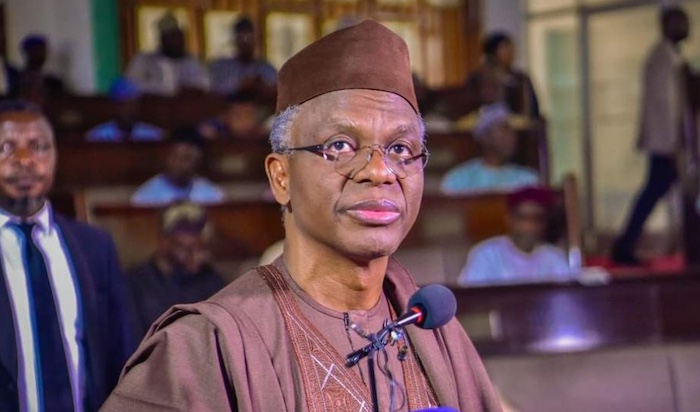
Federal High Court imposes strict bail conditions on former Kaduna governor as DSS prosecution over alleged illegal surveillance deepens concerns about political espionage and national security breaches.
By Hassan Jinjiri | KADUNA, Nigeria | May 19, 2026
The Federal High Court in Abuja has granted bail to former Kaduna State Governor, Nasir El-Rufai, in the sum of N100 million following his arraignment in a high-profile national security case instituted by the Department of State Services over alleged unauthorized surveillance activities targeting the National Security Adviser.
The case, which has rapidly evolved into one of Nigeria’s most politically sensitive security prosecutions in recent years, stems from public comments made by El-Rufai in which he reportedly admitted during a television interview to wiretapping the communications of Nuhu Ribadu.
Legal analysts and political observers say the prosecution has implications far beyond the courtroom, touching on issues of state surveillance, elite political rivalry, intelligence abuse, and internal fractures within Nigeria’s ruling political establishment ahead of the 2027 elections.
Court Imposes Stringent Bail Conditions
Delivering ruling on the bail application, Justice Joyce Abdulmalik approved El-Rufai’s release but attached unusually strict conditions aimed at ensuring compliance throughout the trial process.
The court ordered that:
- El-Rufai must provide one surety in the same amount of N100 million
- The surety must reside in either Maitama or Asokoro, Abuja
- The surety must deposit the original Certificate of Occupancy of a landed property with the court registry
- The surety must be a federal civil servant on Grade Level 17 or above
Additionally, the court directed the surety to:
- Submit proof of salary payments for the last three months
- Provide authentication from a branch bank manager within the court’s jurisdiction
- Swear an affidavit of means
- Sign a bail bond
- Submit a recent passport photograph
- Present a tax clearance certificate covering the previous six months
Justice Abdulmalik also ordered El-Rufai to surrender all valid international passports to the court pending the conclusion of proceedings.
Monthly DSS Reporting Ordered
As part of the conditions attached to the bail, the court directed El-Rufai to report physically to DSS headquarters on the last Friday of every month by 10:00 a.m. to sign an attendance register.
The court warned that any violation of the bail conditions would trigger immediate revocation.
The judge further ordered the former governor to submit:
- A verification letter from the surety’s department
- A letter of attestation from the Chairman of the Kaduna State Traditional Council
The court also granted accelerated hearing of the case, signaling the judiciary’s intention to fast-track proceedings given the national security dimensions involved.
The Wiretapping Allegation at the Center of the Case
The prosecution reportedly originated from remarks made by El-Rufai during a national television appearance in which he allegedly acknowledged involvement in monitoring the communications of NSA Nuhu Ribadu.
Though the full operational context of the alleged surveillance has not yet been publicly disclosed in court, the revelation triggered intense controversy within security and political circles.
Security experts say unauthorized interception of communications involving senior national security officials raises profound legal and constitutional questions involving:
- Abuse of intelligence capabilities
- Unauthorized surveillance operations
- Breach of national security protocols
- Potential compromise of classified information
- Internal political espionage
The DSS prosecution now seeks to establish whether criminal violations occurred under Nigeria’s national security and cybercrime frameworks.
Political Undercurrents Deepen Suspicion
Beyond the legal dimensions, the case has intensified speculation about widening fractures within elite political networks associated with the ruling establishment.
El-Rufai and Ribadu are both influential northern political figures with long-standing involvement in Nigeria’s security and governance architecture.
Observers note that the prosecution unfolds amid increasing political tension ahead of the 2027 general elections, where internal alignments, succession battles, and regional calculations are already reshaping power blocs within the country.
Some analysts interpret the case as:
- A legitimate national security enforcement action
- An elite political confrontation spilling into security institutions
- A warning against unauthorized intelligence operations
- A broader internal power struggle within the political class
The federal government has not publicly framed the prosecution in political terms.
National Security and Surveillance Concerns
The case has reignited national debate over surveillance practices within Nigeria’s political and security ecosystem.
Over the years, allegations of illegal monitoring, phone interception, and intelligence misuse have repeatedly surfaced in Nigerian politics, though few cases have resulted in open prosecution involving senior political figures.
Cybersecurity and intelligence experts warn that unauthorized surveillance activities pose risks to:
- Democratic governance
- Institutional trust
- National security coordination
- Political stability
- Confidential intelligence operations
Some analysts also fear that revelations emerging during trial could expose deeper systemic vulnerabilities within Nigeria’s intelligence architecture.
Legal Questions Surround the Case
Constitutional lawyers say the prosecution may eventually test the limits of several legal principles, including:
- Privacy rights
- National security protections
- Admissibility of intelligence-related evidence
- Executive authority over surveillance activities
- Scope of intelligence operations by political actors
Questions may also arise regarding:
- How surveillance capabilities were allegedly obtained
- Whether any state infrastructure was involved
- The legality of the interception methods used
- Potential institutional complicity
Legal observers expect the accelerated trial to attract national attention as details continue to emerge.
El-Rufai’s Political Influence Still Significant
Despite leaving office as governor, El-Rufai remains one of Nigeria’s most influential and controversial political figures.
Known for his outspoken style and deep involvement in national political debates, the former governor continues to command substantial influence within northern political networks and sections of the ruling political elite.
His prosecution therefore carries implications extending beyond personal legal exposure into broader political calculations surrounding:
- Northern political succession
- Opposition realignments
- Elite loyalty networks
- Security establishment influence
Political observers believe the outcome of the case could significantly affect future alignments ahead of 2027.
Public Reaction Mixed
Public reaction to the prosecution has remained sharply divided.
Some Nigerians argue that no political figure should be above the law, particularly in matters involving national security.
Others question whether the case reflects selective prosecution within a system where allegations of surveillance abuse have historically circulated without accountability.
Human rights advocates are also closely monitoring the proceedings for due process compliance and judicial independence.
The Federal High Court’s decision to grant Nasir El-Rufai N100 million bail marks only the opening phase of what may become one of Nigeria’s most consequential national security trials in recent political history.
At stake is not merely the legal fate of a former governor, but broader questions about surveillance, political power, intelligence operations, and the boundaries of state security authority within Nigeria’s democracy.
As proceedings advance under accelerated hearing, the case is expected to expose deeper tensions inside Nigeria’s political and security establishment at a time when the country’s power dynamics are already entering a volatile pre-2027 transition phase.
For now, the courtroom has become the latest battlefield in Nigeria’s increasingly complex intersection of politics, intelligence, and national security.






Leave a Reply