
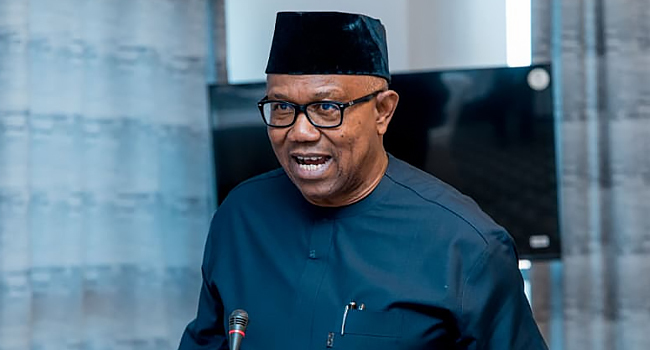
Former Anambra governor says Nigeria’s rising debt burden is crowding out education, healthcare, and poverty reduction as concerns grow over the sustainability of the Tinubu administration’s borrowing strategy.
By John Ishaku | ABUJA, Nigeria | May 19, 2026
Former Anambra State Governor and prominent opposition figure, Peter Obi, has raised fresh concerns over Nigeria’s escalating debt profile following disclosures that the country may spend approximately $11.6 billion servicing debt obligations in 2026.
Obi warned that the growing debt burden should deeply concern Nigerians, particularly as allocations to critical sectors such as healthcare, education, and poverty alleviation continue to lag behind rising debt repayment commitments.
The former Labour Party presidential candidate made the remarks in a statement published on his official X account, days after President Bola Ahmed Tinubu disclosed the projected debt servicing figure during the Africa Forward Summit held in Nairobi, Kenya.
The summit was co-hosted by Emmanuel Macron and William Ruto.
Obi Questions Nigeria’s Borrowing Priorities
While acknowledging that borrowing is not inherently negative, Obi argued that debt becomes dangerous when funds are not invested in productive sectors capable of generating sustainable economic returns.
According to him, many of Nigeria’s previous borrowings have largely financed consumption-driven expenditure rather than transformative development projects.
“There is nothing wrong with borrowing if it is tied to productive investment and guided by fiscal discipline,” Obi stated.
However, he warned that Nigeria’s current borrowing trajectory appears increasingly disconnected from measurable developmental outcomes.
The former governor argued that a substantial portion of the country’s existing debt burden was accumulated under the current administration while new loans continue to be aggressively pursued.
Tinubu Administration’s Borrowing Under Scrutiny
Obi cited several recent external borrowing arrangements linked to the federal government, including:
- Approximately $5 billion from First Abu Dhabi Bank in the United Arab Emirates
- A $1 billion facility through UK Export Finance via Citibank London
- A proposed $1.25 billion facility from the World Bank
- An additional $516 million reportedly arranged through Deutsche Bank
According to Obi, the latest known external borrowing commitments now approach roughly $7.8 billion.
He further noted that domestic borrowing through monthly bond issuances continues to expand Nigeria’s overall debt exposure.
Economic analysts say Nigeria’s debt profile has increasingly become a central issue in national policy debates as the country grapples with:
- High inflation
- Foreign exchange instability
- Rising unemployment
- Weak purchasing power
- Sluggish economic growth
Debt Servicing Now Overshadowing Social Investment
One of Obi’s strongest criticisms focused on what he described as a dangerous imbalance between debt obligations and investment in human capital development.
According to him, Nigeria’s proposed 2026 budget allocates:
- ₦2.46 trillion to healthcare
- ₦2.56 trillion to education
- ₦865 billion to poverty alleviation
Combined, these critical sectors amount to roughly ₦5.885 trillion.
By contrast, Obi estimated that projected debt servicing costs of approximately $11.6 billion could translate to between ₦17 trillion and ₦18 trillion, depending on prevailing exchange rates.
“This means debt servicing alone could exceed combined allocations to healthcare, education, and social protection by almost three times,” Obi warned.
Fiscal policy experts say such imbalances could significantly constrain long-term development and worsen poverty indicators if sustained over multiple budget cycles.
Experts Warn of Structural Economic Risks
Economic observers note that rising debt servicing costs can create a phenomenon known as “fiscal crowding out,” where governments spend increasingly large portions of revenue repaying debts rather than funding infrastructure, education, healthcare, and social programs.
Nigeria’s debt service-to-revenue ratio has already attracted concern from international financial institutions and local economists in recent years.
Some analysts argue that while Nigeria’s total debt-to-GDP ratio may still appear moderate compared to some advanced economies, the real challenge lies in:
- Weak government revenue generation
- Currency depreciation
- Heavy dependence on oil exports
- Rising interest obligations
- Limited productive industrial capacity
Critics warn that borrowing without corresponding productivity gains risks creating long-term fiscal vulnerability.
Obi Compares Nigeria With Global Economies
In defending his argument, Obi referenced countries such as:
- Japan
- United Kingdom
- United States
- United Arab Emirates
- Singapore
- Indonesia
He acknowledged that many of these countries also maintain high debt levels but argued that their borrowings are typically invested in sectors capable of generating long-term economic productivity and repayment capacity.
These sectors include:
- Education
- Healthcare
- Infrastructure
- Innovation
- Industrial development
- Technology
According to Obi, the sustainability of debt depends less on the volume borrowed and more on how effectively the borrowed funds are deployed.
Political Implications Ahead of 2027
Obi’s latest intervention also carries growing political significance ahead of the 2027 general elections.
The former presidential candidate remains one of Nigeria’s most visible opposition voices and has increasingly focused on economic governance issues since the 2023 elections.
His criticism comes amid broader national debates surrounding:
- Cost of living pressures
- Inflationary hardship
- Subsidy removal effects
- Exchange rate volatility
- Rising public debt
Political analysts believe economic performance may become one of the defining issues shaping political alignments ahead of the next electoral cycle.
NDC Realignment Reshapes Opposition Politics
The debt controversy also unfolds against the backdrop of fresh political realignments involving Obi and former Kano State Governor Rabiu Musa Kwankwaso.
Both politicians recently joined the Nigeria Democratic Congress after earlier coalition discussions involving the African Democratic Congress.
Sources close to the opposition movement cited:
- Internal party crises
- External political interference
- Leadership disagreements
- Strategic restructuring ahead of 2027
as factors influencing the realignment.
Observers say economic governance criticisms may increasingly become central to opposition messaging against the Tinubu administration.
Government Yet to Officially Respond
As of the time of filing this report, the Presidency had not issued an official response to Obi’s latest remarks.
However, government officials have consistently defended the administration’s economic policies, arguing that difficult fiscal reforms are necessary to stabilize the economy, attract investment, and restore long-term growth.
Supporters of the administration also argue that inherited structural economic challenges require substantial financing to address infrastructure deficits and fiscal imbalances.
Peter Obi’s warning over Nigeria’s projected $11.6 billion debt servicing obligation has intensified national debate over the sustainability of the country’s fiscal direction under the Tinubu administration.
At the center of the controversy lies a deeper question confronting Africa’s largest economy: whether rising borrowing is financing genuine economic transformation or merely deepening structural dependency and future repayment pressures.
As debt servicing costs increasingly compete with healthcare, education, and poverty reduction for limited public resources, the political and economic consequences of Nigeria’s borrowing strategy are likely to remain at the forefront of national discourse heading toward 2027.
For millions of Nigerians already grappling with economic hardship, the debate is no longer simply about numbers on government balance sheets — but about whether public borrowing is translating into tangible improvements in daily life.




Leave a Reply