
By Amina Musa
ABUJA, Nigeria — September 18, 2026
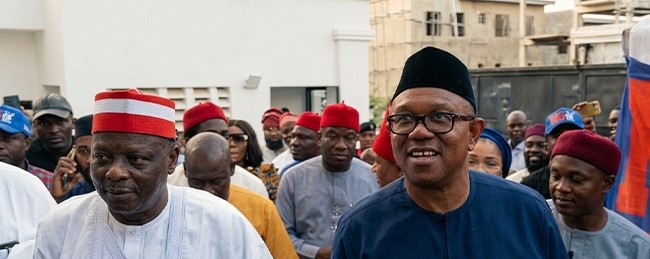
The political machinery around the proposed Peter Obi-Rabiu Kwankwaso ticket is beginning to take organisational shape, with the Obi-Kwankwaso Movement unveiling a 59-member Presidential Campaign Council charged with coordinating mobilisation across Nigeria ahead of the 2027 general elections.
The council brings together zonal and state coordinators and officials responsible for grassroots mobilisation, women affairs, strategy, security and intelligence, legal affairs, information technology, administration and other campaign functions.
John Ughulu, Director-General of the movement, has been named Director-General of the campaign council, while National Secretary Saadatu Sani is also part of the campaign leadership.
The development represents a move by the group to establish a nationwide campaign structure ahead of what is expected to be a highly competitive 2027 political cycle.
However, the announcement also raises questions about the movement’s organisational capacity, the precise political status of the proposed Obi-Kwankwaso ticket and how its independent structure will interact with Nigeria’s formal electoral and party framework as the election approaches.
59 Appointments Stretch Across Nigeria
The council has representatives covering the six geopolitical zones and the Federal Capital Territory, alongside coordinators for each of Nigeria’s 36 states.
The zonal appointments include:
- North-Central: Suleiman Abubakar
- North-West: Hashimu Dungurawa
- North-East: Amadu Gwambe
- South-West: Dr Adebayo Adefolaseye
- South-South: Christopher Ighodaro
- South-East: El-Shaddai Ikeh
The structure also includes directors responsible for specific areas of campaign operations.
Rev. Mike Agbon was named Director of Inter-Ethnic Group in Northern Nigeria, while Sabo Gashua was appointed Director of Grassroots Mobilisation.
Other appointments include Glory Adayi, Women Affairs; Kabir Yahaya, Contact and Engagement; Abdumumini Tijjani, Mobilisation; Yusuf Mani, Special Duties; and Peace Daful, Procurement.
Prof. Charles Nwekeaku was appointed Director of South Eastern Town Hall, while Sunmisola Adebayo was named Director of Information Technology.
Kingdom Okere will oversee Legal Affairs, Abiodun Dabiri Strategy and Planning, Richard Enemona, CSP (Rtd.), Security and Intelligence, and Aisha Abdulrahaman Administration.
Grassroots Politics at the Centre of the Strategy
In a message to the newly appointed officials, Sani framed the council as an organisational vehicle for taking the movement’s message beyond major cities and into local government areas, wards and communities.
She said members had been given responsibility for communicating the vision and aspirations of the movement’s principals to voters nationwide.
The movement says its campaign will focus on a broader national agenda rather than individual political recognition.
Sani described the organisation as a movement seeking to mobilise Nigerians around what it characterised as a more prosperous, united and functional Nigeria.
That remains a political position advanced by the movement rather than an independently established assessment of its programme or electoral prospects.
Independent Movement or Emerging Electoral Platform?
One of the more significant questions surrounding the council is the movement’s decision to maintain an independent organisational structure.
The group said last month that it would not merge with another political organisation ahead of the 2027 elections and reaffirmed its support for Ughulu as founder and Director-General.
That position could become increasingly important as the election timetable advances because campaign organisations, political parties, candidates and electoral bodies occupy different positions within Nigeria’s electoral framework.
The distinction between a political movement’s campaign structure and the legally recognised structures through which candidates contest elections therefore remains an issue to monitor.
Obi-Kwankwaso Ticket: Political Alliance Takes Organisational Form
The campaign council is being established in support of the proposed joint presidential ticket involving Peter Obi and Rabiu Kwankwaso.
The movement identifies Obi and Kwankwaso as its principals and is organising its nationwide mobilisation around their proposed political partnership.
The council’s composition indicates that the movement is attempting to build a structure capable of operating below the national level, with state and zonal officials serving as links between its central leadership and grassroots networks.
The extent to which that structure develops into sustained political organisation across Nigeria will become clearer as campaign activities intensify.
Security and Benue Incident Put Additional Focus on Movement
The council’s unveiling follows the movement’s recent reaction to an incident involving Obi’s convoy during his visit to Benue State.
The group condemned what it described as a disruption of the convoy and called for an impartial investigation.
The movement further claimed that its security personnel deliberately exercised restraint to prevent the situation from escalating into violence.
That account should be treated as the movement’s own version of events pending independent verification or findings from an appropriate investigation.
The episode nevertheless adds another dimension to the movement’s preparations, particularly given the inclusion of a dedicated Security and Intelligence directorate in the new campaign structure.
What We Know
- The Obi-Kwankwaso Movement says it has constituted a 59-member Presidential Campaign Council.
- John Ughulu has been named Director-General of the campaign.
- Saadatu Sani is listed among the campaign leadership.
- Zonal coordinators have been appointed for Nigeria’s six geopolitical zones.
- State coordinators have been designated for the 36 states and the FCT.
- The council contains specialised portfolios covering mobilisation, women affairs, strategy, legal affairs, security, technology and administration.
- The movement says it intends to maintain an independent organisational structure.
What Remains to Be Verified
Several issues surrounding the announcement require further scrutiny as the political process develops.
First is the formal electoral status and legal framework governing the proposed Obi-Kwankwaso ticket and the role of the Nigeria Democratic Congress identified by the movement.
Second is the operational reach of the newly announced state structures. Appointment to a campaign position does not, by itself, establish the size, funding, membership or effectiveness of a grassroots political network.
Third is the extent to which the council will translate its stated mobilisation strategy into measurable political activity across local government areas and wards.
The movement’s claims about its objectives, organisational strength and political appeal should therefore be distinguished from independently verifiable electoral data.
The Road to 2027
The unveiling comes at a stage when Nigerian political actors are positioning themselves ahead of the 2027 elections.
For the Obi-Kwankwaso Movement, the immediate task is no longer simply announcing political intentions. The new council creates an organisational test: whether a national structure spanning six geopolitical zones, 36 states and the FCT can maintain coherent messaging, coordinate grassroots activity and establish an effective campaign operation.
The coming months are likely to provide greater evidence of how the council functions in practice, how the proposed political alliance develops and how the movement’s independent structure fits into the wider electoral landscape.
The 59-member Presidential Campaign Council gives the Obi-Kwankwaso Movement a formal organisational framework for its stated 2027 mobilisation campaign.
Its nationwide spread is clear on paper, but the practical strength of the structure remains a matter for observation and verification.
As Nigeria moves closer to the 2027 elections, the key story will extend beyond the names on the council’s appointment list to what those officials actually build on the ground — and how the proposed Obi-Kwankwaso political alliance ultimately navigates Nigeria’s electoral, legal and party environment.
A1NEWS International Newsroom | Editorial Note
This report distinguishes between information contained in the Obi-Kwankwaso Movement’s announcement and matters requiring independent verification. Political claims and descriptions of the movement’s objectives are attributed to the organisation and are not presented as established electoral outcomes or independent assessments.


Leave a Reply