
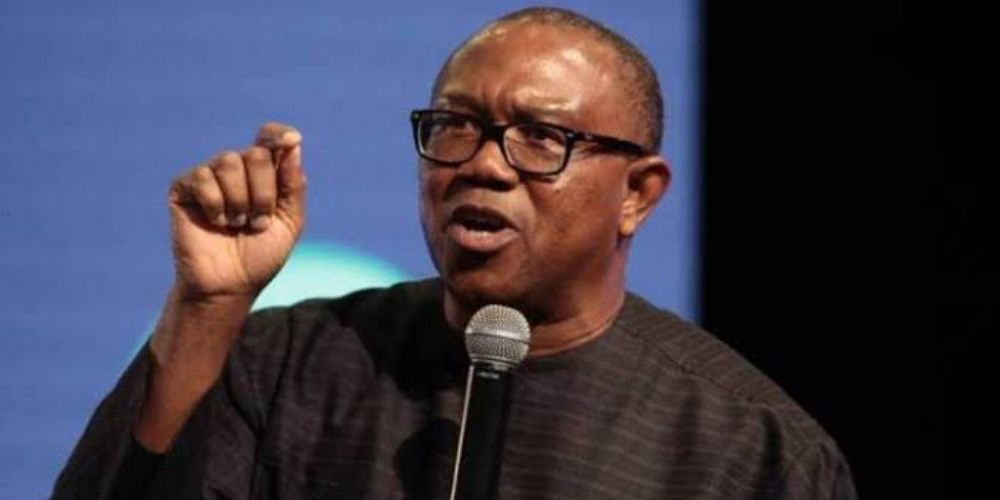
NDC presidential candidate Peter Obi alleges INEC failed Nigerians in 2023, promises independent polling-unit results transmission, retains naira float policy and calls for national unity over historical grievances.
By John Ishaku
Abuja — September 11, 2026 – Presidential candidate of the Nigeria Democratic Congress (NDC), Peter Obi, has mounted a fresh challenge to Nigeria’s electoral and governance systems, alleging that the Independent National Electoral Commission (INEC) failed to meet public expectations during the 2023 general election.
Obi, speaking in an exclusive interview with ARISE News, said Nigerians should no longer rely solely on assurances from electoral authorities but should develop independent mechanisms for monitoring, recording and verifying results from polling units.
He also outlined key elements of his proposed 2027 agenda, including retaining the floating exchange-rate regime introduced under President Bola Tinubu, increasing domestic productivity to strengthen the naira, deploying technology against insecurity and promoting national unity over historical grievances.
His comments place electoral transparency, economic productivity, security and national cohesion at the centre of his emerging 2027 presidential campaign.
Obi Alleges INEC Chairman Worked For His Opposition
Obi accused INEC Chairman Mahmood Yakubu of working for his political opposition during the 2023 presidential election.
The allegation, which Obi presented as part of his explanation for the lessons his political movement drew from the 2023 election, has not in itself established wrongdoing by Yakubu or INEC.
According to Obi, Nigerians and the international community had been given assurances that the electoral commission would conduct a credible election, leading many citizens to place considerable trust in the process.
“In 2023, we took things for granted. We believed INEC. We believed what they said they would do.”
He further alleged that the INEC chairman had projected confidence in the commission’s ability to conduct a fair election while, according to Obi, acting in the interest of his opponents.
“The INEC Chairman convinced the world that he would do the right thing, when in fact he was working for the opposition.”
Obi said the lesson for 2027 was that political actors and citizens would have to independently monitor the electoral process rather than depend exclusively on institutional assurances.
The allegation is significant because INEC’s constitutional responsibility is to conduct elections independently and transparently. Any allegation that its leadership favoured a political party or candidate would therefore require credible evidence and appropriate scrutiny.
Independent Results Transmission System Planned
Obi said his political team would establish a parallel system for collecting and transmitting polling-unit results to its own situation room during the 2027 election.
He said the proposed arrangement would operate alongside the official process and would enable his team to independently compare polling-unit results with results transmitted through INEC’s designated channels.
“We must make sure that in every polling unit, the votes are counted, the votes are recorded properly, the votes are transmitted properly.”
He proposed what he described as a “dual transmission” arrangement, under which results would be transmitted through the official INEC process while also being independently transmitted to his team’s situation room.
The objective, he said, would be to create a verifiable record of what occurred at polling units and reduce the possibility of discrepancies between results recorded at the grassroots and figures announced at higher collation levels.
“We’re not going to have a situation where somebody just pronounces something that didn’t emanate from the polling unit.”
The proposal raises an important distinction: an independent political monitoring system could provide an additional evidentiary record, but it would not replace INEC’s statutory authority to collate and declare election results.
Obi Says He Will Retain Tinubu’s Naira Float Policy
On the economy, Obi said he would retain the floating exchange-rate policy introduced by the Tinubu administration if elected president in 2027.
Asked to identify a policy of the current administration he would preserve, Obi singled out the floating of the naira.
“There’s one – the floating of the Naira. I’m not going to defend it. But I’m going to put productivity to make it more valuable to the people.”
The position represents a departure from any expectation that an Obi administration would automatically reverse the foreign-exchange reforms introduced in June 2023.
The Tinubu administration’s reforms were designed to move Nigeria away from multiple exchange-rate arrangements and toward a more market-driven foreign-exchange system.
The naira subsequently experienced substantial depreciation, contributing to intense public debate over inflation, purchasing power, production costs and living standards.
Obi’s argument is that the exchange-rate mechanism should be supported by higher domestic production and economic productivity.
In practical terms, his position suggests that strengthening the naira should come less from administrative intervention in the foreign-exchange market and more from increasing the volume and competitiveness of goods and services produced in Nigeria.
Technology, Insecurity and the Question of Government Surveillance
Obi also questioned why kidnapping and other forms of insecurity continue to plague Nigerians despite the availability of sophisticated surveillance and communications technology.
Responding to questions about how his administration would confront kidnapping and ransom demands, he argued that modern technology should make it possible for security agencies to identify the locations and movements of criminals.
“In today’s world, you can know where people are.”
Obi contrasted what he described as the government’s ability to monitor political actors with what he considered an inadequate deployment of technological resources against criminals.
“All those equipments they’re using to focus on opponents. Should we focus on criminals?”
He said his administration would prioritise criminals rather than political opponents.
“I’m not going to follow any opponents. I don’t care where they are. I don’t care what they do. It’s not my business. I’m going to focus it where it is.”
Obi acknowledged that something was fundamentally wrong with Nigeria’s security response, given the persistence of kidnappings and other violent crimes.
His argument places technological intelligence, surveillance and targeted security operations at the heart of his proposed approach to insecurity.
However, technology alone does not resolve the institutional challenges surrounding intelligence gathering, inter-agency coordination, prosecution, border security, policing capacity and the protection of citizens’ privacy and civil liberties.
‘Don’t Hold 1966 Coup Against Me’ — Obi
Obi also confronted historical grievances surrounding the 1966 coup and subsequent events in Nigeria’s political history, particularly concerns expressed in some parts of Northern Nigeria.
He urged Nigerians not to attribute historical events that occurred when he was a child to him personally.
“You cannot hold what happened when I was barely three, four years against me.”
Obi acknowledged that Nigeria’s history contains painful and regrettable episodes but argued that the country must avoid allowing historical grievances to permanently determine its political future.
“We must build a future based on love, not on hatred.”
He said national unity would be central to his presidential ambition.
“That’s why my presidency is about unity of the country.”
The statement reflects one of the more politically sensitive dimensions of the 2027 race, where historical memory, ethnic identity, regional distrust and perceptions of political exclusion continue to influence voter sentiment.
What Obi’s Position Means For 2027
Taken together, Obi’s comments point to a campaign strategy built around four broad propositions: stronger independent electoral monitoring, productivity-driven economic management, technology-led security operations and national reconciliation.
His proposed independent results system could increase the availability of parallel election data, but its credibility would depend on transparent methodology, verifiable records, independent observers and clear safeguards against partisan manipulation.
His decision to retain the naira float also suggests that an Obi administration would not necessarily dismantle every major economic reform of the current government. Instead, he proposes changing the conditions surrounding the policy by concentrating on domestic productivity.
On security, his emphasis on technology signals a preference for intelligence-led operations, while his comments on the 1966 coup indicate an attempt to address historical concerns without accepting personal responsibility for events that occurred during his childhood.
Peter Obi’s latest statements provide a clearer indication of how he intends to position himself ahead of the 2027 presidential election.
His criticism of the 2023 electoral process, allegation against the INEC leadership, proposed independent results-monitoring architecture, acceptance of the naira float, technology-focused security strategy and appeal for national unity collectively present an argument for institutional reform rather than a wholesale rejection of every policy of the current administration.
But the most consequential of his claims — particularly the allegation that the INEC chairman worked for his political opposition — remain allegations that require evidence and independent verification.
As Nigeria moves closer to another presidential election, the credibility of competing claims will ultimately depend not on political rhetoric alone but on documentary evidence, transparent institutions and independently verifiable facts.





Leave a Reply