
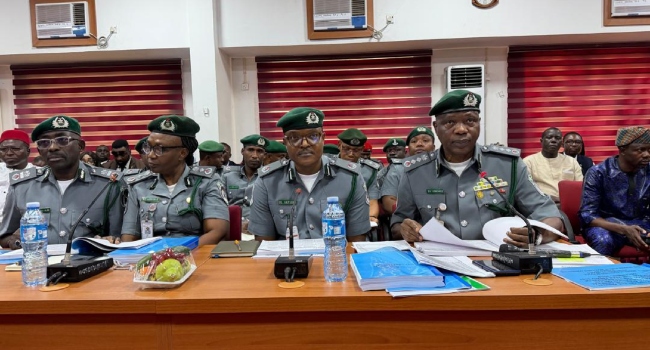
Lawmakers dismiss a major audit allegation against the Nigeria Customs Service after accepting explanations from Comptroller-General Bashir Adeniyi, but launch a fresh reconciliation process to scrutinize dozens of unresolved financial queries.
By Umar Baba / June 17, 2026
ABUJA, Nigeria – The Senate Committee on Public Accounts has dismissed allegations that the Nigeria Customs Service (NCS) failed to remit ₦62.2 billion into the Federation Account, ruling that the disputed funds were wrongly classified in the 2019 Audit Report of the Office of the Auditor-General for the Federation.
The decision followed an extensive investigative hearing in Abuja where lawmakers engaged the Comptroller-General of Customs, Adewale Bashir Adeniyi, over 77 audit queries raised against the agency in the 2019 and 2020 audit reports.
While the committee cleared Customs of the headline allegation, it also established an ad hoc reconciliation committee tasked with reviewing 76 other unresolved audit observations, a move that signals continued legislative scrutiny of one of Nigeria’s largest revenue-generating agencies.
The ₦62.2 Billion Controversy
At the center of the investigation was an audit query alleging that Customs generated over ₦691 billion in revenue in 2017 but remitted only about ₦629 billion into the Federation Account, leaving a discrepancy of approximately ₦62.2 billion.
Officials from the Auditor-General’s office informed lawmakers that the shortfall appeared to constitute unremitted public revenue and therefore warranted investigation by the National Assembly.
The allegation immediately raised concerns about fiscal accountability and transparency within Nigeria’s revenue management framework, particularly at a time when government finances remain under pressure from declining revenues, rising debt obligations, and increasing public expenditure demands.
However, Customs authorities strongly challenged the audit findings.
Customs Explains Nature of Disputed Funds
Defending the agency before the Senate panel, Comptroller-General Adeniyi argued that the disputed amount was never intended for remittance into the Federation Account.
According to him, the ₦62.2 billion consisted of statutory levies collected by Customs on behalf of other government institutions and intervention schemes.
He explained that while certain categories of Customs collections are legally required to be remitted to the Federation Account, other levies are earmarked for designated purposes under existing laws and regulations.
The Customs chief cited levies associated with local production activities involving wheat, textiles, and wines as examples of revenues that are directed to specific accounts rather than the Federation Account.
“The figure in question was improperly classified as under-remitted revenue,” Adeniyi told lawmakers, maintaining that the agency acted in accordance with established financial regulations governing such collections.
Senate Committee Accepts Customs’ Position
Following deliberations and examination of supporting documents, members of the Senate Committee on Public Accounts accepted the explanations provided by the Customs Service.
The committee subsequently dismissed the audit allegation relating to the ₦62.2 billion, effectively clearing the agency of wrongdoing on that specific issue.
Lawmakers also expressed satisfaction with Customs’ responses to the second and third audit queries presented during the hearing.
The decision marked a significant victory for the Customs Service, which has in recent years intensified efforts to improve revenue generation, trade facilitation, and border enforcement operations.
Questions Raised Over Audit Reconciliation Process
Despite accepting Customs’ explanations, several members of the committee questioned why the issue had escalated to the level of a Senate investigation.
Lawmakers argued that discrepancies of this nature should ordinarily be resolved through routine reconciliation exercises between the Office of the Auditor-General and the affected government agency before being brought before parliament.
The concerns highlighted broader institutional challenges within Nigeria’s public financial management architecture, where communication gaps between oversight bodies and government agencies can sometimes result in prolonged disputes over accounting classifications and revenue reporting.
Observers note that such disagreements can create public perceptions of financial irregularities even when the underlying issues stem from technical accounting interpretations.
Adeniyi References Past Institutional Tensions
Responding to lawmakers’ concerns, Adeniyi suggested that the audit years under review coincided with a period marked by strained relations between the National Assembly and the Nigeria Customs Service.
Although he did not elaborate extensively on the nature of those tensions, the statement appeared to indicate that institutional disagreements may have contributed to delays in resolving audit observations through administrative channels.
Financial governance experts argue that stronger collaboration between auditors, oversight institutions, and government agencies is essential to ensuring accurate reporting and preventing avoidable disputes over public finances.
76 Audit Queries Still Under Scrutiny
While the Senate resolved the most prominent allegation against Customs, lawmakers emphasized that numerous issues remain unresolved.
The newly established ad hoc reconciliation committee has been mandated to examine the remaining 76 audit queries contained in the 2019 and 2020 audit reports.
The committee is expected to work closely with officials of the Nigeria Customs Service and representatives of the Auditor-General’s office to reconcile records, verify transactions, and clarify outstanding observations.
Its findings will subsequently be presented to the Senate Committee on Public Accounts for further legislative action.
The outcome of the exercise could have significant implications for fiscal accountability, transparency, and future oversight of government revenue-generating agencies.
Strengthening Accountability in Public Finance
The Senate’s intervention underscores the growing importance of legislative oversight in ensuring accountability across federal institutions.
As one of Nigeria’s leading revenue-generating agencies, the Nigeria Customs Service remains central to government efforts to increase non-oil revenue and improve fiscal sustainability.
Analysts note that effective auditing, transparent reconciliation processes, and timely resolution of financial discrepancies are critical to maintaining public confidence in government institutions and safeguarding national resources.
The ongoing review of the remaining audit queries is therefore expected to attract considerable attention from policymakers, civil society groups, and anti-corruption advocates.
Although the Senate Committee on Public Accounts has exonerated the Nigeria Customs Service from allegations of failing to remit ₦62.2 billion into the Federation Account, the broader audit exercise remains far from concluded.
With 76 additional audit queries still under examination, lawmakers have opted for a reconciliation-based approach aimed at establishing the facts, resolving discrepancies, and strengthening accountability mechanisms within the public sector.
The findings of the newly constituted committee may ultimately shape future reforms in government auditing, revenue administration, and legislative oversight of federal agencies.







Leave a Reply