
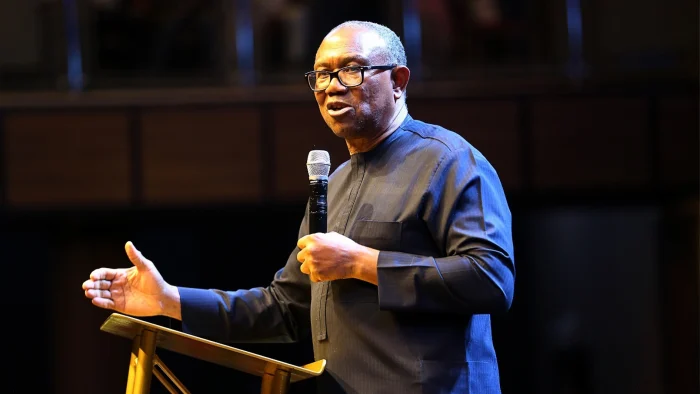
Opposition Leader Raises Alarm Over Rising Debt Burden, Calls for Clearer Use of Loans and Public Accountability
By Amarachi Odenigbo – June 19, 2026
ABUJA, Nigeria – Presidential candidate of the Nigeria Democratic Congress (NDC), Peter Obi, has raised fresh concerns over Nigeria’s rapidly increasing public debt profile, warning that the country risks long-term fiscal strain unless borrowing practices become more transparent, targeted, and performance-driven.
Obi urged the Federal Government to adopt stricter disclosure standards similar to those used in South Africa, where loan facilities are tied to clearly defined development projects and publicly communicated to citizens.
His comments come amid growing national debate over Nigeria’s escalating debt burden, which has nearly doubled in recent years, raising questions about fiscal sustainability, project execution, and accountability in public finance management.
South Africa’s $1bn Loan Model Cited as Benchmark
Obi referenced South Africa’s recent approval of a $1 billion loan from the New Development Bank as an example of structured and transparent borrowing.
According to him, South African authorities clearly outlined from the outset how the funds would be deployed, allowing citizens to track implementation and evaluate outcomes.
The loan was reportedly earmarked for:
- Water supply system upgrades
- Modernisation of sanitation infrastructure
- Electricity distribution improvements
- Waste management expansion in urban centres
Obi argued that this level of clarity enables public oversight and strengthens trust between government and citizens.
“Borrowing Is Not the Problem, Lack of Accountability Is”
The former Anambra State governor emphasized that borrowing itself is not inherently problematic, noting that most economies rely on debt financing to support development.
However, he stressed that the core issue lies in transparency, project traceability, and measurable impact.
According to him, Nigeria’s borrowing framework lacks sufficient clarity on how funds are deployed and what outcomes are achieved.
“There is much to learn from the open and transparent manner in which South Africa secured and explained the purpose of its loan facility. Citizens know what the money is meant for and can monitor the projects,” Obi said.
He argued that every loan contracted in the name of Nigerians should be directly linked to productive investments capable of generating jobs, expanding infrastructure, and reducing poverty.
Nigeria’s Rising Debt Stock Raises Concerns
Obi expressed concern over Nigeria’s rapidly growing debt profile, noting that public debt has reportedly surged from about ₦87 trillion in 2023 to nearly ₦200 trillion in 2026.
While official figures continue to be debated among fiscal analysts, the trajectory reflects a significant increase in borrowing over a short period.
Despite this rise, Obi argued that many Nigerians are unable to identify tangible projects corresponding to the scale of accumulated debt.
He warned that the disconnect between borrowing and visible development outcomes could undermine public trust in government fiscal policy.
Calls for Debt-to-Impact Accountability Framework
Obi urged the Federal Government to adopt a more disciplined borrowing strategy anchored on measurable outcomes and public disclosure.
He outlined key expectations for responsible debt management:
- Full disclosure of loan agreements and project objectives
- Transparent reporting on fund utilisation
- Regular publication of project implementation status
- Independent monitoring of debt-funded projects
- Clear linkage between borrowing and economic impact
He stressed that accountability in public finance is especially critical at a time when Nigerians are facing rising inflation, unemployment, insecurity, and declining purchasing power.
Economic Pressure and Public Debt Debate Intensify
Nigeria’s debt conversation has become increasingly central to national economic discourse, with policymakers, economists, and civil society groups divided over the sustainability of current borrowing levels.
While government officials have defended borrowing as necessary for infrastructure development and economic recovery, critics argue that weak project execution and limited transparency reduce the effectiveness of debt-financed spending.
Obi warned that unchecked borrowing without visible results risks transferring financial burdens to future generations without resolving current economic challenges.
Growing Demand for Fiscal Transparency
The former presidential candidate called for stronger fiscal discipline and improved oversight mechanisms to ensure that public borrowing delivers measurable benefits to citizens.
He insisted that borrowing decisions should not be assessed solely by their approval or size, but by their real-world impact on development indicators such as employment, infrastructure quality, and poverty reduction.
Peter Obi’s remarks have reignited debate over Nigeria’s debt sustainability and the transparency of public borrowing practices. While he acknowledged that debt remains a legitimate development tool, he warned that the absence of clear accountability mechanisms risks weakening economic stability and public confidence. His comparison with South Africa’s structured loan disclosure model highlights growing calls for reforms that link borrowing more directly to measurable national development outcomes.







Leave a Reply