
Regulatory Commission attributes sustained growth to improved operational stability and uninterrupted pipeline operations, while analysts say sustaining momentum will require tackling oil theft and infrastructure challenges.
By John Ishaku
ABUJA, Nigeria — July 13, 2026
Nigeria’s oil industry has recorded its strongest production performance in more than six years after exceeding its crude oil production quota set by the Organisation of Petroleum Exporting Countries (OPEC), a development that could strengthen government revenues, improve foreign exchange earnings, and reinforce investor confidence in Africa’s largest petroleum-producing nation.
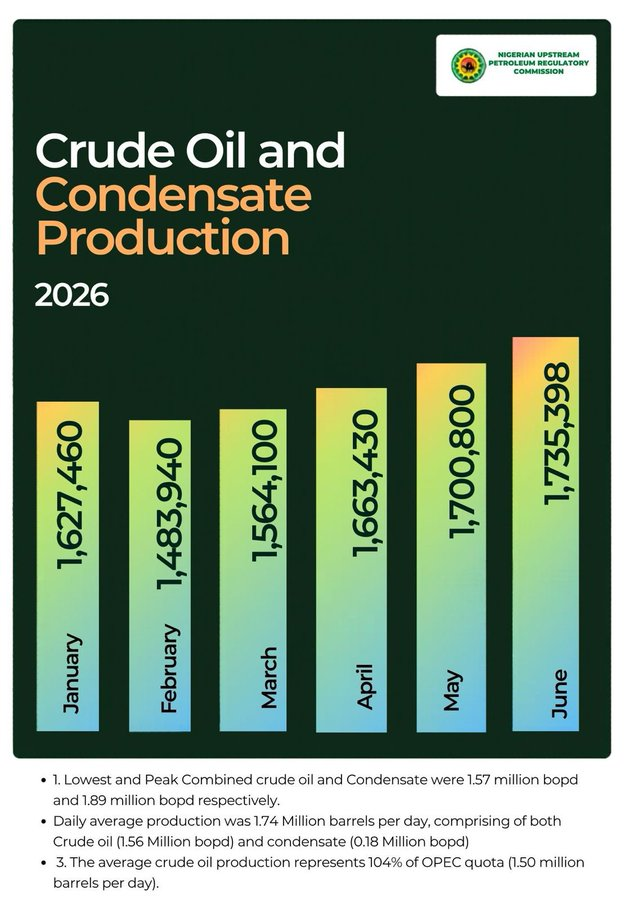
According to figures released by the Nigerian Upstream Petroleum Regulatory Commission (NUPRC), the country’s combined crude oil and condensate production averaged 1,735,398 barrels per day (bpd) in June 2026, marking the fourth consecutive month of production growth.
The Commission disclosed that Nigeria produced 1.56 million barrels of crude oil per day, excluding condensates, alongside approximately 180,000 barrels of condensates daily, enabling the country to achieve 104 per cent of its OPEC production quota of 1.5 million barrels per day.
The latest figures represent Nigeria’s highest crude oil production level since April 2020, making it a 74-month production record, according to the Commission.
The development comes at a critical time when the Federal Government is seeking to strengthen public finances, increase foreign exchange inflows, stabilize the naira, and attract fresh investment into the upstream petroleum sector.
NUPRC Attributes Growth to Stable Operations and Improved Infrastructure Reliability
In a statement signed by the Commission’s Head of Media and Corporate Communications, Eniola Akinkuotu, the NUPRC credited the remarkable improvement to increased operational efficiency across producing fields and the absence of major disruptions to oil transportation infrastructure.
According to the Commission, stable production activities across Nigeria’s oil-producing assets significantly enhanced production uptime throughout June.
Equally important was the uninterrupted operation of major crude evacuation pipelines, which historically have been vulnerable to vandalism, illegal tapping, sabotage, and technical failures.
The Commission stated that improved pipeline integrity allowed producers to evacuate crude more efficiently, thereby reducing production losses that have plagued the industry in previous years.

Peak Production Signals Potential Return to Two Million Barrels Daily
Beyond meeting its OPEC quota, the Commission revealed that Nigeria’s production reached a peak combined output of approximately 1.89 million barrels per day during June.
Although production fluctuated during the month—with the lowest daily output recorded at approximately 1.57 million barrels—the peak performance demonstrates that Nigeria possesses the operational capacity to move closer to the long-discussed 2 million barrels per day production target.
Industry observers view the achievement as evidence that existing production facilities can deliver significantly higher volumes if operational stability continues.
Economic Significance Beyond Production Figures
For Nigeria, rising oil production carries implications that extend well beyond the petroleum industry.
Crude oil remains the country’s largest source of export earnings and one of the government’s primary revenue streams.
Higher production volumes generally translate into:
- Increased federally collected revenues;
- Improved foreign exchange inflows;
- Better fiscal capacity for infrastructure and public services;
- Stronger external reserves;
- Improved investor confidence in Nigeria’s upstream sector.
At a time when Nigeria continues implementing economic reforms and confronting inflationary pressures, improved petroleum earnings could provide much-needed fiscal support.
However, economists caution that production growth alone will not automatically translate into economic prosperity unless accompanied by improved revenue management, refinery expansion, and broader economic diversification.
Operational Gains Reflect Progress Against Longstanding Industry Challenges
Nigeria’s petroleum sector has spent several years battling multiple operational setbacks.
Frequent pipeline vandalism, crude oil theft, illegal refining activities, community unrest, aging infrastructure, and deferred investments have consistently prevented the country from fully utilizing its production capacity.
These challenges repeatedly caused Nigeria to fall below its OPEC production allocations in previous years, costing the country billions of dollars in lost revenue.
The latest production figures therefore suggest measurable improvements in operational management and security around critical oil infrastructure.
Industry stakeholders say sustaining these gains will require continuous collaboration among operators, regulators, host communities, and security agencies.
Maintaining Momentum Remains the Next Challenge
Despite the encouraging figures, analysts note that maintaining production above OPEC quotas will depend on several critical factors.
These include continued investment in upstream exploration, protection of pipeline infrastructure, timely field maintenance, implementation of the Petroleum Industry Act (PIA), and sustained efforts to combat crude oil theft.
Global oil market dynamics—including fluctuations in crude prices and OPEC production policies—will also influence Nigeria’s ability to maximize future production opportunities.
While June’s performance demonstrates significant progress, sustaining consistent output remains the industry’s next major test.
Nigeria’s decision to surpass its OPEC crude oil production quota for the fourth consecutive month represents one of the country’s strongest petroleum sector performances in recent years.
With crude production reaching its highest level in 74 months and combined output approaching two million barrels per day, the latest figures signal renewed operational confidence within the upstream industry.
However, sustaining this momentum will require continued infrastructure protection, investment, regulatory stability, and decisive action against oil theft to ensure that improved production ultimately translates into lasting economic benefits for Nigerians.













Leave a Reply