
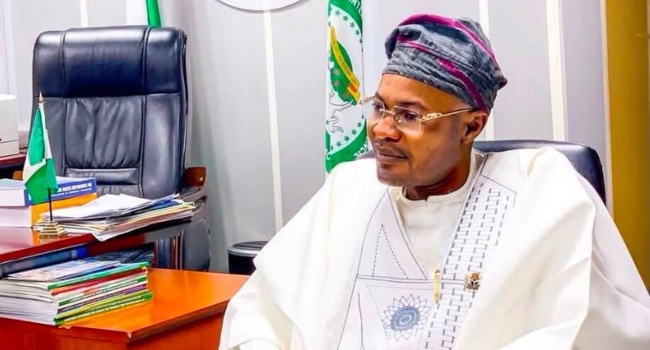
Director-General says statutory safeguards blocked the release of personnel, overhead and capital funds as House probe deepens into the controversial Presidential Foreign Intervention Promotion Council (PFIPC).
By Amarachi Odenigbo
ABUJA, Nigeria — July 24, 2026
The controversy surrounding the disputed Presidential Economic Advisory Council/Presidential Foreign Intervention Promotion Council (PEAC/PFIPC) took a new turn on Thursday as the Budget Office of the Federation informed the House of Representatives that no public funds appropriated for the agency were ever released or spent.
Appearing before the House of Representatives Ad Hoc Committee investigating the establishment, funding and operations of the controversial council, the Director-General of the Budget Office, Tanimu Yakubu, insisted that although budgetary provisions were included in the 2026 Appropriation Act, stringent financial controls prevented any withdrawal or expenditure.
His testimony follows earlier disclosures by the Central Bank of Nigeria (CBN) that accounts opened for the council never received any inflows or remittances, adding another layer to the growing investigation into an agency whose legal status has become the subject of national controversy.
Budget Office: No Money Left Government Coffers
Addressing lawmakers, Yakubu stated categorically that no funds allocated to the council ever matured into lawful expenditure because mandatory statutory and administrative requirements were never fulfilled.
“The conclusion is firm. Not one kobo of the personnel provision could lawfully have been drawn, and not one kobo was drawn,” Yakubu told the committee.
He further explained that:
- Personnel allocations were never accessed.
- Overhead allocations never progressed to cash releases.
- Capital provisions never advanced to procurement or project execution.
“The capital provision never matured into procurement or expenditure. The conditions required for spending were not met and were not close to being met,” he said.
According to the Budget Office, government financial control mechanisms functioned as intended by preventing unauthorized access to appropriated funds.
Financial Controls Prevented Release of Funds
Yakubu disclosed that the Budget Office deliberately withheld financial clearance required before any expenditure could occur.
He explained that:
- No recruitment approvals were granted.
- No payroll was established.
- No personnel emoluments were processed.
- The Federal Ministry of Finance and the Office of the Accountant-General were directed to suspend all payment instruments relating to the council.
As a result, the Budget Office maintained that there are no funds to recover because no government money was ever released.
“The money never moved because the controls held,” Yakubu stated.
He assured lawmakers that the office would continue to provide documents and records to support the ongoing legislative investigation.
House Probe Into PFIPC Intensifies
The House of Representatives established the investigative committee following public controversy surrounding the PFIPC, an organisation whose legal existence has been disputed by the Presidency.
The investigation seeks to establish:
- Whether the council was lawfully created;
- How it obtained budgetary allocations;
- Whether public funds were expended;
- The role of various government institutions in its operations.
Lawmakers have invited officials from multiple federal agencies to provide evidence.
CBN Confirms Accounts Were Never Operated
Earlier in the investigation, the Central Bank of Nigeria (CBN) disclosed that it opened two accounts for the disputed council following instructions from the Office of the Accountant-General of the Federation.
However, Director of Banking Services, Abdullahi Hamisu, informed lawmakers that neither account was ever activated.
According to him:
- No deposits were made;
- No remittances were received;
- No foreign exchange allocations were approved;
- No authorised account signatories were established.
“The accounts have never been operated,” Hamisu said.
The testimony corroborated the Budget Office’s position that no public funds were ultimately disbursed.
Head of Service Denies Office Allocation
The Office of the Head of the Civil Service of the Federation also distanced itself from the disputed agency.
Head of Service Mrs. Didi Walson-Jack informed lawmakers that although correspondence requesting staff deployment was received, no approval was granted.
She also denied reports that the PFIPC occupied office space officially allocated within the Federal Secretariat.
“The Office of the Head of the Civil Service did not allocate office space to the PFIPC,” she said.
Her testimony contradicted public perceptions created after photographs circulated showing the agency apparently operating from government premises.
How the Controversy Began
The PFIPC controversy escalated after Adeniyi Adeyemi publicly presented himself as the Director-General of the council.
For several months, photographs of Adeyemi meeting diplomats, business leaders and prominent public officials circulated widely on social media.
He reportedly operated from office premises in Abuja and participated in official-looking engagements before the Presidency publicly disowned the organisation.
The Presidency subsequently declared that the agency was unknown to the Federal Government and accused Adeyemi of forging appointment documents.
Adeyemi has rejected those allegations.
Allegations Against Presidency Officials
The controversy took another dramatic turn after Adeyemi alleged that the President’s Chief of Staff, Femi Gbajabiamila, received money through an intermediary in connection with his appointment.
Gbajabiamila has categorically denied the allegations and has instituted legal proceedings.
Adeyemi was later arrested in Osun State as investigations expanded.
It is important to note that these allegations remain disputed and have not been established by any court of law.
ICPC Investigation Underway
The Independent Corrupt Practices and Other Related Offences Commission (ICPC) has also commenced investigations into the controversy.
The anti-corruption agency’s inquiry follows President Bola Tinubu’s directive for a comprehensive investigation into the circumstances surrounding the disputed agency.
Among those reportedly invited for questioning is the President’s Chief of Staff.
Investigators are expected to determine whether criminal offences were committed and whether any government processes were manipulated.
Questions Over Budgetary Oversight
Although government officials insist no public money was spent, the controversy has raised broader questions regarding Nigeria’s budget preparation and approval process.
Public finance experts say the inclusion of allocations for a disputed institution highlights the need for stronger verification mechanisms before agencies are included in annual appropriation legislation.
Lawmakers are also expected to examine how the council appeared in official budget documents despite unresolved questions concerning its legal establishment.
The Budget Office’s assertion that “not one kobo was spent” on the disputed PFIPC may ease concerns about direct financial loss to the treasury, but it does not resolve the wider constitutional and administrative questions surrounding the agency’s creation, recognition and inclusion in the federal budget.
With investigations by the House of Representatives and the ICPC continuing, attention is expected to remain focused on determining how the disputed council emerged, whether any laws were breached and what reforms may be necessary to prevent similar controversies in the future.







Leave a Reply