
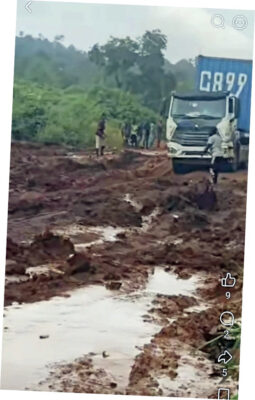
Travellers across Nigeria report 24-hour gridlocks and collapsed federal highways in Kogi, Edo, Ekiti, Delta, Imo and Abia. Investigative account of harrowing journeys, abandoned vehicles, delayed transport—including corpses—and rising costs as multi-billion-naira projects stall.
By A1NEWS International
ABUJA / LAGOS / BENIN CITY, Nigeria — As commuters describe hours-long traffic purgatory and near-fatal road failures across multiple states, Nigeria’s federal highways are increasingly being branded not just as neglected infrastructure, but as deadly corridors that turn ordinary journeys into nightmares.
For the past two weeks, drivers, commuters and transport operators have recounted a growing national crisis: federal roads that have collapsed into craters, gullies and deep potholes—forcing road users to abandon vehicles, trek through perilous stretches and endure standstill traffic for more than 24 hours.
A trip from Lagos to Asaba—normally taking about seven hours—has, in some cases, stretched to 36 hours due to the near-collapse of sections of the dual carriageway, with motorists reporting that movement is repeatedly halted by failed sections of the road, deep erosion and gridlock.
While the Lagos–Ibadan Expressway remains comparatively smoother, road users say the misery starts after the Sagamu Interchange, where worsening surface failures force motorists into hazardous manoeuvres and long delays.
Benin Bypass Collapse—“We Feared the Vehicle Could Fall”
One of the most frightening accounts came from travellers stranded at the Benin Bypass.
Margaret and Jane, who travelled from Abakaliki, Ebonyi State, aboard a luxury night bus on Saturday night, said the bus reached the Benin Bypass around 2:00 a.m. and got trapped in a gridlock triggered by a collapsed portion of the road.
They claimed the bus remained stuck until 3:00 p.m.—a total of 13 hours—as motorists navigated a failed route that caused vehicles to swing dangerously. One of the travellers said passengers feared vehicles might fall into the damaged section, prompting them to request the driver open the door so they could escape on foot.
Other commuters reportedly abandoned vehicles when drivers switched off engines, unable to proceed through the failed road segment.
“Bloodcurdling” Delays—Trauma on Lagos–Asaba and Anambra–Lagos Routes
Road users say the federal road crisis is not limited to one state or corridor.
A school proprietor, Mrs. Nkwachi, described as “bloodcurdling” her experience travelling from Anambra to Lagos. She reportedly left Anambra in her Honda Pilot SUV on a Friday morning but did not arrive until Sunday afternoon—nearly two full days later.
She said passengers feared for their lives as trailers and luxury buses navigated gullies and narrowed parts of the route, sometimes causing vehicles to swing while drivers struggled to pass through erosion-filled sections.
Nkwachi said the experience was so terrifying she vowed not to travel by road again unless repairs are carried out.
Deaths, Stench and Distress—How Bad Roads Threaten Even Bereavement Logistics
The degradation of roads has also reportedly affected transportation of corpses—adding distress for families already coping with loss.
A motor hearse conveying a corpse from Ajegunle to Abam, in Arochukwu Local Government Area of Abia State, reportedly departed on Thursday, August 20. Sources said the corpse had been temporarily embalmed to last for about 16 hours, but roughly 24 hours later, the vehicle was still within Delta State, and the corpse was said to have begun emitting an offensive odour.
Transporters and Businesses Bleed—From Empty Terminals to Lost Incomes
The road crisis is also taking a toll on commercial livelihoods dependent on predictable road movement.
By Monday evening, transport operators who normally load about four buses nightly reportedly had no vehicles ready at their Lagos terminals. With buses travelling to the South-East and returning to Lagos reportedly stuck in gridlock, the earnings of drivers, touts, station managers and other stakeholders have been strained.
“Heartbeat of the Nation” Under Siege—Edo’s Federal Roads Deteriorate
Edo State is widely described as “The Heartbeat of the Nation” due to its strategic position and road network linking major regions. Yet residents say that reputation is increasingly undermined by decades of neglect and the dilapidation of several federal corridors.
Across Benin, commuters said they now navigate roads marked by potholes, failed sections, erosion and damaged shoulders—conditions they say have escalated public-safety risks and raised transport costs.
Residents described harrowing journeys on routes including the Benin–Asaba–Onitsha Expressway, with claims of prolonged travel times, frequent vehicle breakdowns and accidents.
A motorist said he spent about a week travelling from Benin to Asaba due to road conditions. He said his vehicle broke down on the affected portion, and other articulated vehicles reportedly got stuck in potholes.
Another road user said rainfall worsens the crisis by allowing water to accumulate on failed sections, leaving motorists stranded for hours.
For a businesswoman living in Asaba but travelling from Benin, what was expected to be a three-hour trip became a 10-hour journey, with passengers reportedly crying as buses manoeuvred through dangerous link roads inside communities.
Imo and Abia—Federal Roads That Turn Daily Commuting Into Survival Struggles
In Abia State, commuters said they are suffering across multiple dilapidated federal roads, including the Aba–Ikot Ekpene, Bende–Ohafia, Ohafia–Arochukwu and Umuahia–Ikot Ekpene highways.
Residents said rehabilitation plans have not translated into effective work, with communities also struggling economically as farmers face difficulties transporting produce to urban markets.
In Imo State, road users described federal corridors as a daily challenge—citing delays, funding gaps and poor workmanship. They highlighted hotspots such as the Onitsha–Owerri route (including the Mgbidi axis), where deep craters reportedly trap trucks for days. They said rainfall covers potholes with water, contributing to breakdowns and accidents.
Residents also referenced additional corridors where poor drainage, erosion and failed pavement reportedly continue to destabilize travel.
They further recalled that a bus accident in 2024 was linked to a pothole-related swerve, deepening public concerns over the safety of these federal links.
Kogi—“Abandoned for Over 45 Years” Road Woes Fuel Fear, Damage and Kidnapping Claims
In Kogi State, travellers recounted painful experiences on federal roads including portions of the Lokoja–Abuja highway, the 255-km Kabba–Ilorin Road, and shorter corridors such as Kabba–Omuo and Kabba–Okene.
One traveller described the Kabba–Ilorin Road as having been abandoned for decades after reconstruction, narrating a trip from Lokoja to Ilorin that should normally take seven to eight hours but reportedly took more than 12 hours.
She said deep potholes forced dangerous manoeuvres, making road users unable to predict which side of the road was safer—while trucks reportedly move aggressively along the damaged corridor. She added that the conditions are believed to have intensified fears of robbery and kidnapping.
Another passenger described the Kabba–Omuo road as eaten away by erosion and said drivers responded by charging higher fares because the route now takes significantly longer to traverse.
Ekiti—Multi-Billion Naira Contracts, Yet “Roads to Nowhere”
In Ekiti State, residents say federal highways have become a test of public promise versus lived reality.
They pointed to major corridors—including the Akure–Ado–Ekiti dual carriageway and roads connected to major education and cargo routes—as projects with large contract values but ongoing visible deterioration.
One former senator, Babafemi Ojudu, was cited describing Nigeria as having “happened” to the Akure–Ado–Ekiti road—after residents said completion delays and stalled construction left the second carriageway incomplete long after official flag-offs.
Residents also alleged that equipment reportedly disappeared from construction sites, leaving the public with a route described as unsafe—marked by potholes, broken shoulders and traffic jams.
As Nigerians continue to lose time, money and safety on federal highways, the pattern reported across Kogi, Edo, Ekiti, Delta, Abia, Imo and neighbouring states suggests systemic failure: inadequate maintenance, incomplete rehabilitation and preventable damage that transforms transport routes into gridlock corridors and public-safety hazards.
With travellers increasingly vowing to avoid road journeys and transport businesses reporting empty terminals and delayed departures, the road crisis threatens not only mobility—but also the credibility of Nigeria’s infrastructure contracting and repair timelines.
A1NEWS investigations seek accountability from relevant federal and state authorities, including on-road timelines, workmanship standards, and the status of ongoing rehabilitation contracts—before public confidence collapses further.










Leave a Reply