
Opposition party warns that Nigeria’s mounting external borrowing could saddle future generations with unsustainable debt, accuses National Assembly of weakening legislative oversight and urges voters to support Peter Obi and Rabiu Kwankwaso in January 2027 elections.
By A1NEWS Political Investigative Desk
ABUJA, NIGERIA | NOVEMBER 5, 2026
The Nigeria Democratic Congress (NDC) has intensified its criticism of President Bola Tinubu’s borrowing strategy, warning that Nigeria’s growing debt obligations could impose a significant financial burden on future generations unless urgent measures are taken to strengthen fiscal discipline and accountability in public expenditure.
The opposition party has called on Nigerians to participate massively in the January 16, 2027 presidential election, describing the forthcoming general election as a critical opportunity for citizens to demand responsible leadership, transparency and prudent management of national resources.
The party’s position followed President Tinubu’s latest request to the National Assembly for approval of an additional $7.7 billion in external borrowing, reportedly equivalent to approximately ₦10.79 trillion, to help finance the 2026 budget deficit.
In a statement issued by its National Presidential Campaign Council spokesperson, Dr Chiogo Constance Ikokwu, the NDC described the proposed borrowing as another indication of what it characterised as an increasingly troubling pattern of government dependence on external loans.
The party argued that the implications of continued borrowing extend beyond the current administration, potentially transferring substantial repayment obligations to generations of Nigerians who had no role in making the financial decisions.
$7.7 BILLION LOAN REQUEST TRIGGERS FRESH POLITICAL CONTROVERSY
At the centre of the controversy is President Tinubu’s latest request for legislative approval of a $7.7 billion external borrowing plan intended to support the financing of the 2026 national budget deficit.
The proposed facility has reignited the debate over Nigeria’s debt sustainability, the government’s revenue-generation capacity and the effectiveness of public spending.
For the NDC, the latest request represents a continuation of what it describes as a recurring borrowing pattern, raising concerns about the country’s long-term fiscal stability.
Ikokwu criticised the frequency of the administration’s loan requests, using the expression “One Week! New Loan!” to underscore the party’s dissatisfaction with what it considers excessive dependence on borrowing.
According to the party, the growing debt burden raises fundamental questions about the government’s economic priorities, the returns expected from borrowed funds and the extent to which Nigerians are benefiting from public expenditure.
However, the broader economic debate also requires scrutiny of the specific terms of the proposed facility, including its interest rate, repayment schedule, currency exposure, intended projects and expected economic returns.
These details will be essential in determining whether the proposed borrowing represents productive investment or an additional fiscal burden.
NDC ACCUSES NATIONAL ASSEMBLY OF WEAKENING OVERSIGHT
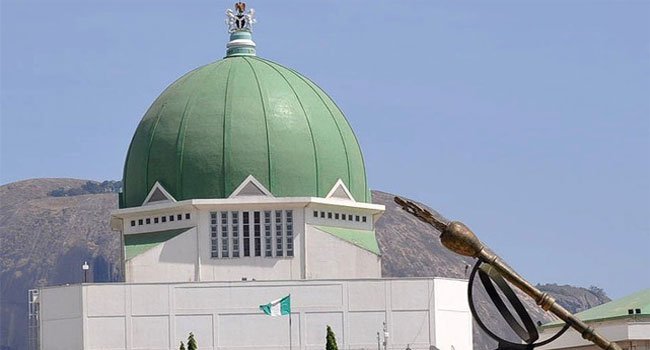
Beyond its criticism of the executive arm of government, the NDC has questioned the effectiveness of the National Assembly’s oversight responsibilities in scrutinising federal borrowing proposals.
Ikokwu alleged that lawmakers had become overly accommodating of the executive, describing the legislature as a “rubber-stamp” institution.
She argued that legislative approval of government borrowing should involve rigorous examination of the economic justification, repayment capacity and potential consequences for the country’s financial future.
In her words:
“Truly, it seems that right now, we cannot stop President Tinubu from his One Week! New Loan! One Week! New Loan! borrowing spree, which is already hitting the roof, because, regrettably, he has pocketed the National Assembly. We seem to have a rubber-stamp legislature that, before a loan request formally gets to its desk, it has already been endorsed.”
The allegation raises an important constitutional question concerning the independence of the legislature and its responsibility to scrutinise public borrowing.
Under Nigeria’s constitutional framework, the National Assembly plays a critical role in approving federal borrowing arrangements and exercising oversight over public finance.
Nevertheless, the NDC’s allegation of compromised legislative independence remains a political accusation and would require independent evidence to establish any improper conduct by lawmakers.
DEBT BURDEN AND FUTURE GENERATIONS: QUESTIONS OVER FISCAL SUSTAINABILITY
Nigeria’s borrowing debate has increasingly become a question of intergenerational economic responsibility.
While external loans can finance infrastructure, stimulate economic activity and address budgetary shortfalls, excessive borrowing without corresponding productive returns can create long-term fiscal pressures.
Debt servicing obligations may also reduce the resources available for essential sectors such as education, healthcare, infrastructure, security and social protection.
The NDC maintains that Nigeria must avoid a situation where future administrations and generations inherit financial obligations arising from borrowing decisions that do not produce sufficient economic benefits.
The party insists that public borrowing must be supported by transparent expenditure plans, measurable development outcomes and clear accountability mechanisms.
Its position reflects a wider national debate over whether Nigeria’s fiscal strategy should place greater emphasis on borrowing or strengthening domestic revenue mobilisation, reducing wasteful expenditure and improving public-sector efficiency.
NDC URGES NIGERIANS TO SUPPORT OBI AND KWANKWASO
Turning its criticism into an electoral appeal, the opposition party urged Nigerians to mobilise ahead of the January 16, 2027 presidential election and support its candidates, Peter Obi and Engr. Rabiu Musa Kwankwaso.
Ikokwu argued that citizens should not surrender to economic hardship or become discouraged by what the party considers inadequate government accountability.
She pointed to the November 4, 2026 elections in the United States, arguing that American voters had demonstrated the importance of electoral participation in determining political leadership.
According to her, Nigerians facing rising living costs, economic uncertainty and other financial pressures should similarly recognise the ballot as a powerful instrument for demanding political change.
The NDC spokesperson called on citizens to turn out in large numbers and use their votes to demand a government that prioritises public welfare, transparency and responsible management of national resources.
The party’s appeal places economic management and public debt at the centre of its emerging campaign message.
OBI’S ONE-TERM PROMISE AND THE NDC’S GOVERNANCE MESSAGE
The statement also comes amid Peter Obi’s reported declaration that he would serve only one four-year term if elected president in 2027.
The position is likely to form part of the broader political conversation surrounding the opposition’s campaign, particularly concerning leadership accountability, political succession and the possibility of institutional reforms within a single presidential term.
For the NDC, the central argument is that Nigeria requires a government capable of restoring public confidence, strengthening democratic institutions and ensuring that national resources are managed in the interests of ordinary citizens.
However, beyond campaign declarations, voters will ultimately assess political parties and candidates on the credibility of their economic proposals, fiscal policy, implementation capacity and measurable commitments to national development.
THE BIGGER QUESTION: HOW MUCH BORROWING CAN NIGERIA SUSTAIN?
The controversy surrounding the proposed $7.7 billion loan highlights a fundamental challenge confronting Nigeria’s economic management: balancing immediate financing needs against long-term debt sustainability.
The critical issues extend beyond the size of individual borrowing requests.
They include the country’s capacity to generate sufficient revenue, the proportion of public income allocated to debt servicing, the productivity of borrowed funds and the transparency of government expenditure.
The debate also places responsibility on the National Assembly to ensure that borrowing proposals undergo meaningful scrutiny rather than being treated as routine administrative approvals.
For Nigerians, the central concern is whether borrowed resources will translate into improved living standards, employment opportunities, reliable infrastructure and sustainable economic growth.
The NDC’s warning over Nigeria’s mounting debt burden has added another dimension to the political contest ahead of the 2027 general election.
By linking the Tinubu administration’s borrowing strategy to the country’s economic future, the party is seeking to make fiscal accountability a defining issue in the coming electoral campaign.
Nevertheless, the debate should extend beyond political accusations to include transparent disclosure of borrowing terms, independent assessment of debt sustainability, legislative scrutiny and measurable evidence of how borrowed funds are utilised.
Ultimately, Nigerians will have to determine through the democratic process which political leadership offers the most credible path towards economic recovery, fiscal responsibility and national development.
As the 2027 elections approach, the real test for political parties will not simply be their ability to criticise existing policies, but their capacity to present practical, transparent and sustainable alternatives.
A1NEWS will continue to monitor Nigeria’s borrowing plans, legislative responses, debt sustainability concerns and political developments ahead of the 2027 general elections.



Leave a Reply