
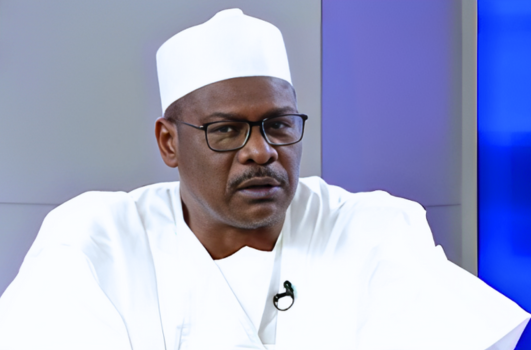
Borno South senator says he only alerted security agencies after receiving information on Boko Haram/ISWAP ransom video, insists he has never handled ransom payments or negotiated with terrorists.
By Umar Baba
ABUJA, Nigeria — July 25, 2026
Senator Ali Ndume, representing Borno South Senatorial District in the National Assembly, has strongly denied allegations linking him to ransom negotiations involving victims abducted by terrorists in Borno State, describing the claims as false, misleading and capable of undermining ongoing efforts to combat insecurity in Nigeria’s North-East.
The lawmaker insisted that he has never negotiated with kidnappers or terrorist groups, nor received or handled ransom funds on behalf of victims or government authorities.
Ndume made the clarification during an appearance on Politics Today, a Channels Television programme, on Friday, where he responded to allegations made by the President of the Borno South Youth Alliance, Samaila Kaigama.
The accusations relate to the abduction of residents of Ngoshe, a community in Gwoza Local Government Area of Borno State that has suffered repeated attacks from Boko Haram and Islamic State West Africa Province (ISWAP) insurgents.
Senator Rejects Allegations of Receiving Billions in Cash
Responding to claims that he served as an intermediary in ransom negotiations, Ndume categorically denied ever participating in discussions between kidnappers and government officials.
According to him, the allegation that he handled billions of naira in ransom payments is completely untrue.
“I have said it already. In my life, I have never seen ₦1 billion cash, not to talk of ₦5 billion,” Ndume stated.
The senator maintained that at no time did he negotiate with terrorists or facilitate ransom payments for the release of kidnapped victims.
‘My Only Role Was Alerting Security Agencies’
Explaining his involvement, Ndume said he merely acted as a responsible public official after receiving information from Kaigama regarding a video allegedly released by Boko Haram/ISWAP.
According to him, the video reportedly demanded a ransom of ₦5 billion for the release of abducted residents.
Rather than opening communication with the terrorists, Ndume said he immediately passed the information to relevant security agencies for appropriate action.
He stressed that informing security authorities about credible intelligence should not be misconstrued as participating in negotiations with criminal groups.
The senator argued that elected representatives have a duty to relay security information whenever threats to citizens emerge, particularly in conflict-affected communities.
Fresh Spotlight on Nigeria’s Kidnap Crisis
The controversy comes against the backdrop of Nigeria’s worsening kidnapping crisis, particularly across the North-East, North-West and North-Central regions, where armed groups continue to abduct civilians for financial gain and strategic leverage.
Successive administrations have maintained that government policy does not support the payment of ransom to terrorists, warning that such payments could finance further violence and strengthen criminal networks.
Despite this policy, families and communities often face immense pressure to secure the release of loved ones, fueling persistent debates over unofficial negotiations and the role of intermediaries.
Security analysts have repeatedly warned that allegations involving public officials in ransom negotiations require careful investigation because of their implications for national security, public confidence and counterterrorism operations.
Demand for Credible Investigation
The claims and denials have intensified calls for transparency regarding kidnapping incidents and ransom allegations, particularly where elected officials are mentioned.
Observers argue that any allegation connecting public office holders to terrorist negotiations should be supported by verifiable evidence and, where necessary, independently investigated to protect both public trust and the integrity of security operations.
Experts also caution against spreading unverified claims that could undermine counterinsurgency efforts or expose communities to additional security risks.
Growing Security Concerns in Borno
Borno State remains one of Nigeria’s most affected regions by insurgency despite years of sustained military operations against Boko Haram and ISWAP.
Communities across southern Borno, including Gwoza and surrounding areas, continue to experience attacks, kidnappings and displacement, making security one of the dominant issues confronting residents.
The latest controversy highlights the continuing humanitarian and security challenges facing communities that remain vulnerable to insurgent activities.
Senator Ali Ndume has firmly rejected allegations that he participated in ransom negotiations or handled funds connected to the release of kidnapped residents in Borno State, insisting his only action was to notify security agencies after receiving information about an alleged terrorist ransom demand.
As insecurity and kidnappings continue to threaten communities across Nigeria, the incident underscores the importance of accurate information, transparent investigations and coordinated security responses to protect citizens while preventing misinformation from complicating counterterrorism efforts.





Leave a Reply