
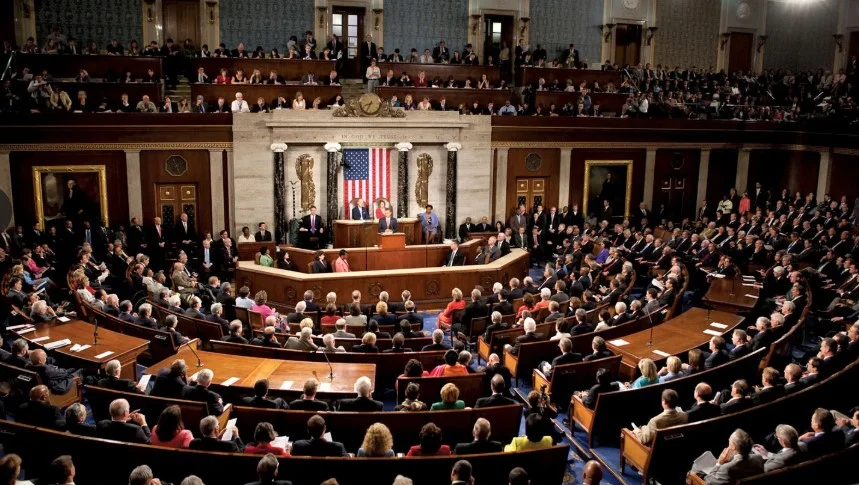
Congressman Gregory Steube’s amendment seeks to suspend all U.S. assistance to Nigeria until Washington certifies that Abuja has taken effective steps to curb violence and hold perpetrators accountable.
By A1NEWS International
WASHINGTON, D.C./ABUJA – July 16, 2026
The United States House of Representatives has approved an amendment seeking to withhold 100 percent of U.S. assistance to Nigeria until the Federal Government demonstrates measurable progress in addressing violence and protecting vulnerable communities, particularly Christians targeted in attacks.
The amendment, sponsored by Republican Congressman Gregory Steube of Florida, was adopted by a voice vote on Wednesday and incorporated into the Fiscal Year 2027 State Department Appropriations Bill, which was later passed by the House in a 217–209 vote, largely along party lines.
While supporters describe the measure as an accountability mechanism aimed at protecting religious freedom and human rights, the proposal is expected to generate diplomatic debate between Abuja and Washington, especially as the two countries continue to cooperate on counterterrorism and regional security.
The legislation must still be approved by the U.S. Senate and signed by President Donald Trump before it becomes law.
House Approves Tougher Restrictions on Nigeria Aid
The adopted amendment significantly strengthens an earlier provision contained in the appropriations bill.
Originally, the legislation proposed withholding 50 percent of U.S. assistance allocated to Nigeria until the U.S. Secretary of State certifies that the Nigerian government has taken effective steps to:
- Prevent violence;
- Protect vulnerable communities;
- Investigate attacks; and
- Hold perpetrators accountable.
Congressman Steube’s amendment increases the withholding from 50 percent to 100 percent, while retaining the same certification requirements.
The amendment was approved through a voice vote, indicating no formal recorded roll-call was requested during consideration.
Steube: ‘American Taxpayers Should Not Fund Failure’
Following the House vote, Congressman Steube announced the outcome on his official X (formerly Twitter) account.
“My amendment to withhold 100% of U.S. aid to Nigeria until its government stops the slaughter of Christians has passed.
“American taxpayers should never bankroll governments that turn a blind eye while Christians are abducted, tortured, and murdered. No more wasteful foreign aid!”
During debate on the House floor, Steube argued that Nigeria continues to experience widespread violence that the government has allegedly failed to address adequately.
He maintained that reducing aid by only half would not provide sufficient leverage to encourage reforms.
“Foreign aid should never be a reward for failure,” he told lawmakers.
Steube further linked the proposal to America’s fiscal concerns, arguing that the United States should prioritize domestic financial responsibilities while ensuring overseas assistance produces measurable results.
Certification Conditions Remain Unchanged
Although the amendment increases the financial consequences for Nigeria, it does not introduce new benchmarks.
Under the legislation, aid could resume once the U.S. Secretary of State certifies that Nigeria has taken effective action to:
- Prevent violent attacks;
- Protect affected communities;
- Investigate incidents of violence;
- Prosecute offenders; and
- Demonstrate accountability.
The certification mechanism is intended to provide measurable standards before any suspended assistance can be restored.
Background: Religious Freedom Concerns
The congressional action follows increasing scrutiny within Washington over reports of religious violence in Nigeria.
Human rights organizations have repeatedly documented attacks attributed to terrorist groups, armed bandits, criminal gangs and communal conflicts affecting both Christian and Muslim communities in different parts of the country.
Some advocacy organizations have argued that Christians have been disproportionately targeted in certain regions, particularly in the Middle Belt and parts of northern Nigeria.
The Nigerian government, however, has consistently maintained that the country’s security challenges are primarily driven by terrorism, banditry, farmer-herder conflicts and criminality rather than a government policy of religious persecution.
Nigeria’s Security Challenges Remain Complex
Security analysts note that Nigeria’s security landscape involves multiple overlapping conflicts, including:
- Boko Haram insurgency;
- Islamic State West Africa Province (ISWAP) attacks;
- Armed banditry;
- Kidnappings for ransom;
- Farmer-herder conflicts;
- Separatist-related violence; and
- Organized criminal activities.
Experts caution that while some attacks have religious dimensions, many incidents are also influenced by ethnic, economic, environmental and territorial disputes.
Diplomatic Relations Could Face New Pressure
The House vote comes amid evolving diplomatic relations between Nigeria and the United States.
According to the legislative debate, the amendment follows President Donald Trump’s 2025 decision to redesignate Nigeria as a Country of Particular Concern (CPC) over allegations relating to religious freedom.
It also follows a period of diplomatic tension reportedly arising after a U.S. military missile strike on Nigerian territory during counterterrorism operations on Christmas Day 2025.
Despite those disagreements, both countries have continued to cooperate on intelligence sharing and counterterrorism operations targeting extremist groups operating across northern Nigeria and the Lake Chad Basin.
Analysts believe the proposed aid restrictions could complicate future bilateral engagements if eventually enacted.
Legislation Still Faces Senate Approval
Despite clearing the House of Representatives, the amendment is far from becoming law.
Under the U.S. legislative process, the appropriations bill must now:
- Be considered and approved by the Senate;
- Be reconciled if differences emerge between House and Senate versions;
- Receive final approval from both chambers; and
- Be signed into law by President Donald Trump.
Until those steps are completed, U.S. assistance to Nigeria remains unchanged.
Potential Implications for Nigeria
If enacted, the legislation could affect a wide range of U.S.-supported programmes in Nigeria, including assistance relating to:
- Public health;
- Humanitarian relief;
- Governance;
- Democracy promotion;
- Security cooperation;
- Education; and
- Development initiatives.
However, the precise scope of any future funding restrictions would depend on the final wording of the legislation and any exemptions included in the enacted law.
The U.S. House’s decision to support Congressman Gregory Steube’s amendment represents one of the strongest congressional efforts in recent years to condition American assistance to Nigeria on measurable improvements in addressing violence and protecting vulnerable communities.
While supporters argue the measure strengthens accountability and human rights protections, critics are expected to question whether broad aid restrictions could undermine humanitarian programmes and ongoing security cooperation.
For now, the proposal remains a legislative initiative awaiting Senate consideration and presidential approval before it can alter U.S.-Nigeria relations or foreign assistance.
As of the time of filing this report, the Nigerian Government had not issued an official response to the House vote.






Leave a Reply