
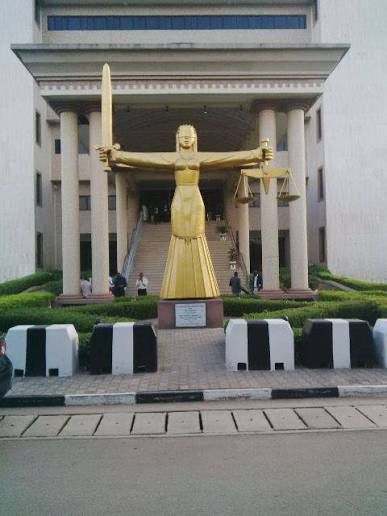
Federal High Court declines to compel INEC to recognise the Wabara-led PDP Board of Trustees, while the Court of Appeal restores INEC’s 2027 election timetable, reinforcing the electoral body’s authority ahead of the general elections.
By Angela Udende
ABUJA, Nigeria – July 18, 2026
Nigeria’s evolving legal landscape ahead of the 2027 general elections recorded another significant development on Friday as two separate courts delivered judgments that strengthened the position of the Independent National Electoral Commission (INEC) while dealing fresh setbacks to political actors seeking judicial intervention in internal party disputes and electoral preparations.
In one decision, the Federal High Court in Abuja dismissed a suit seeking to compel INEC to recognise the Senator Adolphus Wabara-led Board of Trustees (BoT) and the Tanimu Turaki-led interim National Working Committee (NWC) of the Peoples Democratic Party (PDP).
In another, the Court of Appeal overturned an earlier Federal High Court judgment that had nullified INEC’s revised timetable for the 2027 general elections, affirming the commission’s statutory powers to regulate electoral timelines.
The rulings are expected to influence political party preparations, internal leadership contests and electoral administration as Nigeria moves closer to the 2027 polls.
Federal High Court Rejects Wabara-Led PDP Faction’s Suit
Justice Salim Ibrahim of the Federal High Court, Abuja, dismissed the suit filed by members of the Senator Adolphus Wabara-led Board of Trustees after upholding preliminary objections challenging the court’s jurisdiction.
The plaintiffs had asked the court to compel INEC to update its records by recognising the Tanimu Turaki (SAN)-led interim National Working Committee allegedly approved by the party’s National Executive Committee.
They also sought an order directing INEC to publish the names of the faction’s leadership on its official records.
Among the plaintiffs were Senator Adolphus Wabara, former Niger State Governor Muazu Babangida Aliyu, Prof. Jerry Gana, Chief Olabode George, Hajiya Maryam Ciroma, Hajiya Zainab Maina, Dame Esther Uduehi and the PDP.
Court Declines Jurisdiction
Before addressing the substantive issues, Justice Ibrahim considered applications filed by another PDP faction aligned with the Minister of the Federal Capital Territory, Nyesom Wike, seeking to join the proceedings.
The court granted the joinder request, holding that the interests of the opposing faction would be directly affected by any judgment delivered.
After hearing arguments, the judge upheld the preliminary objections and struck out the case for want of jurisdiction.
The court described the action as an abuse of court process, holding that the issues raised had substantially been determined in previous litigation.
The judgment effectively leaves INEC’s current recognition of the PDP leadership unchanged.
Appeal Court Restores INEC’s 2027 Election Timetable
In a separate judgment delivered the same day, a three-member panel of the Court of Appeal sitting in Abuja restored INEC’s revised timetable for the 2027 general elections.
The appellate court unanimously allowed INEC’s appeal against an earlier judgment delivered by Justice Mohammed Umar of the Federal High Court, which had invalidated portions of the commission’s election timetable.
The lower court had ruled that INEC lacked powers to prescribe timelines for party primaries, candidate nominations and submission of membership registers beyond what was expressly provided under the Electoral Act 2026.
Revised Timetable Upheld
The Court of Appeal disagreed with the lower court’s interpretation.
According to the appellate court, INEC’s Revised Timetable constitutes subsidiary legislation made pursuant to powers granted under the Electoral Act and therefore carries legal force.
The panel held that every deadline contained in the timetable fell within the powers granted to the commission by the Electoral Act.
The judgment effectively restores deadlines for political parties to conduct primaries, nominate candidates and comply with administrative requirements ahead of the 2027 elections.
Background to the Dispute
The litigation originated from a suit filed by the Youth Party, which argued that INEC exceeded its statutory powers by fixing timelines for party primaries and candidate submissions.
The party maintained that political parties should only be bound by the Electoral Act’s requirement that candidates’ particulars be submitted not later than 120 days before the election.
INEC, however, argued that effective election management requires structured timelines and administrative coordination.
The commission further contended that the suit was hypothetical and that political parties lacked legal grounds to challenge the timetable in the manner presented before the court.
Growing Judicial Influence Ahead of 2027 Elections
The latest judgments add to a series of court decisions shaping Nigeria’s political environment before the 2027 general elections.
In recent months, courts have delivered significant rulings on:
- Internal leadership disputes within political parties.
- Recognition of party executives and congresses.
- Electoral timelines and candidate nomination procedures.
- Party primaries and internal democracy.
- INEC’s regulatory authority under the Electoral Act.
Legal analysts say the increasing resort to litigation reflects the high political stakes surrounding preparations for the next general elections.
Implications for Political Parties
The rulings reinforce INEC’s authority to regulate electoral processes while signalling judicial reluctance to intervene in internal political disputes where jurisdictional issues arise.
For the PDP, the dismissal of the Wabara-led faction’s suit means the leadership crisis remains unresolved politically rather than judicially.
For all registered political parties, the Appeal Court judgment means preparations for the 2027 elections must proceed in accordance with INEC’s revised timetable unless overturned by the Supreme Court.
Friday’s decisions represent another important chapter in Nigeria’s pre-election legal landscape.
While the Federal High Court declined to interfere in the PDP’s leadership dispute by refusing to compel INEC to recognise the Wabara-led faction, the Court of Appeal strengthened the electoral commission’s authority by affirming the legality of its revised 2027 election timetable.
As political parties intensify preparations for the next general elections, the judgments underscore the judiciary’s central role in interpreting electoral laws while emphasising that compliance with established legal and administrative procedures remains essential for a credible democratic process.








Leave a Reply