
INEC halts planned voter register update following backlash over timing and potential disenfranchisement.
By Usman Baba | Abuja, Nigeria
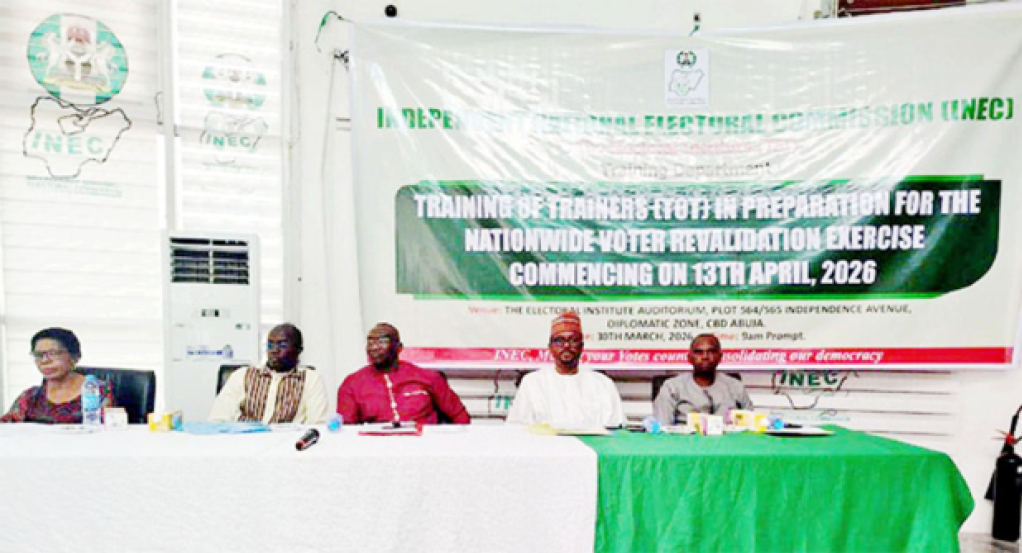
The Independent National Electoral Commission (INEC) has suspended its planned nationwide voter revalidation exercise amid growing concerns from opposition parties, civil society groups, and political analysts.
The commission has directed all Resident Electoral Commissioners (RECs) to halt preparations pending further instructions.
In a letter dated April 4, 2026, and signed by its Secretary, Rose Oriaran-Anthony, INEC instructed RECs to step down all publicity and logistical arrangements for the exercise.
The commission also announced that its scheduled meeting with RECs on April 9 would now be held virtually.
INEC had earlier proposed the voter revalidation exercise as part of efforts to clean up the voter register by removing ineligible entries and improving electoral credibility ahead of future elections.
However, the move has triggered widespread criticism over its timing and potential impact on voter participation.
Opposition, Stakeholders Raise Concerns
The African Democratic Congress (ADC) strongly opposed the exercise, describing it as a “recipe for chaos” that could disenfranchise millions of voters.
The party argued that requiring already registered voters to revalidate their details less than a year to the general elections could suppress turnout and deepen voter apathy.
Similarly, a faction of the Peoples Democratic Party (PDP) questioned the timing, describing it as “suspicious” and potentially aimed at excluding eligible voters.
A coalition known as Concerned Former Legislators also warned that the exercise could disproportionately affect northern Nigeria, raising fears of reduced voting strength in the region ahead of the 2027 elections.
Experts Warn on Timing, Logistics
Political analysts and academics have acknowledged the need to update the voter register but cautioned against rushed implementation.
They noted that issues such as deaths, relocation, and demographic changes justify periodic updates but stressed that the process must be inclusive and accessible.
Concerns were raised over the proposed short timeframe—reportedly about three weeks—which experts say is insufficient for a country with over 90 million registered voters.
They also pointed to logistical challenges, including limited access to registration centres in rural areas and poor infrastructure, which could hinder participation.
INEC Defends Objective
Despite the suspension, INEC maintains that the revalidation exercise is intended to strengthen, not restrict, electoral participation.
According to the commission, the goal is to improve the integrity and accuracy of the voter register ahead of future elections.
Officials noted that existing legal provisions already allow for public scrutiny of the voter register and the removal of duplicate or invalid entries using biometric verification systems.
The suspension highlights growing tensions over electoral preparations ahead of the 2027 elections. While voter register updates are necessary, the controversy underscores the need for transparency, adequate timing, and inclusiveness to maintain public trust in the electoral process.










Leave a Reply