
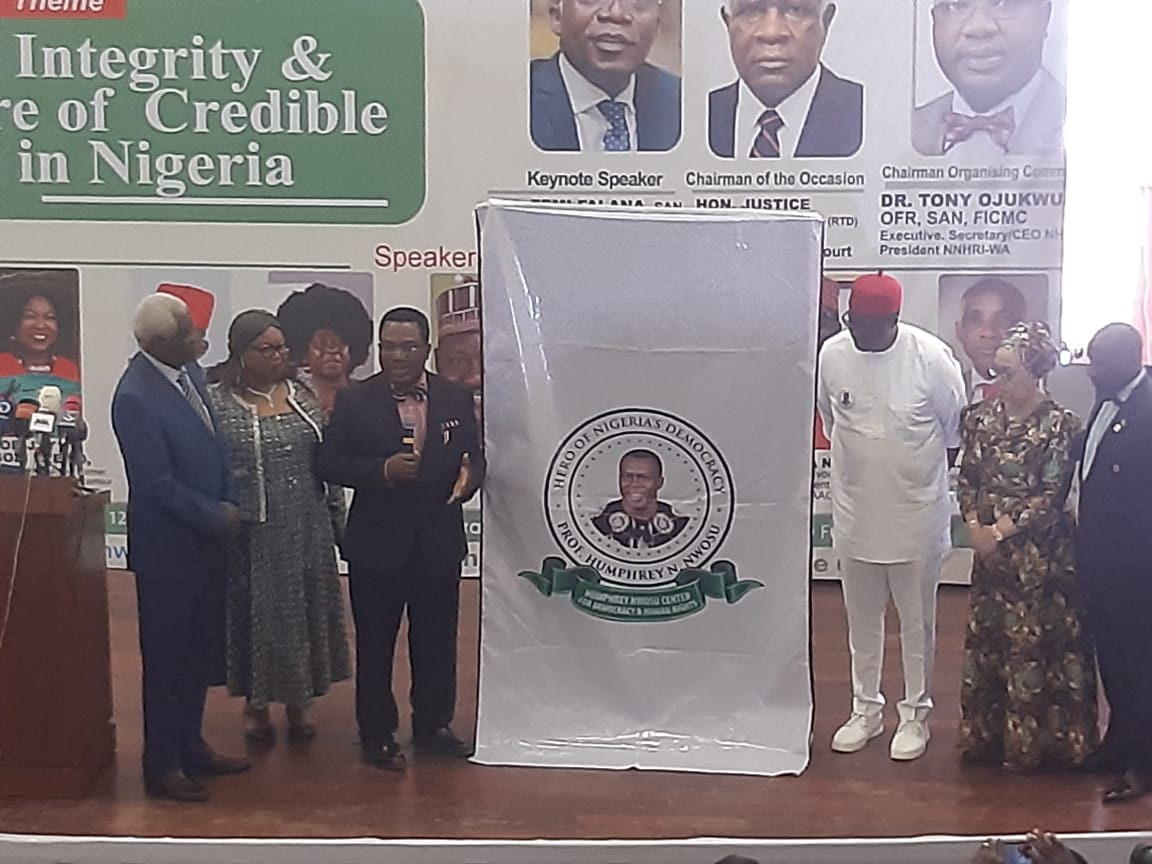
NHRC, Democracy Advocates Unveil Humphrey Nwosu Centre, Call for Reforms to Strengthen Public Trust in Elections
By A1NEWS International
ABUJA, Nigeria – June 10, 2026
As Nigeria marks another Democracy Day anniversary amid growing concerns over electoral credibility and citizens’ trust in democratic institutions, key stakeholders have called for urgent reforms and stronger commitment to electoral integrity as the foundation for the nation’s democratic progress.
The call was made on Tuesday in Abuja during the Annual June 12 Commemoration Lecture held in honour of the late former Chairman of the National Electoral Commission (NEC), Prof. Humphrey Nwosu, alongside the official unveiling of the Humphrey Nwosu Centre for Democracy and Human Rights.
The event, jointly organised by the National Human Rights Commission (NHRC) and the Humphrey Nwosu Centre for Democracy and Human Rights, was themed: “Electoral Integrity and the Future of Credible Elections in Nigeria.”
The gathering attracted prominent figures from government, the judiciary, security agencies, civil society organisations, academia, and the media, all united by concerns about the future of democratic governance in Nigeria ahead of the 2027 General Elections.
Electoral Integrity Key to Democratic Survival
Delivering his address, the Executive Secretary of the NHRC, Dr. Tony Ojukwu, described the theme as both timely and critical given the current state of Nigeria’s democracy.
According to him, credible elections remain the bedrock upon which democratic legitimacy, public confidence, and accountable governance are built.
“Against this important national background, the theme of this lecture is timely, relevant and forward-looking,” Ojukwu stated.
He noted that the forum provides a strategic opportunity for election administrators, policymakers, political actors, security agencies, civil society groups, the media, and voters to critically examine the challenges confronting Nigeria’s electoral process and identify practical solutions.
Ojukwu stressed that electoral integrity goes beyond election-day activities and encompasses transparency, accountability, inclusiveness, respect for human rights, and adherence to the rule of law.
He added that discussions generated during the lecture would contribute significantly to preparations for the 2027 elections by promoting informed dialogue, voter education, institutional accountability, and active democratic participation.
“The lecture is expected to generate practical ideas, informed reflections, and constructive recommendations capable of strengthening Nigeria’s democratic institutions and safeguarding the integrity of future elections,” he said.
Democracy and Human Rights Are Inseparable
The NHRC boss further emphasized the strong relationship between democracy and human rights, noting that neither can thrive in isolation.
According to him, the partnership between the Commission and the Humphrey Nwosu Centre represents a strategic alliance aimed at promoting justice, accountability, civic participation, and respect for citizens’ constitutional rights.
“We recognise that democracy and human rights are inseparable. Credible elections, the rule of law, civic participation, freedom of expression, equality, and accountable governance are fundamental pillars of a democratic society where human rights can flourish,” Ojukwu stated.
Observers at the event noted that concerns over voter apathy, electoral violence, political interference, misinformation, and declining public trust continue to pose significant threats to Nigeria’s democratic development.
Humphrey Nwosu Centre Unveiled to Preserve Democratic Ideals
Speaking on the vision behind the newly established Centre, Co-founder, Engr. Nnaemeka Nwosu, said the institution was created to preserve the democratic ideals championed by the late Prof. Humphrey Nwosu and to promote credible governance across Nigeria and Africa.
He described the Centre as a platform dedicated to advancing democratic values, protecting human rights, and nurturing ethical leadership.
“We envision a Nigeria and Africa where democracy thrives, human rights are protected, elections are credible, and leaders serve with integrity,” he said.
Nwosu disclosed that the Centre would operate around five core pillars designed to address critical governance challenges and strengthen democratic institutions.
Five Strategic Pillars for Democratic Advancement
According to him, the Centre’s activities will focus on:
Electoral Integrity and Reform
Promoting transparent electoral processes, policy reforms, and institutional accountability to enhance public confidence in elections.
Human Rights and Justice
Advocating the protection of civil liberties and ensuring access to justice for all citizens.
Civic Education and Participation
Encouraging voter awareness, political engagement, and responsible citizenship.
Leadership Development for Youths and Women
Building a new generation of ethical leaders capable of driving sustainable democratic development.
Research, Policy Innovation and Documentation
Supporting evidence-based policymaking, democratic research, and preservation of Nigeria’s democratic history.
Nwosu maintained that these pillars would contribute to protecting democracy, strengthening institutions, and preparing future leaders to uphold the values of transparency and accountability.
“Let us build a nation where truth is never silenced, where integrity is never negotiable, where democracy is not taken for granted but fiercely protected,” he urged.
Falana Delivers Keynote on Future of Democratic Governance
The highlight of the event was the keynote lecture delivered by renowned human rights lawyer and Senior Advocate of Nigeria, Femi Falana.
The lecture focused on safeguarding electoral credibility, deepening democratic accountability, and ensuring stronger institutional safeguards ahead of future elections.
The event was chaired by retired Supreme Court Justice, Justice Abdu Aboki, while representatives of the Senate President and the Inspector-General of Police also delivered goodwill messages emphasizing the need for national unity and democratic consolidation.
The official unveiling of the Humphrey Nwosu Centre for Democracy and Human Rights was performed by Dr. Tony Ojukwu amid applause from participants who described the initiative as a significant step toward preserving Nigeria’s democratic heritage.
Looking Ahead to 2027
With less than a year before political activities for the 2027 General Elections intensify, stakeholders at the event agreed that rebuilding public trust in electoral institutions must remain a national priority.
They argued that transparent elections, independent institutions, active citizen participation, and adherence to democratic principles remain essential if Nigeria is to overcome recurring electoral controversies and consolidate democratic governance.
As the nation commemorates the legacy of June 12 and the sacrifices made in the struggle for democratic rule, the consensus emerging from the Abuja gathering was clear: Nigeria’s democratic future depends largely on the integrity of its elections and the willingness of institutions and leaders to uphold the values of accountability, transparency, and justice.






Leave a Reply