
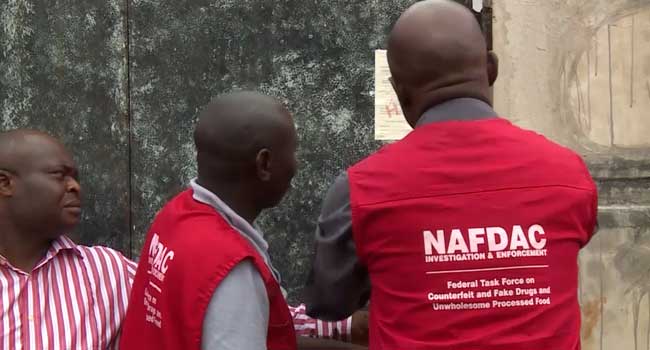
Enforcement operation uncovers alleged regulatory violations, tampered seals and continued production of prohibited alcoholic beverages as agency intensifies nationwide public health campaign.
By Kiki Oladele
OTA, Ogun State, Nigeria — July 28, 2026
The National Agency for Food and Drug Administration and Control (NAFDAC) has intensified its nationwide enforcement against the production and distribution of banned sachet alcoholic beverages, sealing three manufacturing companies in Ota, Ogun State, over alleged violations of the Federal Government’s prohibition on alcohol packaged in sachets and small polyethylene terephthalate (PET) bottles.
The enforcement operation, which exposed alleged regulatory breaches, unauthorized removal of products under official restriction, and the alleged illegal resumption of production after factory equipment had been sealed, signals NAFDAC’s determination to enforce compliance with one of Nigeria’s most controversial public health policies.
The latest crackdown comes as the Federal Government continues efforts to reduce harmful alcohol consumption, particularly among young people, while strengthening regulatory oversight of Nigeria’s beverage manufacturing industry.
Coordinated Enforcement Targets Defiant Manufacturers
The enforcement exercise was led by the Assistant Director of NAFDAC’s Investigation and Enforcement Directorate, Mr. Kunle Ojo, whose team carried out inspections across multiple alcohol manufacturing facilities in Ota, one of Nigeria’s major industrial hubs.
According to a statement issued by the agency, investigators uncovered evidence suggesting that some manufacturers had continued producing banned alcoholic products despite repeated regulatory warnings and enforcement actions.
NAFDAC described the discoveries as serious breaches of existing public health regulations and vowed to prosecute any company found deliberately violating the law.
Factory Allegedly Removed Products Under Regulatory Hold
Officials disclosed that during the first inspection conducted last Friday, enforcement officers discovered sachet alcoholic drinks still being actively produced alongside large quantities of PET bottles intended for packaging.
The agency immediately placed the factory’s operations on regulatory hold pending further action.
However, during a subsequent inspection, officials allegedly discovered that the prohibited products had been secretly removed from the premises without regulatory authorization.
According to NAFDAC, the unauthorized removal of products already under enforcement constitutes a significant violation that may attract additional legal sanctions.
Investigators are expected to determine where the products were moved and whether they entered Nigeria’s consumer market despite the ban.
Second Company Allegedly Continued Production Despite Ban
At a second manufacturing facility, whose identity was withheld by the agency pending further investigation, enforcement officers reportedly caught workers actively producing sachet alcoholic beverages in direct violation of the Federal Government’s directive.
Following the discovery, NAFDAC immediately sealed the premises to halt production.
Officials say further investigations will establish the volume of prohibited products manufactured and whether distribution networks were already supplying the products across Nigerian markets.
Third Factory Allegedly Broke Official Seals to Resume Production
Perhaps the most serious allegation emerged during inspections of a third manufacturing company.
According to NAFDAC, the company had previously been inspected in January 2026, when enforcement officers suspended operations by placing 22 production machines under official seal.
The agency also confiscated millions of PET bottles and sachet packaging materials scheduled for destruction.
During the latest inspection, however, investigators allegedly discovered that the factory had broken the official regulatory seals and resumed production of banned alcoholic beverages without authorization.
Officials also recovered millions of additional PET bottles prepared for packaging.
The factory was immediately sealed for violating regulatory directives.
NAFDAC described the alleged tampering with official enforcement measures as a grave offence that could attract severe administrative and criminal penalties if proven.
Why the Federal Government Banned Sachet Alcohol
The Federal Government’s phased ban on alcoholic beverages packaged in sachets and small PET containers was introduced as part of broader efforts to reduce alcohol abuse, particularly among vulnerable populations.
Public health experts have argued that the small packaging format makes alcoholic beverages:
- Easily affordable.
- Widely accessible to minors.
- Attractive to low-income consumers.
- Difficult to regulate in informal markets.
Health advocates have also linked the proliferation of inexpensive alcoholic sachets to rising cases of substance abuse, road accidents, domestic violence, mental health disorders and other alcohol-related social problems.
While the policy initially generated resistance from sections of the beverage industry, regulators insist the transition period provided manufacturers with adequate time to adjust production lines toward compliant packaging formats.
Industry Concerns and Economic Implications
The enforcement campaign has renewed debate within Nigeria’s manufacturing sector.
Some industry stakeholders argue that the ban has affected production costs, employment opportunities and market competitiveness, particularly for small and medium-sized beverage manufacturers.
Others contend that stricter enforcement is necessary to ensure a level playing field by preventing non-compliant companies from gaining unfair commercial advantages over businesses that have complied with the regulations.
Economic analysts note that regulatory certainty is critical for both consumer protection and investor confidence.
They argue that consistent enforcement helps strengthen compliance across the manufacturing sector while protecting legitimate businesses from unfair competition.
NAFDAC Reaffirms Zero-Tolerance Policy
Addressing the operation, NAFDAC reiterated that it would maintain a zero-tolerance approach toward regulatory evasion.
The agency stated that the nationwide enforcement exercise forms part of its broader strategy to eliminate prohibited alcoholic products from Nigerian markets and safeguard public health.
NAFDAC also appealed to consumers, distributors and retailers to cooperate with regulatory authorities by reporting any illegal production, distribution or sale of banned sachet alcoholic beverages.
Officials stressed that community participation remains essential to strengthening enforcement and preventing non-compliant products from re-entering commercial circulation.
Investigation Continues
Although the agency has not publicly disclosed the identities of the affected companies, officials confirmed that investigations remain ongoing to determine the full extent of the alleged violations.
Regulatory authorities are expected to examine production records, supply chains and distribution channels to identify whether prohibited products reached consumers despite previous enforcement actions.
Industry observers believe the outcome of the investigations could influence future enforcement strategies and shape compliance standards across Nigeria’s alcohol manufacturing sector.
The sealing of three alcohol manufacturing companies in Ogun State represents one of NAFDAC’s most significant enforcement actions since the nationwide implementation of the sachet alcohol ban.
Beyond shutting down non-compliant factories, the operation underscores the agency’s determination to enforce public health regulations, strengthen consumer protection and hold manufacturers accountable for regulatory violations.
As investigations continue, the case is expected to test both the effectiveness of Nigeria’s regulatory enforcement framework and the willingness of manufacturers to comply with policies designed to promote safer alcohol consumption and protect public health.








Leave a Reply