
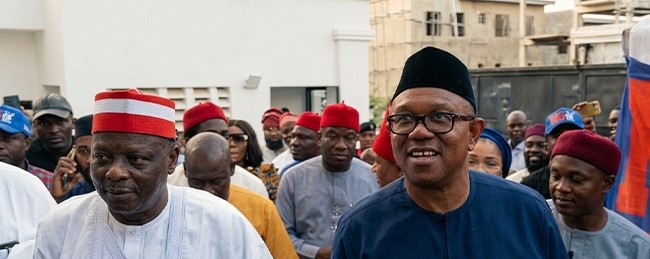
Opposition leaders join emerging party amid realignments, call for unity and no litigation
By Anthoney Disu | Abuja, Nigeria | May 3, 2026
Former Anambra State Governor, Peter Obi, and ex-Kano State Governor, Rabiu Musa Kwankwaso, have formally joined the Nigeria Democratic Congress (NDC), marking a significant development in Nigeria’s evolving opposition landscape.
The duo were presented with membership cards on Sunday following a closed-door meeting with party leaders in Abuja.
Their defection comes amid ongoing political realignments ahead of the 2027 general elections, as opposition figures continue to seek a unified platform.
Obi, the 2023 presidential candidate of the Labour Party (LP), and Kwankwaso, former presidential candidate of the New Nigeria People’s Party (NNPP), had recently exited the African Democratic Congress (ADC) following internal crises.
They were received into the NDC by former Bayelsa State Governor and party leader, Seriake Dickson.
Obi Calls for Unity, No Litigation
Addressing party members and supporters, Obi urged stakeholders to avoid internal disputes and litigation, stressing the need for unity and focus.
“Please, let there be no litigation. We want to build a party that Nigerians will be proud of,” he said.
He emphasised that the NDC aims to form a government capable of addressing insecurity, economic hardship, and governance challenges.
“We want to ensure that Nigerians can live without fear and that families no longer struggle daily for survival,” Obi added.
He also called on his supporters nationwide to align with the new political platform.
Kwankwaso Mobilises Support Base
Kwankwaso urged Nigerians to register with the NDC, declaring that his political structure had already commenced mobilisation efforts.
He described the party as a viable alternative capable of driving national transformation if properly supported.
NDC Promises Stability, Growth
Welcoming the new entrants, Dickson described the development as a major boost for the party, expressing confidence that their inclusion would strengthen its national appeal.
“With leaders like these, Nigeria can become new again,” he said.
He maintained that the NDC, though relatively new, is positioned to compete effectively, highlighting its internal stability and absence of factional disputes.
“This is a party without factions and without litigation. We are ready to grow and lead,” Dickson added.
Exit from ADC Crisis
Obi’s move follows his earlier departure from the ADC, where he had aligned with several prominent opposition figures, including Atiku Abubakar, Rotimi Amaechi, Rauf Aregbesola, and Nasir El-Rufai.
The party, however, became embroiled in prolonged leadership disputes and court cases, which weakened cohesion and stalled decision-making.
Obi cited these internal crises and lack of shared vision as reasons for his exit, noting that his decision was guided by the need for a functional and credible political platform.
The defection of Obi and Kwankwaso to the NDC underscores intensifying political realignments ahead of the 2027 elections. As opposition forces continue to reorganise, the emergence of new alliances could significantly reshape Nigeria’s political dynamics in the coming months.



Leave a Reply