
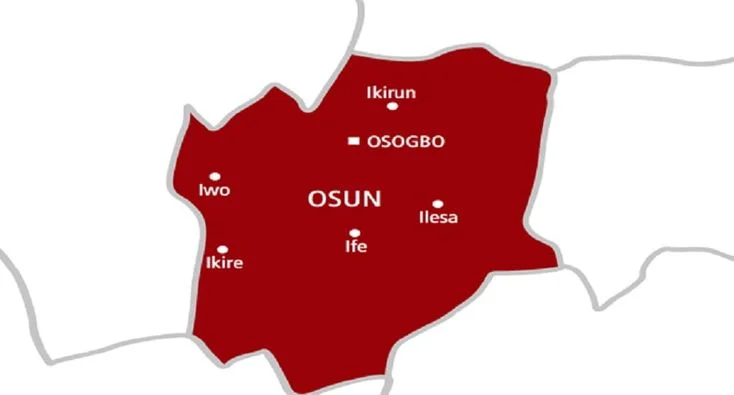
President Tinubu orders EFCC to vacate the Osun account-freezing order ahead of the governorship election, triggering a fresh debate over anti-corruption independence, due process and the limits of presidential authority.
By Ndidi Ogenyi and Angela Unigbe
ABUJA/OSOGBO, Nigeria — August 7, 2026
The controversy surrounding the freezing of the Osun State Government’s Federal Statutory Allocation Account has escalated into a wider political and constitutional debate after President Bola Ahmed Tinubu directed the Economic and Financial Crimes Commission (EFCC) to return to court and seek the vacation of the order.
The presidential intervention, coming only days before the August 15 Osun governorship election, has divided political opinion and raised questions over the operational independence of Nigeria’s anti-corruption agencies.
Former Vice President Atiku Abubakar and the African Democratic Congress (ADC) have questioned the implications of the President’s intervention, arguing that it creates fresh doubts about the extent to which anti-graft agencies can operate independently of the Presidency.
The All Progressives Congress (APC), Osun State Peoples Democratic Party (PDP) and other stakeholders, however, have defended the President’s decision, saying the timing of the EFCC’s action risked undermining confidence in the electoral process.
The dispute has therefore moved beyond the immediate question of whether the Osun account should remain frozen. It now raises a broader institutional question:
Can an anti-corruption agency exercise its statutory powers independently when the President believes an enforcement action could affect public confidence in an election?
How the Osun Account Controversy Began
The crisis erupted after the EFCC restricted the Osun State Government’s Federal Statutory Allocation Account over an investigation involving alleged financial irregularities.
The EFCC said its investigation concerns suspected fraudulent handling of Ecology Funds, Intervention Funds and Federal Account Allocation Committee (FAAC) allocations reportedly amounting to about ₦11 billion.
The Commission maintained that its intervention was connected to suspicious financial transactions and its responsibility to prevent the possible movement of funds under investigation.
The timing, however, immediately generated controversy because the restriction occurred shortly before the state’s governorship election.
Governor Ademola Adeleke and opposition political actors questioned the timing and described the action as potentially capable of creating political consequences.
The EFCC rejected suggestions that the investigation was politically motivated.
Tinubu Orders EFCC Back to Court
President Tinubu subsequently directed the EFCC to immediately return to court and seek the vacation of the order freezing the account.
In a personally signed statement, the President said he was “deeply embarrassed” not by the EFCC’s exercise of its mandate but by the timing of the action.
Tinubu said the proximity of the action to the Osun election could create the perception that a federal institution was being used to influence the electoral process.
He argued that maintaining public confidence in the integrity and fairness of the democratic process justified his intervention.
The President nevertheless reiterated that anti-corruption and law-enforcement agencies should be allowed to perform their statutory responsibilities professionally and without political interference.
That apparent tension—between institutional independence and presidential responsibility for the conduct of federal institutions—is now at the centre of the controversy.
Atiku: Directive Raises Questions About EFCC Independence
Former Vice President Atiku Abubakar sharply criticised the development.
Through his Senior Special Assistant on Public Communication, Phrank Shaibu, Atiku argued that the presidential directive undermined the perception that anti-corruption agencies operate independently of the Presidency.
His central argument was that if the President could direct the EFCC to vacate a court order, Nigerians could reasonably ask how operationally independent the agency was.
Atiku also questioned the circumstances surrounding the reported court order, noting an apparent discrepancy between the EFCC’s public explanation of its action and the President’s reference to a court order.
He argued that the Presidency should clarify the legal basis for the intervention.
Atiku’s position has turned the Osun dispute into a broader debate about the institutional architecture of Nigeria’s anti-corruption system.
ADC Questions Presidency’s Account of the Court Order
The ADC also challenged the Presidency’s explanation.
National Publicity Secretary Bolaji Abdullahi reportedly argued that the EFCC had publicly defended its intervention primarily on the basis of its statutory and preventive powers.
The party therefore demanded clarification about the reported court order and the circumstances surrounding the President’s instruction.
According to the ADC’s position, the apparent contradiction requires public explanation because the issue is no longer merely about the Osun account but about the relationship between the Presidency, the judiciary and an independent investigative agency.
The party argued that either the President had received information that differed from the EFCC’s public account or that there was a need to reconcile the two narratives.
APC Defends Tinubu’s Intervention
The Osun State chapter of the APC took the opposite position.
The party said the President’s directive should not be interpreted as clearing the Adeleke administration of any allegations under investigation.
According to the APC, Tinubu’s concern was principally the timing of the EFCC action and the possibility that Nigerians could interpret it as an attempt to influence the election.
The party therefore urged Governor Adeleke and his supporters to reconsider earlier accusations against the Presidency and the APC.
The APC’s argument is that the President’s intervention demonstrates that the Federal Government is sensitive to the need for electoral fairness rather than evidence of political interference.
PDP Welcomes Presidential Intervention
The Osun State PDP also welcomed Tinubu’s directive.
State chairman Sunday Bisi said the intervention demonstrated concern about the circumstances surrounding the account restriction.
For the PDP, the President’s decision provides an opportunity to remove an issue that could have overshadowed the election and created unnecessary tension between the Federal Government and Osun State.
The party has interpreted the intervention as evidence that the Presidency does not intend to use the EFCC controversy to undermine the state government.
Lawyers Question EFCC’s Handling of the Matter
The controversy has also attracted legal criticism.
Some lawyers cited in reports on the matter argued that the EFCC should have exercised greater caution in restricting a state government’s statutory account.
Senior Advocate Abdul Balogun reportedly argued that government agencies must operate strictly within the limits of their statutory powers and respect due process.
Constitutional lawyer Mathew O. Ari questioned why the intervention occurred so close to the election, arguing that the timing naturally invited political interpretation.
Professor of Law Adewale Odu similarly argued that even where an investigative agency possesses evidence of suspected wrongdoing, its enforcement actions must be conducted in a manner that does not unnecessarily create the perception of political victimisation.
These arguments, however, represent legal opinions and do not by themselves establish that the EFCC acted unlawfully.
The ₦11 Billion Question
One of the most important unresolved issues is the substance of the EFCC investigation itself.
The Commission has linked its investigation to alleged irregularities involving approximately ₦11 billion in Ecology Funds, Intervention Funds and FAAC-related transactions.
The public therefore faces two separate questions:
First: Was there sufficient evidence to justify an investigation and restriction of the account?
Second: Was the method and timing of the restriction legally and institutionally appropriate?
These questions should not be conflated.
A presidential directive to vacate an account-freezing order does not, by itself, establish that the underlying financial investigation is false.
Likewise, an EFCC investigation does not automatically establish that the Osun State Government or any individual official committed a financial crime.
Those issues ultimately require evidence and, where criminal charges are filed, judicial determination.
The Constitutional and Institutional Fault Line
The dispute exposes a difficult institutional problem.
Nigeria’s anti-corruption agencies need operational independence if they are to investigate powerful political actors without fear or favour.
At the same time, the President is constitutionally responsible for the overall conduct of the Federal Government and may be politically accountable for actions taken by federal institutions.
The question is where the boundary lies.
If a President can direct an investigative agency to discontinue or reverse an enforcement action whenever political controversy emerges, critics could argue that institutional independence becomes vulnerable.
Conversely, if an anti-corruption agency can take actions with significant political and electoral consequences without regard to timing or public confidence, critics could argue that enforcement itself could inadvertently undermine democratic stability.
The Osun controversy has brought this unresolved tension into sharp focus.
The Election-Timing Problem
The August 15 governorship election is central to the dispute.
The EFCC maintains that its action was based on an ongoing investigation rather than the electoral calendar.
The opposition, however, has argued that the timing creates legitimate grounds for suspicion.
President Tinubu appears to have accepted the importance of that perception, even while defending the general independence of anti-corruption agencies.
This distinction is significant.
The President did not say the EFCC lacked an investigative mandate. Rather, his stated concern was that the timing could create an impression of federal interference in the electoral process.
A ₦2 Billion Lawsuit Adds a Judicial Dimension
The Osun State Government has also taken the dispute to court.
Governor Adeleke and other state officials filed a ₦2 billion suit against the EFCC over the restriction of the state’s account.
The EFCC, its chairman and First Bank Nigeria Limited were reportedly joined as defendants.
The case introduces another important dimension because the judiciary may ultimately be required to determine whether the restriction complied with applicable laws and whether the state is entitled to damages.
The outcome could establish important guidance on the relationship between anti-corruption investigations and the financial operations of state governments.
What Remains Unanswered?
Several questions remain outstanding:
1. What exactly did the EFCC discover?
The Commission has cited alleged suspicious transactions and an investigation involving about ₦11 billion. The detailed evidence has not been publicly tested in court.
2. What was the precise legal basis for the account restriction?
The competing accounts concerning the EFCC’s powers and the reported court order require clarification.
3. What prompted the President’s intervention?
Tinubu has publicly cited the timing and the potential effect on electoral confidence.
4. Does the directive compromise EFCC independence?
Atiku and ADC say it does. The Presidency and supporters argue that intervention was necessary to protect democratic credibility.
5. Will the underlying investigation continue?
The President’s directive to vacate the order does not necessarily answer whether the EFCC’s broader financial investigation has been terminated.
6. What will the court decide?
The ₦2 billion suit could provide the legal forum for resolving several of the disputed questions.
A Test for Nigeria’s Anti-Corruption Architecture
The Osun account controversy has exposed a deeper challenge facing Nigeria’s democratic institutions: how to reconcile aggressive anti-corruption enforcement with political neutrality, due process and institutional independence.
The credibility of the system depends not only on whether suspected financial crimes are investigated, but also on whether the process is demonstrably fair.
An anti-corruption agency must be able to investigate governments without fear.
But government institutions must equally ensure that enforcement actions cannot reasonably be interpreted as electoral manipulation.
The responsibility therefore extends beyond the EFCC and the Presidency to the judiciary, political parties, civil society and the electorate.
The Osun account freeze has transformed from a financial investigation into a major institutional and political controversy.
Atiku and the ADC have seized on Tinubu’s directive as evidence that questions remain over the independence of anti-corruption agencies. The APC and PDP, however, have interpreted the intervention differently, focusing on the need to protect public confidence in an election taking place only days after the EFCC’s action.
For the EFCC, the credibility of its ₦11 billion investigation will depend on whether it can produce verifiable evidence capable of surviving judicial scrutiny.
For the Presidency, the challenge is to demonstrate that its intervention was genuinely motivated by electoral neutrality rather than political considerations.
And for the judiciary, the pending litigation may provide an opportunity to clarify the legal boundaries between financial investigations, state accounts, executive authority and due process.
Ultimately, the most important issue is not which political camp wins the argument.
It is whether Nigeria can build anti-corruption institutions strong enough to investigate political power without themselves becoming instruments of political power.







Leave a Reply