
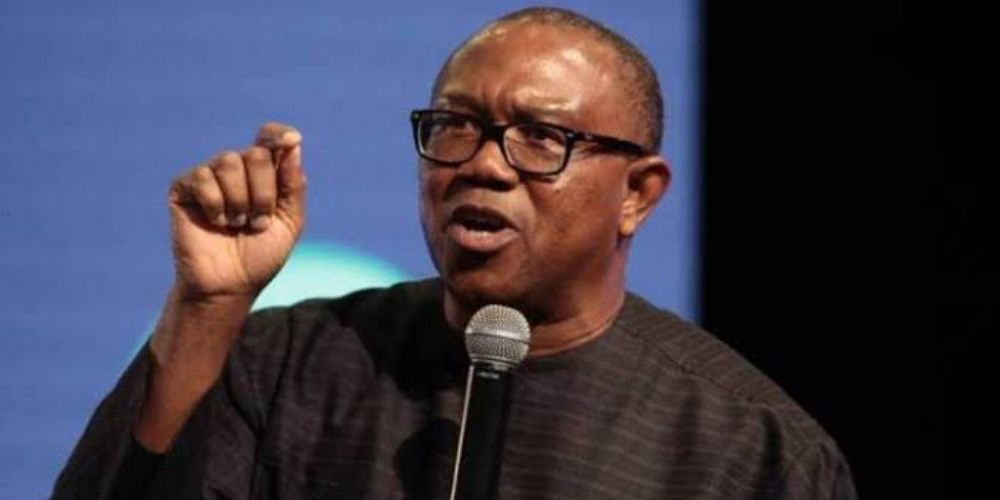
Former Anambra governor urges African leaders to prioritise productivity, education, institution-building, and economic reforms over political distractions.
By John Ishaku / May 26, 2026
CAPE TOWN, SOUTH AFRICA —Former Labour Party presidential candidate and leader of the Nigeria Democratic Congress (NDC), Peter Obi, has declared that Africa possesses no legitimate reason to remain poor despite being one of the most naturally endowed continents in the world.
Speaking during an international policy dialogue in Cape Town, South Africa, Obi argued that Africa’s persistent poverty crisis is not caused by lack of resources but by governance failures, corruption, weak institutions, policy inconsistency, and poor leadership culture across many African states.
The former Anambra State governor made the remarks during the Spier Dialogue Event themed “Policies for Growth in Africa,” where policymakers, economists, government officials, and development experts gathered to discuss Africa’s economic future.
Obi: Africa Is Rich in Human and Natural Capital
In a statement shared via his X account after the event, Peter Obi said Africa remains strategically positioned for global economic relevance because of its enormous natural and demographic advantages.
According to him, the continent controls vast mineral deposits, possesses more than 60 per cent of the world’s uncultivated arable land, and hosts the youngest population globally.
Obi maintained that these advantages should ordinarily place Africa among the world’s leading economic powers rather than among regions battling widespread poverty, unemployment, and infrastructural collapse.
“Africa has no reason to be impoverished. Our continent is endowed with vast natural and human resources,” Obi stated.
He argued that Africa’s youthful population should be viewed as an economic asset capable of driving innovation, industrialisation, agricultural expansion, and entrepreneurship if properly harnessed.
Governance Failures Identified as Major Obstacle
Despite Africa’s abundant resources, Obi said the continent continues to struggle because of systemic governance failures.
He identified corruption, fragile democratic institutions, ineffective leadership, and rising governance costs as some of the major impediments preventing sustainable development across African nations.
Political analysts observing Obi’s intervention note that his comments reflect growing frustration among reform advocates who believe African governments have prioritised politics over productivity and state-building.
According to development experts, several African economies remain trapped in cycles of debt, unemployment, inflation, weak industrial output, and dependence on raw material exports despite decades of independence.
Obi stressed that many African countries continue to spend excessively on political administration while underinvesting in critical sectors such as healthcare, education, technology, agriculture, and infrastructure.
Call for Shift From Politics to Productivity
The former presidential candidate urged African leaders to abandon what he described as “endless political distractions” and instead focus on economic productivity and nation-building.
He warned that excessive political competition, divisive elections, and elite power struggles were diverting attention away from developmental priorities urgently needed across the continent.
According to Obi, Africa’s future depends largely on aggressive investment in Human Development Index (HDI) indicators, especially education, healthcare, poverty reduction, and youth empowerment.
He painted a grim picture of conditions across many African states, citing low life expectancy, rising infant mortality, worsening poverty levels, and increasing unemployment among young people.
SMEs Facing Harsh Economic Environment
Obi also raised concerns about the deteriorating business climate across Africa, particularly the struggles faced by small and medium enterprises (SMEs), which economists widely regard as the backbone of economic growth and job creation.
He stated that many businesses are collapsing under the weight of poor infrastructure, inconsistent government policies, inflationary pressures, currency instability, and limited access to credit facilities.
Economic observers say Obi’s remarks resonate strongly in Nigeria and several African economies currently battling rising inflation, declining purchasing power, and shrinking private sector investments.
Analysts further argue that policy inconsistency and unstable regulatory environments continue to discourage both local and foreign investments needed to stimulate industrial growth.
Demand for Competent and Compassionate Leadership
In one of the strongest parts of his address, Peter Obi called for a new generation of African leadership driven by competence, empathy, accountability, and developmental vision.
He argued that Africa’s transformation would only occur when leaders begin prioritising production over consumption and development over political maneuvering.
Obi advocated for institutional strengthening, anti-corruption reforms, reduction in governance costs, and creation of business-friendly environments capable of attracting investment and stimulating innovation.
He insisted that genuine investment in people and institutions remains the surest path toward building a productive, secure, democratic, and prosperous Africa.
Broader Implications for Africa’s Future
Obi’s comments come at a time when many African countries are confronting economic instability, rising debt burdens, youth migration crises, and increasing public dissatisfaction with governance structures.
Across the continent, calls for reforms have intensified amid concerns that Africa’s enormous resource wealth has failed to translate into broad-based prosperity for ordinary citizens.
Development economists argue that while Africa possesses immense potential in agriculture, mining, renewable energy, technology, and manufacturing, weak governance structures and institutional inefficiencies continue to undermine progress.
The debate surrounding Africa’s development trajectory is expected to remain central in future regional and global policy discussions as governments seek sustainable solutions to poverty, unemployment, insecurity, and inequality.
As Africa navigates mounting economic and governance challenges, Peter Obi’s remarks have reignited conversations about leadership accountability, resource management, and the continent’s untapped potential.
His intervention underscores a growing consensus among reform advocates that Africa’s greatest challenge may no longer be scarcity of resources, but the political will to transform those resources into sustainable prosperity for its people.






Leave a Reply