
New regional chairman pledges unity as ECOWAS enters a defining phase marked by terrorism, political transitions and the departure of three member states
By A1NEWS International
FREETOWN, Sierra Leone | July 20, 2026
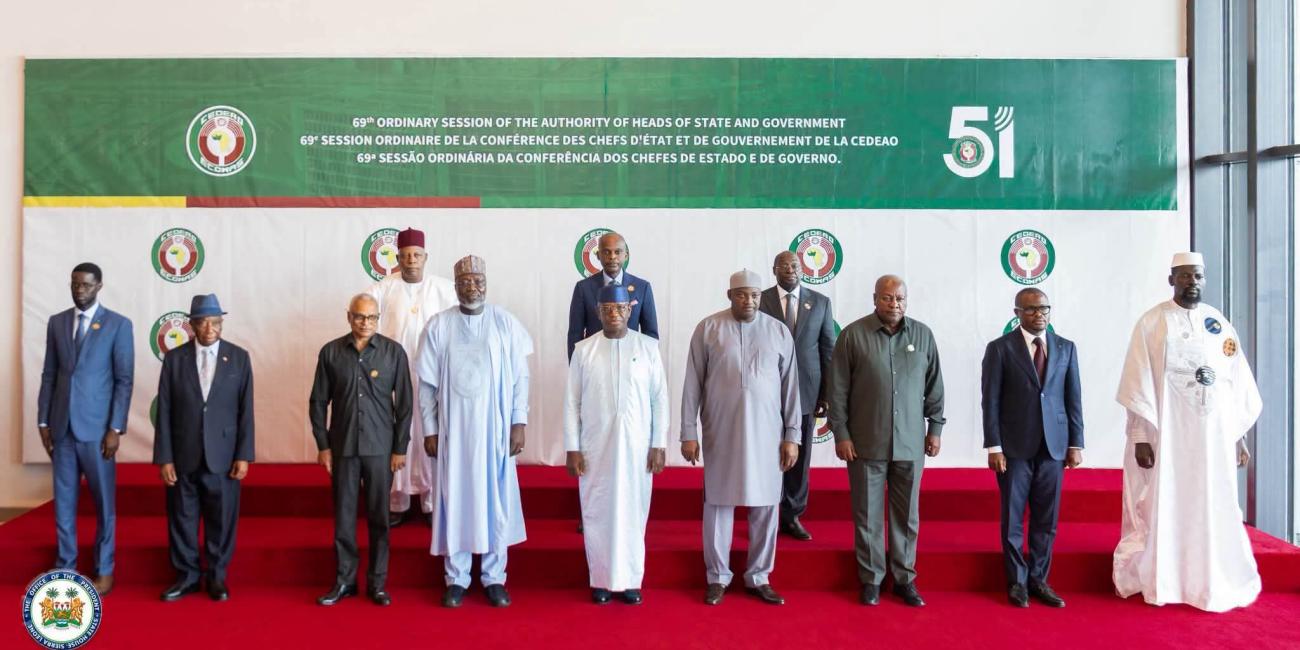
Senegal’s President Bassirou Diomaye Faye has been elected Chairman of the Authority of Heads of State and Government of the Economic Community of West African States (ECOWAS), assuming leadership of the 15-member regional bloc at one of the most consequential moments in its nearly five-decade history.
Faye succeeds Sierra Leonean President Julius Maada Bio, whose tenure coincided with deepening political instability, military takeovers, worsening insecurity and the unprecedented withdrawal of Burkina Faso, Mali and Niger from the regional organisation.
His emergence was announced on Sunday during the 69th Ordinary Session of the ECOWAS Authority of Heads of State and Government in Freetown, Sierra Leone, where regional leaders gathered to deliberate on security, democratic governance, economic integration, trade, infrastructure and institutional reforms.
The summit also produced another major leadership change, with General Biram Diop elected President of the ECOWAS Commission, replacing Dr Omar Alieu Touray.
The leadership transition comes as ECOWAS attempts to redefine its relevance amid growing geopolitical competition, violent extremism, constitutional crises and calls for stronger regional cooperation.
A Leadership Transition at a Critical Time
President Faye’s election places one of Africa’s youngest democratically elected leaders at the centre of efforts to restore confidence in one of the continent’s most influential regional organisations.
Since assuming office in Senegal, Faye has projected an image of institutional reform, accountability and African-led solutions to regional challenges.
His election is widely viewed as an opportunity for ECOWAS to rebuild political consensus after years of strained relations among member states.
The regional bloc continues to grapple with multiple crises, including:
- Rising terrorist attacks across the Sahel
- Political instability and unconstitutional changes of government
- Cross-border organised crime
- Economic pressures driven by inflation and debt
- Youth unemployment and irregular migration
- Implementation of the ECOWAS Trade Liberalisation Scheme
- Regional infrastructure development
- The future relationship with Burkina Faso, Mali and Niger
Faye Promises Unity and Cooperation
Following his election, President Faye expressed appreciation to fellow West African leaders for the confidence reposed in Senegal.
In a statement posted on his official X account, he said:
“It is with humility that I welcome the trust placed in our country, called to the presiding presidency of ECOWAS.”
He thanked his fellow Heads of State and Government for what he described as their spirit of fraternity during the summit.
Faye also congratulated General Biram Diop on his election as President of the ECOWAS Commission, pledging Senegal’s full support for the Commission’s work.
He concluded his message with a call for regional solidarity, declaring:
“Long live ECOWAS. Long live a reconciled and united West Africa.”
The statement reflected themes likely to dominate his tenure—dialogue, reconciliation and institutional cooperation.
New ECOWAS Commission Leadership
Another key outcome of the summit was the appointment of General Biram Diop as President of the ECOWAS Commission.
The Commission serves as the executive arm of ECOWAS, responsible for implementing decisions adopted by the Authority of Heads of State and Government.
Observers say the incoming Commission leadership will play a significant role in advancing reforms aimed at strengthening regional institutions and restoring confidence in ECOWAS after several years of political turbulence.
Security Remains ECOWAS’ Biggest Test
Perhaps the greatest challenge facing the new chairman is regional security.
West Africa continues to experience escalating attacks by extremist groups operating across the Sahel and Lake Chad Basin.
Countries including:
- Nigeria
- Burkina Faso
- Mali
- Niger
- Benin
- Togo
have all experienced increasing security threats ranging from insurgency and terrorism to kidnapping and transnational organised crime.
The deteriorating security situation has strained national budgets, displaced millions of people and slowed economic development across the region.
Analysts say President Faye will be expected to strengthen intelligence sharing, military cooperation and coordinated regional responses to terrorism.
Repairing Relations After the Alliance of Sahel States
One of the defining diplomatic challenges before the new ECOWAS leadership involves rebuilding relations with Burkina Faso, Mali and Niger.
The three military-led governments formally withdrew from ECOWAS after prolonged disagreements over sanctions, constitutional transitions and regional governance.
They have since established the Alliance of Sahel States (AES) as an alternative regional framework.
Although their departure represents one of the biggest institutional setbacks in ECOWAS history, regional observers believe diplomatic engagement could still prevent deeper fragmentation of West Africa.
President Faye is expected to play a central role in determining whether dialogue can reopen channels of cooperation.
Economic Integration Still a Priority
Beyond politics and security, ECOWAS continues pursuing its long-standing objective of creating a fully integrated regional economy.
Key priorities include:
- Expanding intra-African trade
- Improving transport connectivity
- Accelerating regional infrastructure
- Promoting industrialisation
- Enhancing food security
- Advancing implementation of the African Continental Free Trade Area (AfCFTA)
- Strengthening regional financial cooperation
Business leaders have repeatedly urged ECOWAS to remove non-tariff barriers that continue to impede cross-border commerce.
Observers say stronger economic integration could help reduce poverty, create jobs and enhance regional competitiveness.
What Faye’s Election Means for West Africa
Political analysts describe President Faye’s emergence as an opportunity for generational leadership within ECOWAS.
His administration inherits a bloc confronting difficult questions about:
- Democratic governance
- Institutional credibility
- Regional security
- Economic resilience
- Youth inclusion
- Climate-related challenges
- Migration
- International partnerships
Whether ECOWAS succeeds in addressing these issues may significantly influence West Africa’s political and economic trajectory over the coming years.
Regional Expectations
Diplomats attending the summit noted that member states increasingly expect ECOWAS to move beyond declarations toward measurable implementation of regional decisions.
Among the expectations facing the new chairman are:
- Restoring confidence in democratic institutions
- Enhancing conflict prevention mechanisms
- Strengthening election observation missions
- Expanding regional infrastructure investment
- Promoting inclusive economic growth
- Improving responses to humanitarian crises
Success, analysts argue, will depend on sustained political commitment from member states rather than leadership changes alone.
Bassirou Diomaye Faye assumes the chairmanship of ECOWAS at a defining moment for West Africa.
His election reflects both continuity and the possibility of renewed regional engagement as ECOWAS confronts terrorism, political instability, economic pressures and institutional reform.
Whether his tenure succeeds in rebuilding regional unity and restoring confidence in ECOWAS will depend on the bloc’s ability to transform commitments into practical outcomes that improve security, strengthen democratic governance and deepen economic integration across West Africa.

Leave a Reply