
Closed-door reconciliation meeting fuels speculation that emergency rule in Rivers State may soon be lifted after months of political paralysis, security fears, and constitutional controversy
By Moureen Dogo / ABUJA, Nigeria / June 27, 2025
President Bola Ahmed Tinubu has convened a high-level reconciliation meeting involving suspended Siminalayi Fubara, Federal Capital Territory Minister Nyesom Wike, and Rivers State House of Assembly Speaker Martins Amaewhule in what appears to be the strongest signal yet of a possible resolution to the prolonged political crisis in Rivers State.
The closed-door meeting held at the Presidential Villa comes months after Tinubu imposed emergency rule in the oil-rich state following escalating political hostilities, legislative paralysis, and growing security concerns linked to pipeline vandalism and governance breakdown.
Political observers say the summit may represent a turning point in one of Nigeria’s most explosive political confrontations since the return to democratic rule.
First Face-To-Face Meeting Since Emergency Declaration
Thursday’s gathering marked the first publicly known direct engagement between Tinubu and Fubara since the President suspended the Rivers governor, his deputy, and the state legislature under emergency powers invoked in March 2025.
The emergency intervention followed months of bitter political warfare between Fubara and his estranged political mentor, Wike, whose loyalists dominated the Rivers Assembly under Speaker Amaewhule.
Sources familiar with the discussions described the meeting as part of a broader effort to restore political stability and reopen channels of cooperation among rival factions.
Although no official communiqué was released after the meeting, multiple political insiders indicated that significant progress was made toward easing tensions.
Photographs Signal Dramatic Political Thaw
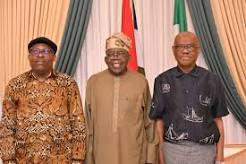
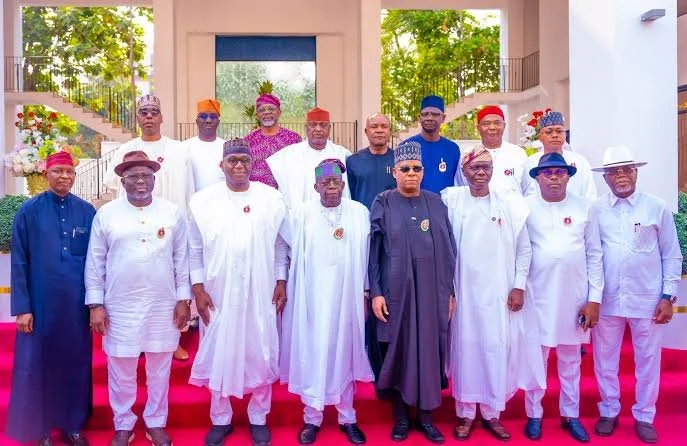
Images released from the Presidential Villa showed Tinubu flanked by visibly relaxed political rivals, including smiling appearances by both Fubara and Wike.
Additional photographs captured the President walking alongside Fubara, Amaewhule, and lawmakers in what analysts interpreted as deliberate political messaging aimed at projecting reconciliation and unity.
The optics of the meeting immediately triggered widespread speculation that negotiations behind the scenes may have advanced further than previously acknowledged publicly.
Political analysts noted that the cordial atmosphere contrasted sharply with months of hostility, impeachment threats, and institutional conflict that paralysed governance in Rivers State.
Emergency Rule May Be Nearing An End
Though the Presidency remained silent on whether emergency rule would be formally terminated, sources within political circles suggested that lifting the controversial measure could depend on the durability of the reconciliation process.
Tinubu had invoked Section 305 of the 1999 Constitution to justify emergency measures after citing deteriorating security conditions and governance breakdown in the state.
The President subsequently appointed retired naval chief Ibok-Ete Ibas as interim administrator following the suspension of elected officials.
The move generated fierce constitutional debate nationwide, with critics questioning whether the suspension of democratically elected officials exceeded presidential powers under the Constitution.
Political Feud Escalated Into Constitutional Crisis
The Rivers crisis evolved into one of Nigeria’s most volatile political standoffs after relations between Fubara and Wike collapsed publicly.
The conflict divided the state legislature, triggered impeachment attempts, and led to institutional paralysis across critical arms of government.
At the peak of the crisis, the Rivers State House of Assembly complex was engulfed in a controversial fire incident that deepened political tensions and security concerns.
Subsequent legal battles reached the Supreme Court, which upheld Amaewhule’s position as Speaker and invalidated certain local government election processes linked to the crisis.
Observers say the prolonged confrontation severely weakened governance structures and heightened instability in Nigeria’s oil-producing Niger Delta region.
Quiet Negotiations Reportedly Preceded Villa Meeting
Political sources indicated that discreet negotiations between Fubara and Amaewhule may have laid the groundwork for Thursday’s reconciliation meeting.
Several mediation efforts involving influential political actors, traditional leaders, and federal officials were reportedly undertaken before the Presidential Villa summit.
Analysts believe Tinubu’s direct intervention reflects growing concern within the Federal Government over the economic and security implications of prolonged instability in Rivers State.
Rivers Crisis Carries National Economic Implications
Rivers State remains one of Nigeria’s most economically strategic states due to its dominant role in crude oil production and energy infrastructure.
Security disruptions, political instability, and threats to oil facilities in the state have historically carried broader implications for national revenue generation and investor confidence.
Experts warn that continued political uncertainty in Rivers could undermine economic stability in the Niger Delta and complicate national security management.
Questions Remain Over Power Restoration
Despite the apparent thaw, major constitutional and political questions remain unresolved.
It remains unclear whether suspended elected officials will be fully reinstated or whether fresh political conditions may accompany the lifting of emergency rule.
Observers are also watching closely to determine whether the fragile détente between Fubara and Wike can survive beyond symbolic reconciliation gestures.
Political analysts caution that deeper structural grievances within Rivers politics may still pose risks to long-term stability.
President Tinubu’s high-profile reconciliation meeting with Siminalayi Fubara, Nyesom Wike, and Rivers lawmakers marks a potentially decisive moment in the political crisis that pushed Rivers State into emergency rule.
While the images emerging from the Presidential Villa suggest reduced hostilities, the durability of the peace process and the future of democratic governance in Rivers remain uncertain.
For now, the meeting has revived cautious optimism that one of Nigeria’s most dangerous political confrontations may be inching toward resolution — though significant constitutional, political, and security challenges still lie ahead.






Leave a Reply